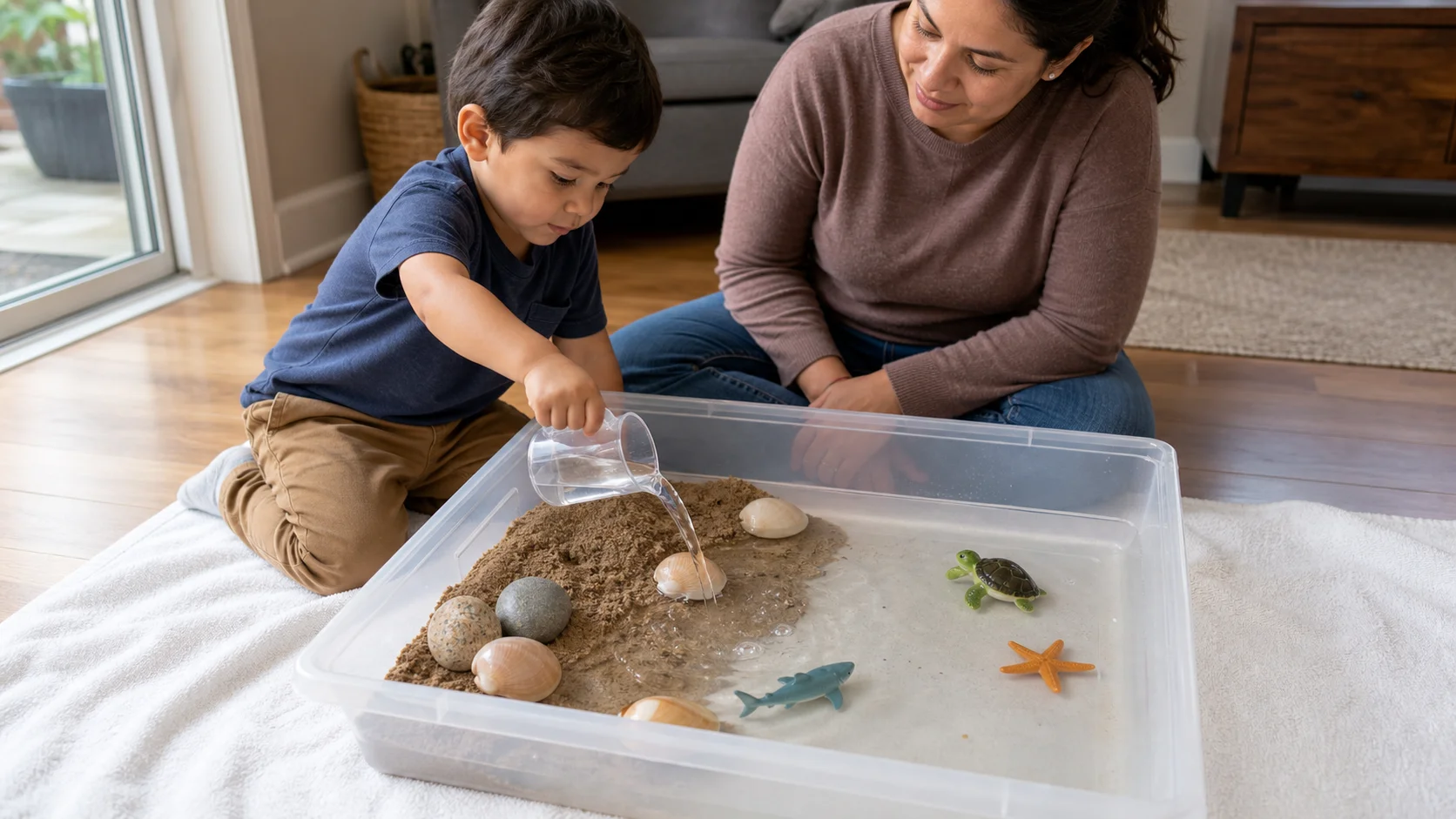
A toddler beside a shallow bin with shells, sand, and toy sea creatures, pouring a small cup of water into one corner while a grown-up watches nearby.
ThinkingAutism supportAction ResultIndoor Floor Or Outdoor Patio

Underwater Scene Fill.

A shallow ocean bin lets your child pour a little water, watch the scene change, and stop before the play gets too wild.

Play time
10+ min
Age
2-3 years
Energy
Low
Mess
Medium
Effort
Medium
Where
Indoor Floor Or Outdoor Patio
Start here

The recipe.

Medium parent effort
9 things

What you need

  • 1 shallow plastic bin
  • 6 to 10 collected items such as rocks, shells, and leaves
  • 1 small scoop of sand or soil
  • 2 to 4 small water-safe toy sea creatures, if available
  • 1 small measuring cup
  • water
  • 1 towel
  • 1 adult
  • 1 child
10 min minimum

Setup

Then start the loop
Step 01
On the floor or on a low outdoor surface, spread 1 towel and set 1 shallow plastic bin in the middle.
Step 02
Inside the dry bin, spread 6 to 10 rocks, shells, and leaves, add 1 small scoop of sand or soil in one area, and place 2 to 4 water-safe toy sea creatures if you have them.
Step 03
Beside the bin, set 1 small measuring cup half-filled with water, sit close enough to steady the bin, and show your child the dry scene before the first pour.
"Shell in. Little pour."
The loop

How play unfolds.

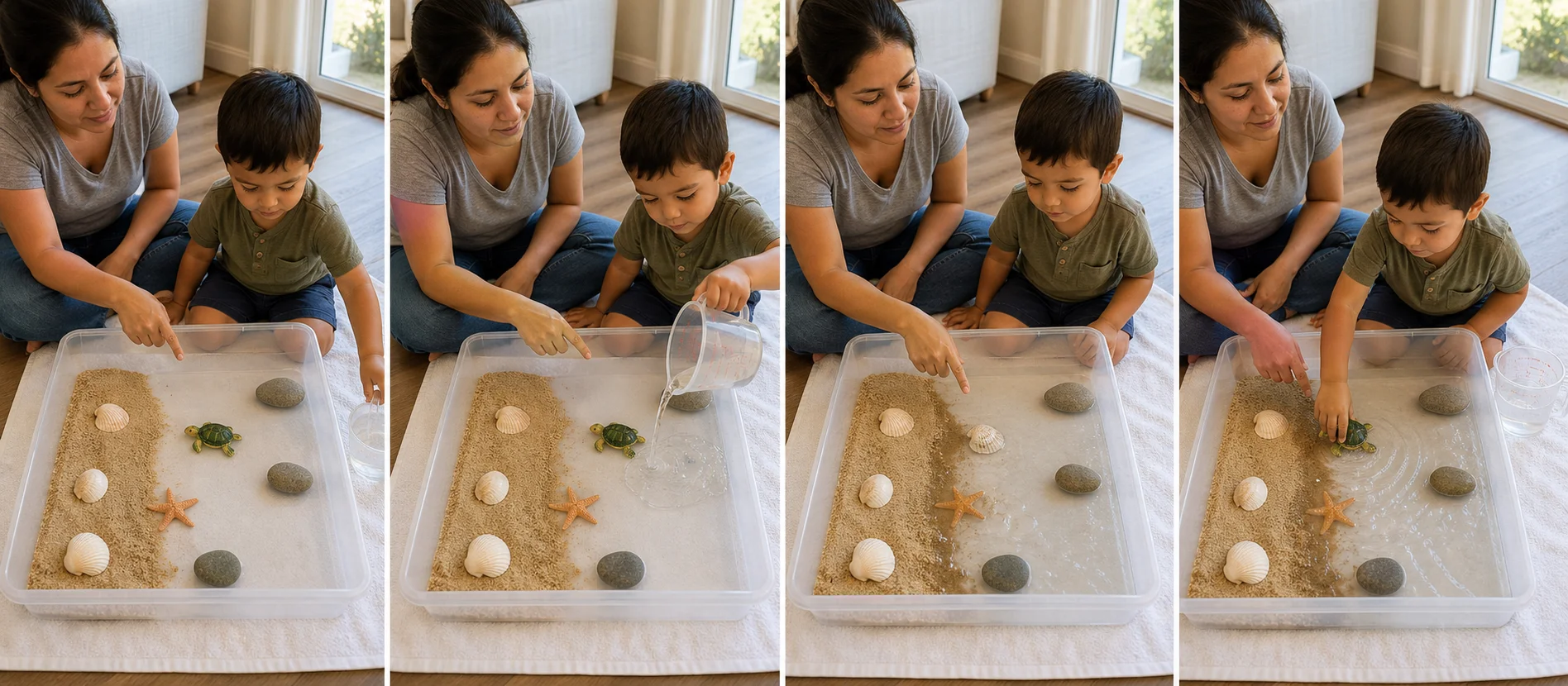
Four panels show a dry ocean scene in a shallow bin, a child adding a small pour of water, the child watching shells and toys shift, and one gentle wave through the finished scene.
  1. 01
    Model one slow pour into one corner of the bin, pause, and point to what changed in the scene.
  2. 02
    Let your child place or move one item, pour a small amount of water into one part of the bin, and watch what shifts, floats, or gets covered.
  3. 03
    Let your child move one toy or hand gently through the water to make one small wave.
  4. 04
    Repeat the same pour-and-watch turn until the cup is empty, the scene looks filled, or your child says done.

Safety Check

  • Stay close the whole time because the bin holds water plus small natural items and toy figures that can be mouthed, thrown, or tipped.
  • Keep all rocks, shells, leaves, and toy sea creatures large and smooth enough for close-supervision toddler play, and skip tiny, sharp, or breakable finds.
  • Stop or switch back to the dry-item role if wet, gritty, or cold textures feel too strong, and pour all the water out once the play turns into throwing, slipping the bin, or fast dumping.
Supporting the play

What to say in the moment

Match what you say to what you see.

Prompt ladder
Level 1 (Start)
Put one ocean piece in.
Level 2 (Keep going)
Little pour, then watch.
Level 3 (Stretch)
Make one tiny wave.
Level 4 (Extend)
Help the fish swim one more time.
If your child seems...
What you'd see
Focused
What to do
Say
"You made the water move."
Add
Ask one simple learning prompt after the pour-and-watch pause.
Extend
Let the child choose the next shell, rock, leaf, or sea toy for the next round.

Make it easier

Younger end
  • -Use only three or four large scene pieces so the child notices changes faster.
  • -Keep the sea toys already in place so the child only has to add one dry item before the pour.
  • -Let the adult choose the pour spot while the child only watches and makes the wave.

Make it harder

Older end
  • +Ask the child to choose one dry area that still needs water before each turn.
  • +Let the child do two tiny pours into different parts of the bin before making the wave.
  • +Invite the child to move the same sea toy through two gentle waves without knocking over the scene.

If it's not working

If you see
If child ignores it
Keep the cup yourself, ask your child to place just one shell, rock, leaf, or sea toy, and do the first pour and narration while they watch.
If you see
If child misuses it
Pause the water, hold the loose items in your hand, and offer one piece at a time or one toy to move while you control the cup.
If you see
If child gets frustrated
Go back to a dry-scene turn, let your child touch or move only the toys, or finish after one successful pour and say the ocean is done for now.
Skill spotlight
Action Result

Pour a little and watch what changes

This helps the child see that one small action can change a whole scene, stay with the result before rushing to the next turn, and use early water-play control during bath, sensory-bin, and pretend-play routines.

  • One small pour at a time gives your child a clear before-and-after result they can actually see.
  • The dry-item, pour, and wave roles make it easier to stay in the activity even if wet textures only work in short turns.
  • Because the scene stays visible the whole time, your child can pause and notice what changed before rushing into the next move.
Real-world transfer
  • Noticing what water does during bath, sink, and outdoor pour play
  • Slowing down long enough to watch the result of one action
  • Using a small cup with more control instead of dumping fast