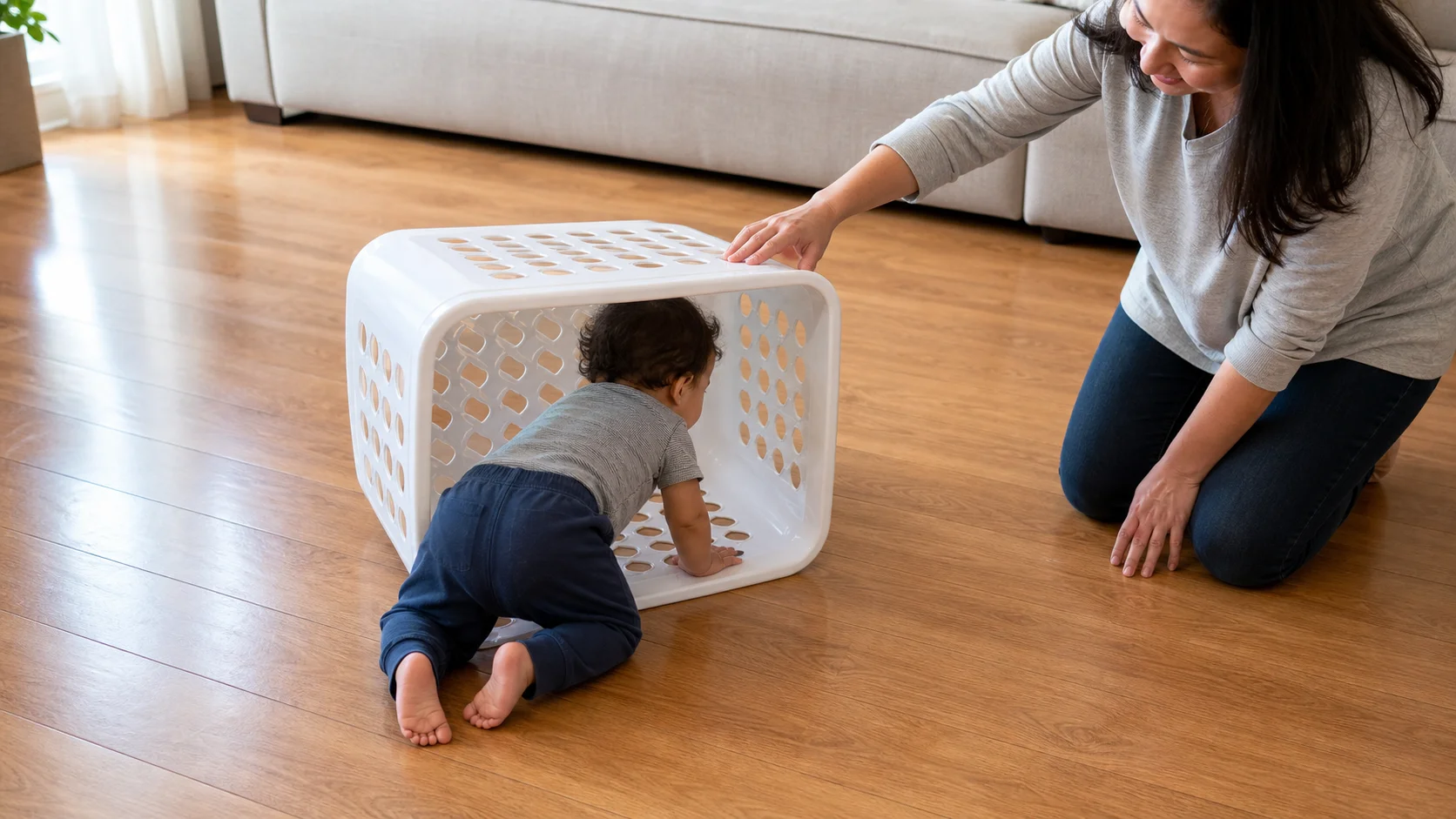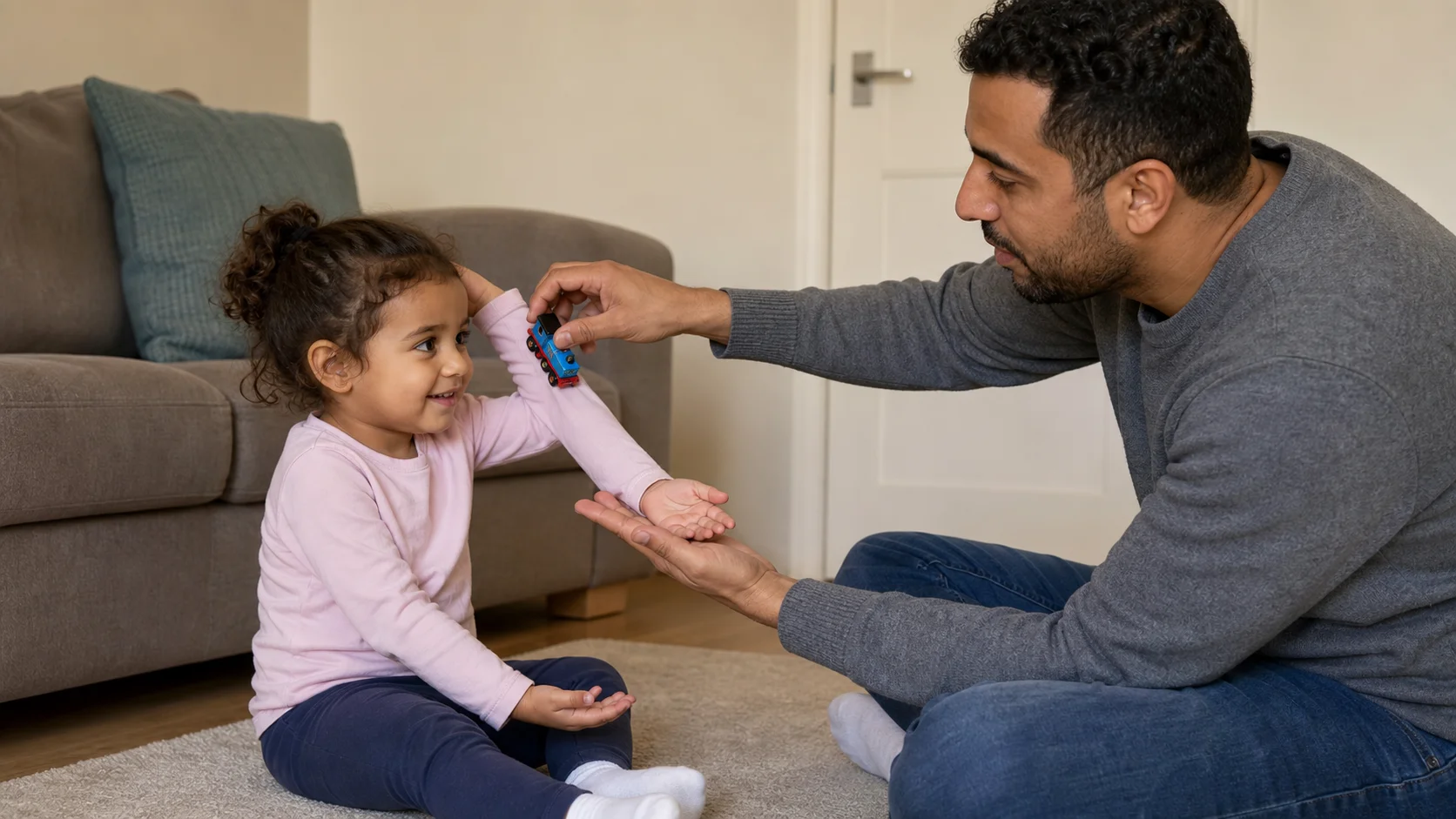
A grown-up and toddler sit face to face on the floor while a toy train rolls up the toddler's arm and down the other side.
Skill builderSpeech delay supportPause Before ActionIndoor

Train Arm Ride.

One toy train, one repeated body path, and a clear pause your child can answer with another turn request.

Play time
1-5+ min
Age
1-4 years
Energy
Low
Mess
No
Effort
Low
Where
Indoor
Start here

The recipe.

Low parent effort
2 things

What you need

  • 1 toy train
  • 1 adult partner
1 min minimum

Setup

Then start the loop
Step 01
Sit on the floor facing your child in a calm indoor spot.
Step 02
Move close enough that you can reach both of your child's arms comfortably.
Step 03
Hold the toy train in your hand and keep the first turn for yourself so your child can watch the path.
"Choo choo up."
The loop

How play unfolds.

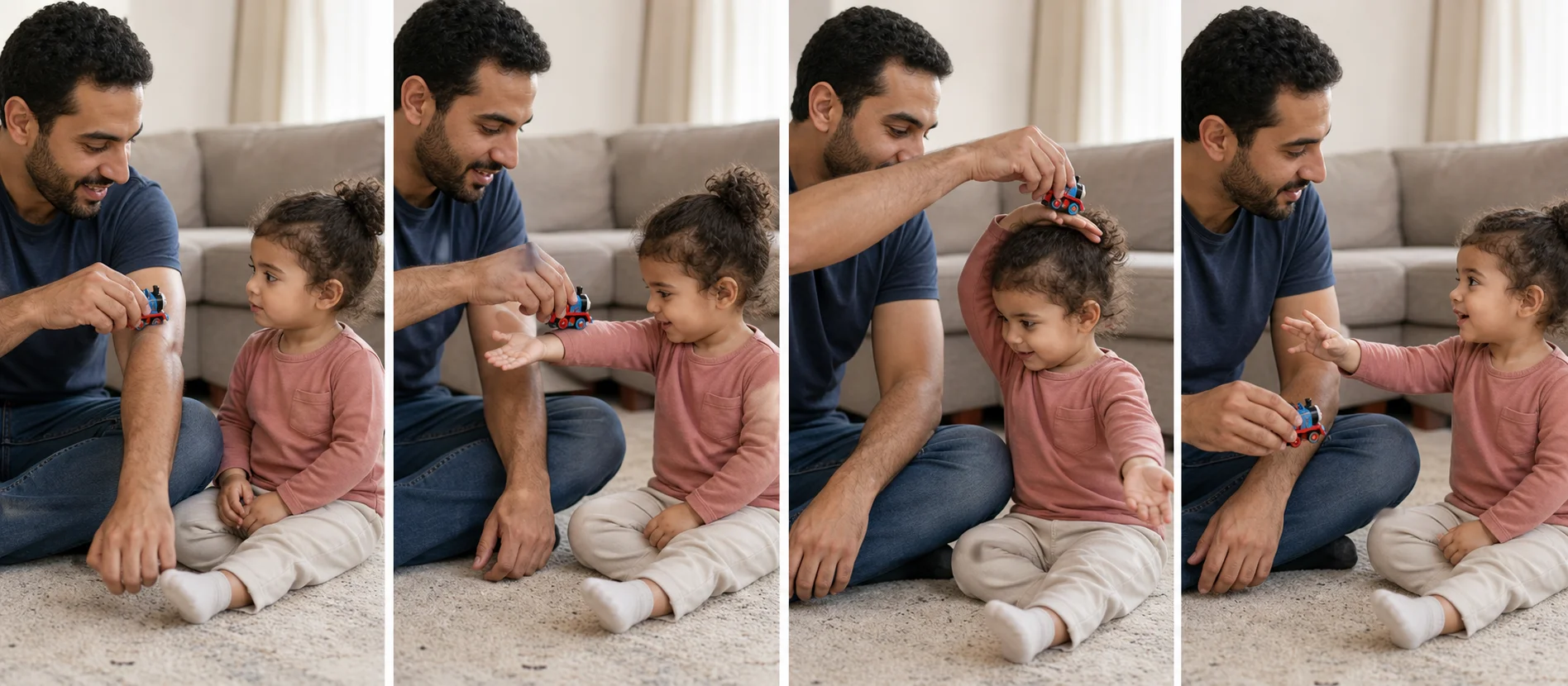
A multi-panel sequence showing a grown-up rolling a toy train on their own arm first, then along the toddler's arm path, pausing, and restarting after the toddler signals for more.
  1. 01
    Roll the train up your own arm, over your head, and down the other arm while saying a short train phrase.
  2. 02
    Roll the train along the same path on your child, or keep it on the arms only if that version works better.
  3. 03
    Pause with the train in your hand and wait for any clear "more" signal.
  4. 04
    Start the same ride again as soon as your child signals for another turn.

Safety Check

  • Keep the train movement slow and gentle near the face and head.
  • Stop if your child tries to mouth the train, throws it, or pulls away from touch.
  • Use the arm-only version if the head path feels too intense for your child.
Supporting the play

What to say in the moment

Match what you say to what you see.

Prompt ladder
Level 1 (Start)
"Train ride."
Level 2 (Keep going)
"More train?"
Level 3 (Stretch)
"Your turn again."
Level 4 (Extend)
"Slow train now."
If your child seems...
What you'd see
Focused
What to do
Say
"You are ready."
Add
Keep the same train path for one or two more turns.
Extend
Pause a little longer and let your child signal first.

Make it easier

Younger end
  • -Keep every turn on the same arm first before crossing over the head.
  • -Use the same two or three words every round.
  • -Let watching your turn count before you ask for a signal.

Make it harder

Older end
  • +Wait an extra second before starting the next ride so your child has to signal more clearly.
  • +Switch which arm goes first while keeping the same train path.
  • +Let your child hold out the arm they want the train to start on.

If it's not working

If you see
If child ignores it
Do the train path on your own body again with a bigger "choo choo" voice, then stop with the train near your child's arm and wait.
If you see
If child misuses it
Keep the train in your hand, let your child touch it briefly, and restart with one short arm-only ride before trying the full path again.
If you see
If child gets frustrated
Skip the over-the-head part, roll only up one arm and down again, and count that as a full turn.
Skill spotlight
Pause Before Action

Waiting through a short shared pause before the next turn

This helps a child stay with a short pause, expect what comes next in a shared routine, and use that pause to communicate for another turn.

  • The repeated train path gives your child a predictable routine, so the pause is easier to notice and answer.
  • The stop-and-restart loop gives quick practice with waiting through one short break before the next turn.
  • Any clear look, reach, sound, or word can restart the ride, so the game supports communication without needing much language.
Real-world transfer
  • Waiting through short stop-and-go moments in shared play
  • Using a simple signal to keep a favorite routine going