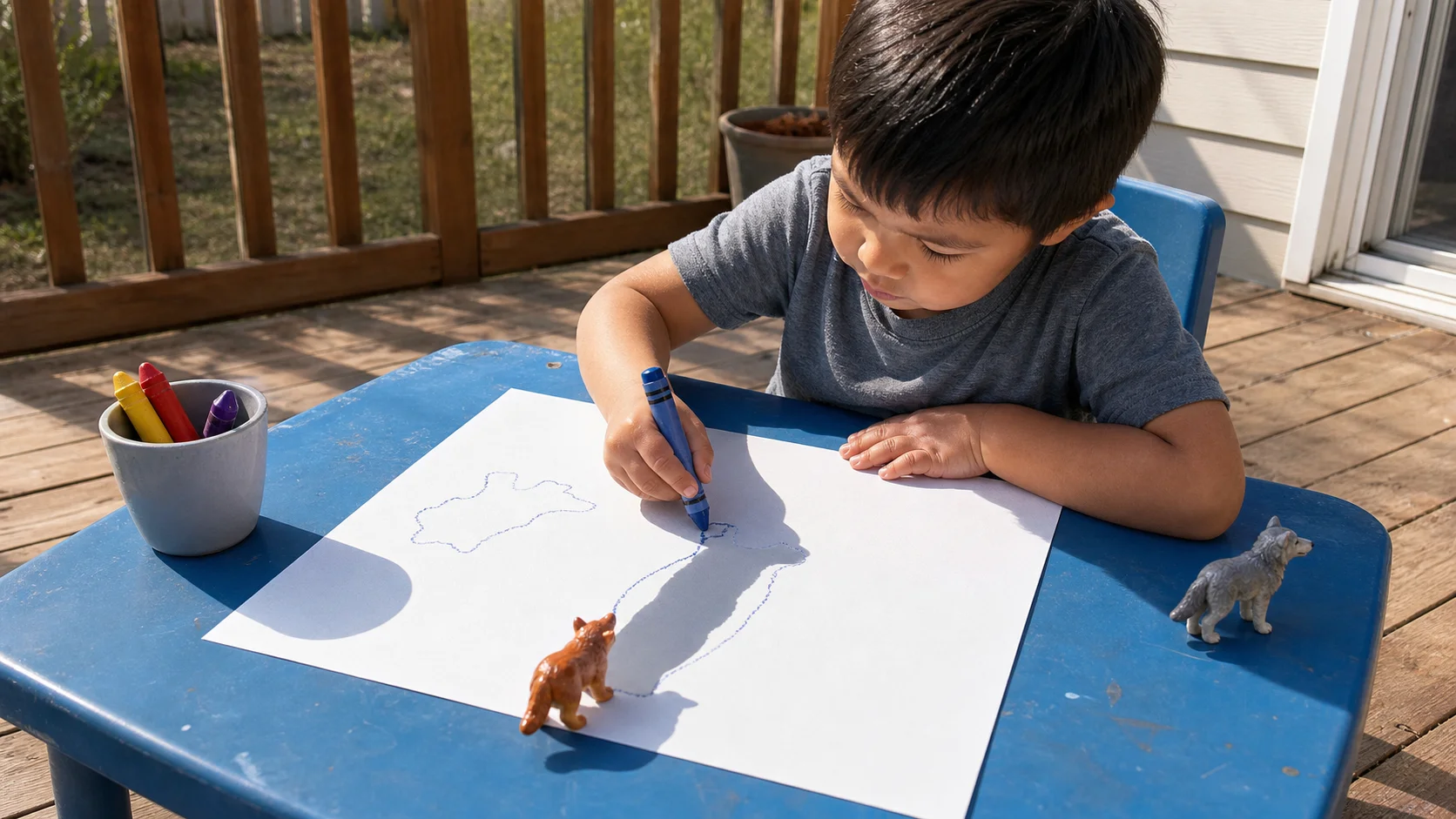
Toddler tracing the shadow of a small toy on a sheet of paper at a sunlit table.
LiteracyTrace Letter ShapeIndoor Or Outdoor

Toy Shadow Trace.

One toy and one clear shadow turn tracing into a simple drawing game with an easy reset.

Play time
5-20+ min
Age
3-4 years
Energy
Low
Mess
Low
Effort
Low
Where
Indoor Or Outdoor
Start here

The recipe.

Low parent effort
5 things

What you need

  • 1 sheet of paper large enough for more than 1 traced outline
  • 1 small set of pencils or crayons
  • 2 or 3 small toys or models that can cast clear shadows
  • 1 sunny table spot or 1 lamp
  • 1 table
5 min minimum

Setup

Then start the loop
Step 01
On the table, lay the paper flat where sunlight or a lamp can cast a strong shadow across the page.
Step 02
Beside the paper, place the crayons within easy reach and set out two or three small toys so your child can choose one at a time.
Step 03
Sit beside your child and keep the light steady until one dark shadow edge shows clearly on the page.
Step 04
At the bottom edge of the paper, place the first toy so it stays still and its shadow stretches onto the page instead of off the table.
"Hold it still. Trace around."
The loop

How play unfolds.

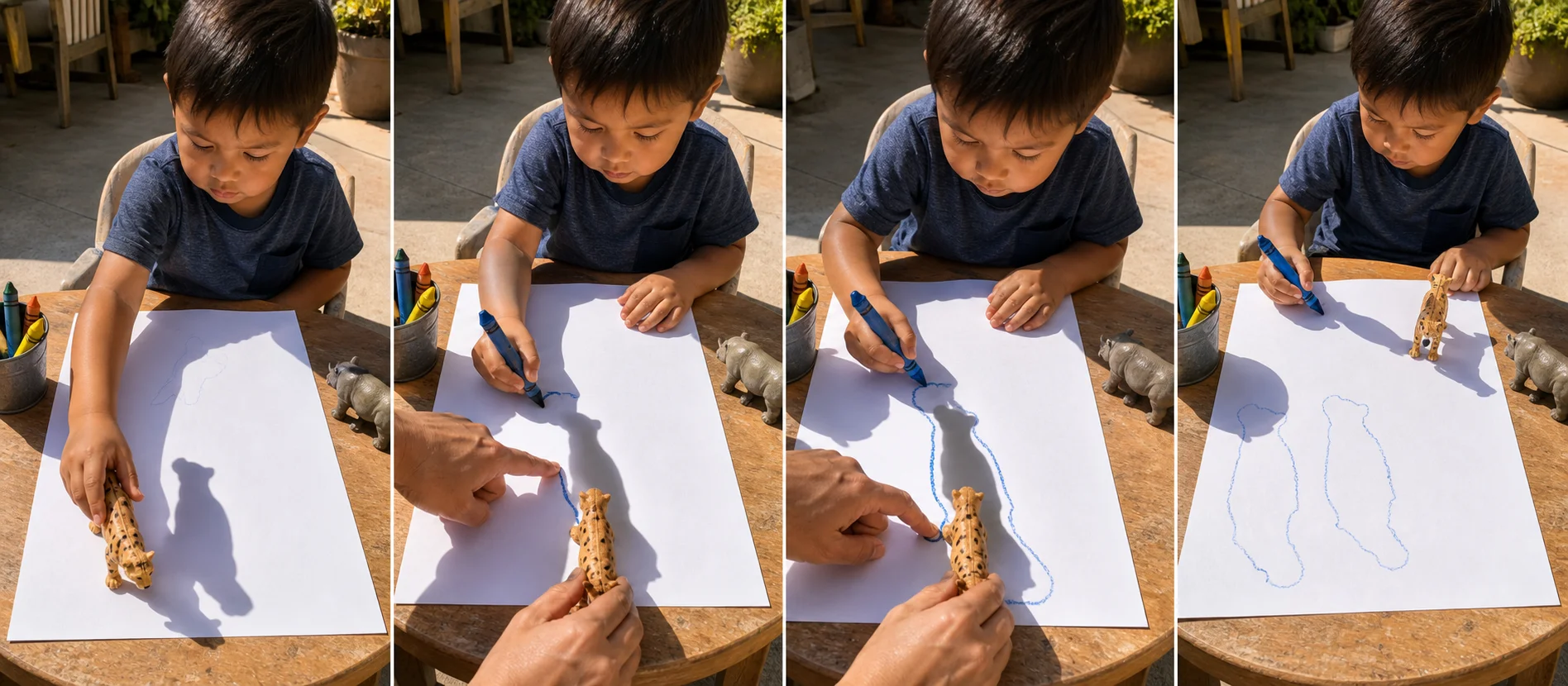
Multi-panel sequence showing a toy placed in the light, a clear shadow falling on paper, a child tracing the outline, and the toy moved for another shadow.
  1. 01
    Let your child choose one toy and help place it so a clear shadow falls on the paper.
  2. 02
    Point to one easy edge and say, "Trace this part," then let your child trace as much of the outline as they can.
  3. 03
    Count the turn as done when your child can see the toy shape on the page, even if the outline is partial.
  4. 04
    Move the toy to a blank spot or choose a new toy, make another shadow, and repeat until the page feels full enough or attention drops.

Safety Check

  • Use only age-appropriate small toys and stay close so they are not mouthed or thrown.
  • Keep the light source stable so your child does not reach into a hot lamp or knock it onto the work surface.
  • Help hold the toy steady when needed so the tracing turn does not turn into pencil pokes or frustration-driven rough movements.
Supporting the play

What to say in the moment

Match what you say to what you see.

Prompt ladder
Level 1 (Start)
"Pick one toy. Trace its shadow."
Level 2 (Keep going)
"Move it over. Make a new shadow."
Level 3 (Stretch)
"Can this toy make a different shadow?"
Level 4 (Extend)
"Fill one more empty spot with a shadow."
If your child seems...
What you'd see
Focused
What to do
Say
"That shadow is ready."
Add
Ask, "Which toy is next?" before the next round.
Extend
Let your child slide the toy to a blank spot and begin tracing before you point.

Make it easier

Younger end
  • -Keep the same toy in the same shadow spot for two turns so your child can trace a familiar outline again before switching.
  • -Turn the paper so the easiest shadow edge sits closest to your child's drawing hand.
  • -Offer one toy choice at a time instead of showing all the toys at once.

Make it harder

Older end
  • +Rotate the same toy and trace the new shadow shape before choosing a different toy.
  • +Ask your child to place the next shadow in an empty part of the page without crossing an old outline.
  • +Let your child check whether the shadow looks dark and clear before asking for help.

If it's not working

If you see
If child ignores it
Start with one favorite toy and trace just one easy section of the shadow together before asking for a full outline.
If you see
If child misuses it
If your child scribbles away from the shadow or keeps moving the toy, go back to one adult-held toy and ask for "trace this part" while pointing to one short edge.
If you see
If child gets frustrated
Switch to a bigger simpler toy shadow, hold the toy steady for them, or count one partial outline as a win and stop there.
Skill spotlight
Shape Tracing

Tracing a visible shadow outline

This helps your child match hand movement to a visible line, slow the crayon down around curves, and stay with one short drawing job. Those same actions show up in early tracing, copying shapes, and other careful table play.

  • A clear shadow gives your child a visible path to follow, which lowers the pressure of a blank page.
  • Moving the toy and tracing again repeats the same slow crayon control with a new shape each round.
  • Even one partial outline leaves a real result on the paper, so the payoff shows up fast.
Real-world transfer
  • Following visible lines during tracing, coloring, and other early paper tasks
  • Slowing the hand down enough for circles, outlines, and simple copied shapes
  • Noticing how moving an object changes what shows up in light and shadow

Parent questions