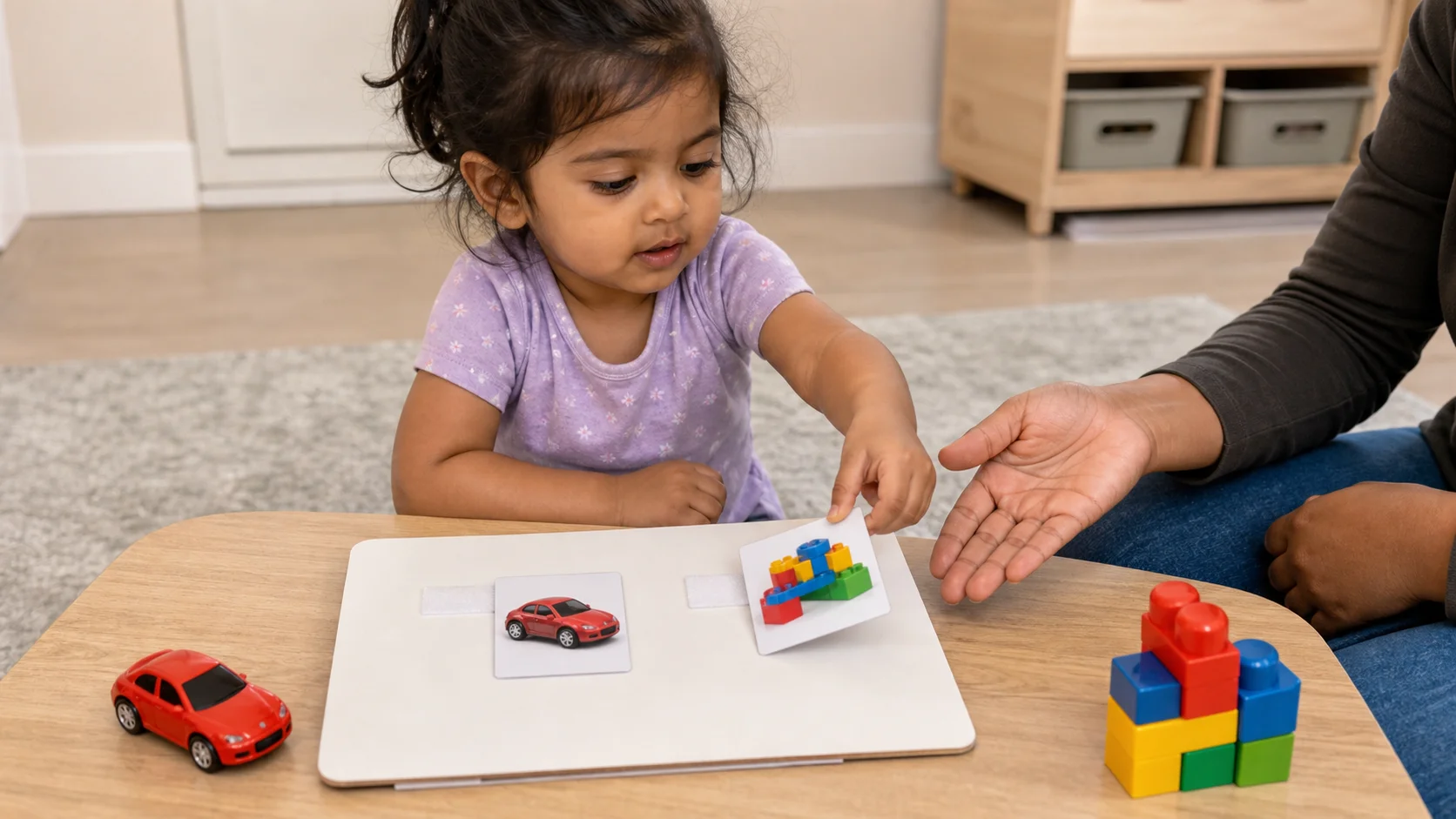
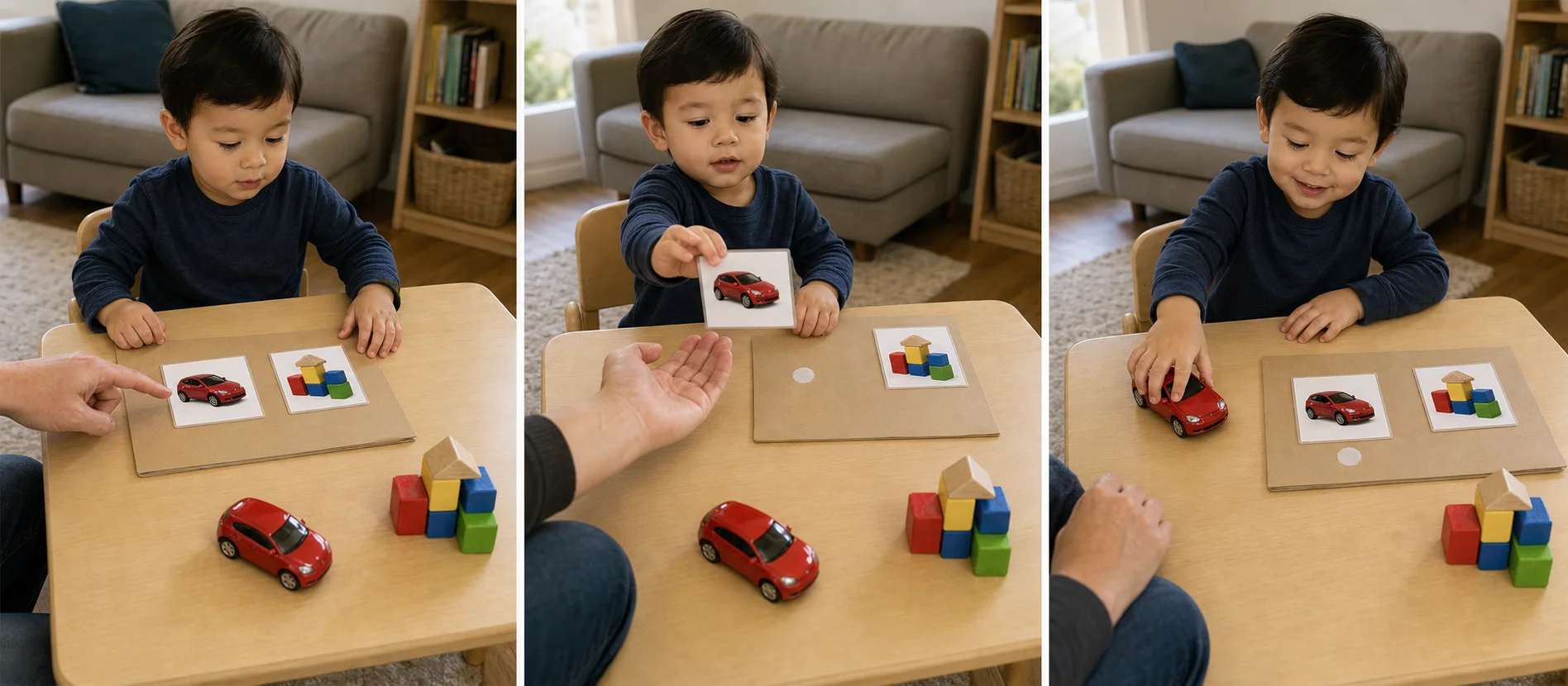
A child pointing to one of two toy pictures on a low choice board while the matching toys sit nearby.
Skill builderAutism supportPass And ReceiveIndoor

Toy Choice Board.

A low-language picture choice game where your child picks a toy by pointing to, pulling, or handing over one picture.
Play time
5-10+ min
Age
2-5 years
Energy
Low
Mess
No
Effort
Medium
Where
Indoor
Start here

The recipe.

Medium parent effort
5 things

What you need

  • 1 choice board, such as the printed template, a folder, clipboard, or piece of paper
  • 2 play pictures showing toys or activities that are available right now
  • 2 matching toys or play materials
  • Tape, glue, or hook-and-loop fastener to hold pictures on the board
  • Optional visual request template with "I want" or "More"
5 min minimum

Setup

Then start the loop
Step 01
On the floor or a low table in the play area, put the choice board where your child can see and reach it.
Step 02
On the board, attach 2 pictures side by side that match toys you can offer right now.
Step 03
Beside you or behind your knee, keep the 2 matching toys visible but not loose in your child's hands yet.
Step 04
Next to the board, place the optional request template if you are using it.
Step 05
Check that the board shows 2 clear picture choices, the matching toys are nearby, and your child has room to point, pull, or hand you one picture.
"Choose one."
The loop

How play unfolds.

Four panels showing a grown-up placing two toy pictures, a child choosing one picture, the grown-up giving the matching toy, and the picture returning to the board.
  1. 01
    Point to each picture, name it, and ask, "What do you want to play?"
  2. 02
    Wait for your child to point, pull, hand over, touch, look clearly at, or show 1 picture.
  3. 03
    Say the choice out loud, then give the matching toy for a short play round.
  4. 04
    Put the picture back on the board when the round is done.
  5. 05
    Offer the same 2 choices again, or swap in 1 new picture if your child is finished with that toy.

Safety Check

  • Use only pictures for toys that are available and safe to play with right now.
  • Store small pictures, fastener pieces, tape, and laminated cards away from children who mouth materials.
  • Keep the toys behind you or beside your knee if grabbing both toys would take over the activity.
  • Stop or simplify if your child mouths the pictures, tears fasteners off repeatedly, or becomes upset because a pictured toy is not available.
Supporting the play

What to say in the moment

Match what you say to what you see.

Prompt ladder
Level 1 (Start)
"Look: cars or blocks."
Level 2 (Keep going)
"You picked cars. Cars are ready."
Level 3 (Stretch)
"Put the picture here."
Level 4 (Extend)
"Pick one for my turn."
If your child seems...
What you'd see
Focused
What to do
Say
"You picked that picture."
Add
Name the toy and action already happening.
Extend
Let your child choose the toy for your next turn.

Make it easier

Younger end
  • -Use 2 very different toys so the pictures are easy to tell apart.
  • -Place the pictures farther apart on the board.
  • -Keep each play round brief so your child gets another quick chance to choose.

Make it harder

Older end
  • +Add a third picture only after 2 choices feel easy.
  • +Have your child place the chosen picture on the request template if it is already part of the setup.
  • +Ask your child to return the picture to the board before the next choice.

If it's not working

If you see
If child ignores it
Hold one picture next to its matching toy, name it, and offer just that picture and one other.
If you see
If child misuses it
Move the toys behind you and say, "Picture first, then toy." Help your child hand you one picture before giving the toy.
If you see
If child gets frustrated
Accept a point, reach, look, or touch as the choice, say it out loud, and give the toy right away.
Skill spotlight
Pass And Receive

Using a picture to make a play choice, Passing or showing a choice to another person

This helps a child learn that a visible choice can tell another person what they want, even when words are hard or still developing.

  • Choosing from two pictures gives your child a visible way to show what they want.
  • Handing over or showing one picture turns a choice into a short back-and-forth exchange.
  • Returning the picture to the board makes the next choice easier to see and repeat.
Real-world transfer
  • Showing a grown-up what they want.
  • Making a choice without needing a full sentence.
  • Waiting through a short exchange before the next thing starts.
  • Using pictures during play, routines, snacks, or cleanup.

Parent questions

Back to library
Keep playing

Related activities.