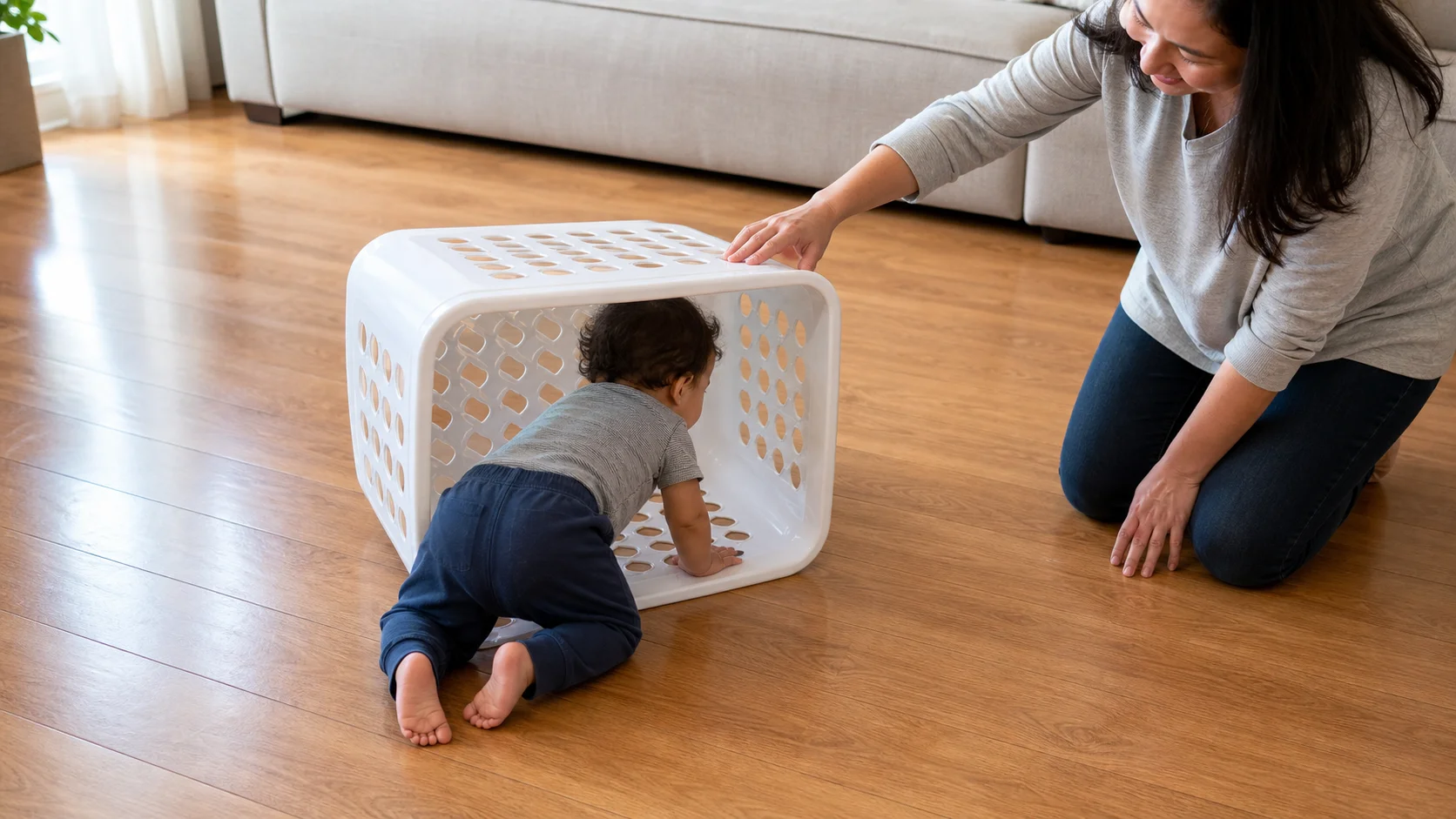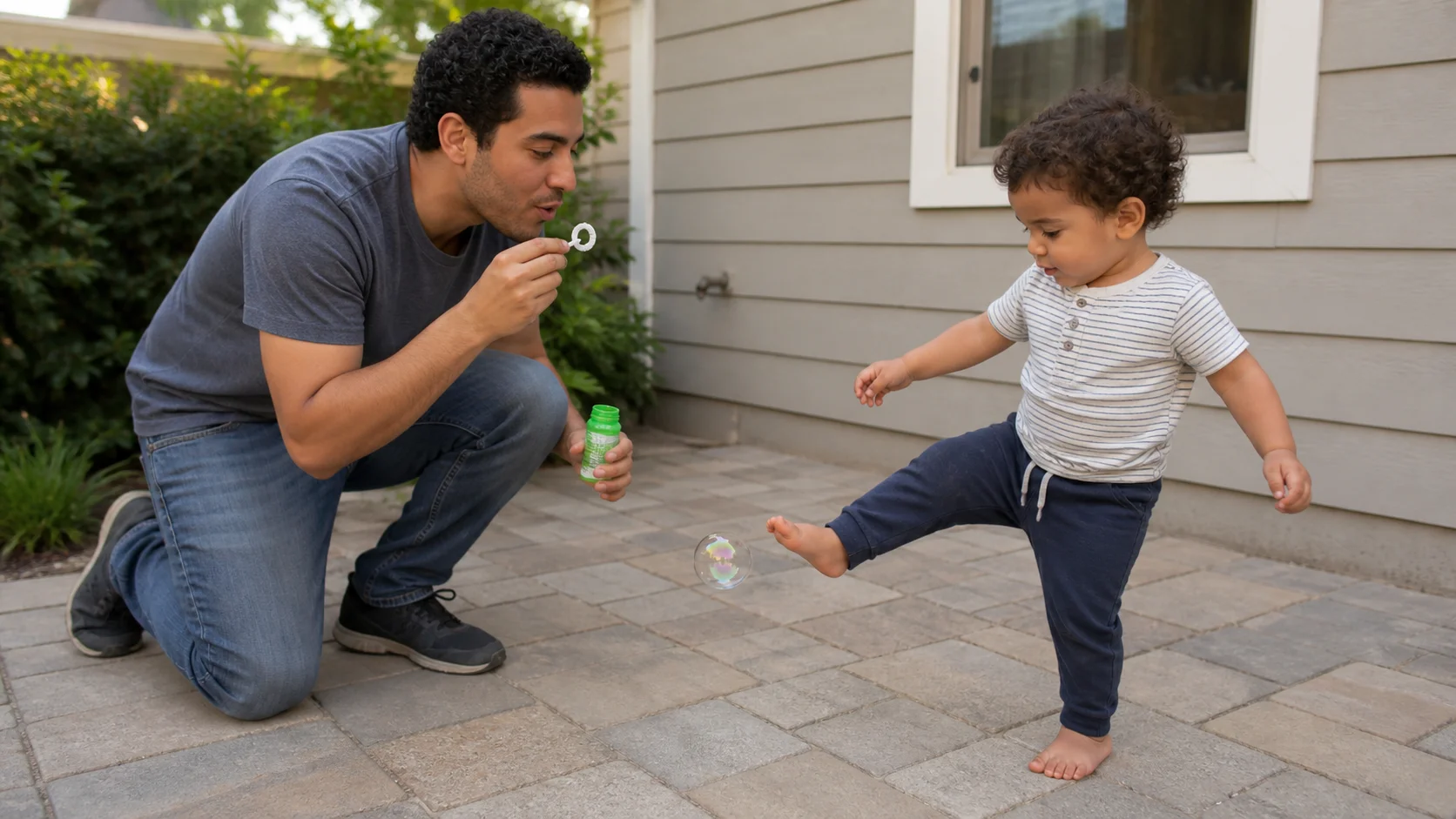
A toddler balances on one foot and reaches with the toes toward a low bubble while a grown-up kneels nearby with the bubble wand.
Fine motorShift WeightIndoor Or Outdoor

Toe Bubble Pop.

One low bubble at a time turns bubble play into a short balance-and-pop routine.

Play time
5+ min
Age
2-3 years
Energy
Medium
Mess
Low
Effort
Low
Where
Indoor Or Outdoor
Start here

The recipe.

Low parent effort
5 things

What you need

  • 1 bottle of bubble solution
  • 1 bubble wand
  • 1 flat indoor floor spot or level outdoor patch
  • 1 child
  • 1 adult
5 min minimum

Setup

Then start the loop
Step 01
Pick a flat, dry floor spot or level outdoor patch with enough open space for your child to stand and lift one foot without bumping into anything.
Step 02
Keep the bubble bottle and wand in the adult's hand or right beside you so they stay out of your child's reach.
Step 03
Stand your child facing you with both feet flat on the ground, then kneel or stand 1 to 2 feet in front of the toes.
Step 04
Blow 1 slow test bubble low across the toes and say, `Foot up, pop, foot down.`
Foot up.
The loop

How play unfolds.

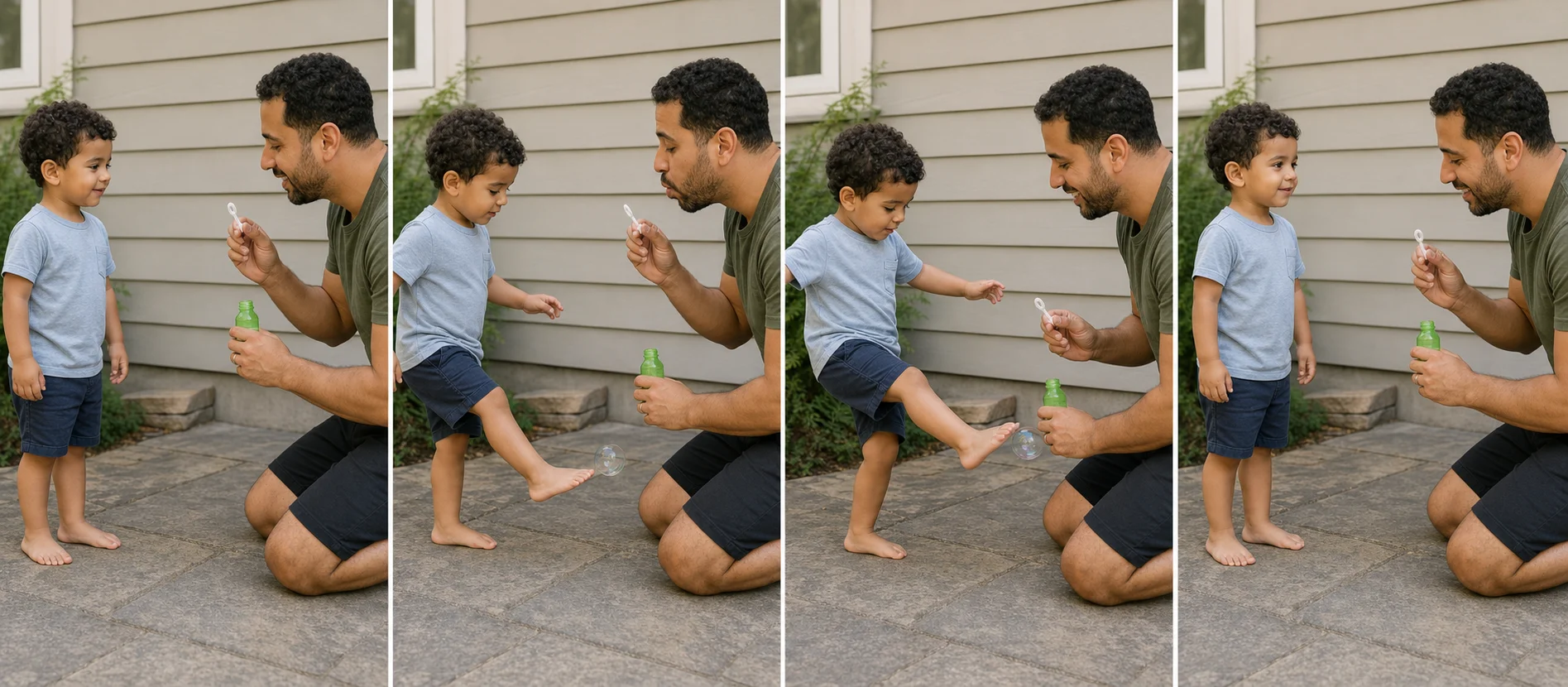
A multi-panel sequence shows a grown-up blowing a low bubble, a child lifting one foot to toe-pop it, and both feet resetting before the next turn.
  1. 01
    Blow 1 slow bubble low across the front of your child's toes and say, `Foot up, pop.`
  2. 02
    Let your child lift 1 foot and pop or tap the bubble with the toes.
  3. 03
    Wait for both feet to reset on the ground, then blow the next low bubble and repeat for 5 to 8 turns, or stop after 3 clear toe pops.

Safety Check

  • Bubble residue can make smooth floors slippery. Wipe wet spots before the next turn.
  • Keep the bubble bottle and wand with the adult so your child does not mouth them or grab them mid-turn.
  • Stay close and stop if your child starts chasing high bubbles, loses balance, or is standing on uneven ground.
Supporting the play

What to say in the moment

Match what you say to what you see.

Prompt ladder
Level 1 (Start)
Foot up, pop.
Level 2 (Keep going)
One more bubble.
Level 3 (Stretch)
Hold, then pop.
Level 4 (Extend)
Pick your foot.
If your child seems...
What you'd see
Focused
What to do
Say
Try the other foot.
Add
After the pop, use one learning prompt such as "Same or different?"
Extend
Wait one beat before the next bubble so the child balances a little longer.

Make it easier

Younger end
  • -Stay with the child's stronger or favorite foot for the whole round.
  • -Blow only one bubble after each full feet-down reset instead of a small pair.
  • -Keep every bubble on the same side of the body so the child does not need to twist to reach it.

Make it harder

Older end
  • +Alternate feet every turn after the child gets 2 calm pops in a row.
  • +Let the child hold the lifted foot up for 1 slow count before popping.
  • +Drift the bubble a little left or right of center so the toes have to aim more carefully.

If it's not working

If you see
If child ignores it
Blow 1 bubble right beside your child's shoe, pop it with your own toe first, and invite just 1 copy turn.
If you see
If child misuses it
If your child swats with hands, hops forward, grabs the wand, or mouths the bottle, step closer, keep the bubble tools with the adult, and restart with 1 slow bubble at toe level.
If you see
If child gets frustrated
Let your child hold your hand or a wall for 1 try, use the easier foot, and stop after 1 successful toe tap or pop.
Skill spotlight
One-Foot Weight Shift

Lifting one foot long enough to pop a bubble with the toes

This helps a child hold the body steady on one leg while the other foot does a small target job, which shows up in kicking, stepping into pants, and moving across uneven spots without falling right away.

  • Lifting one foot for a low moving target turns bubble play into a short balance job your child can see right away.
  • Keeping the bubble low gives your child a reason to aim with the toes instead of racing after bubbles around the room.
  • Resetting both feet before the next bubble keeps each turn contained and easy to repeat.
Real-world transfer
  • Standing on one foot for a moment during dressing
  • Kicking or toe-tapping a target without falling right away
  • Steadying the body before stepping over small obstacles or changing direction

Parent questions