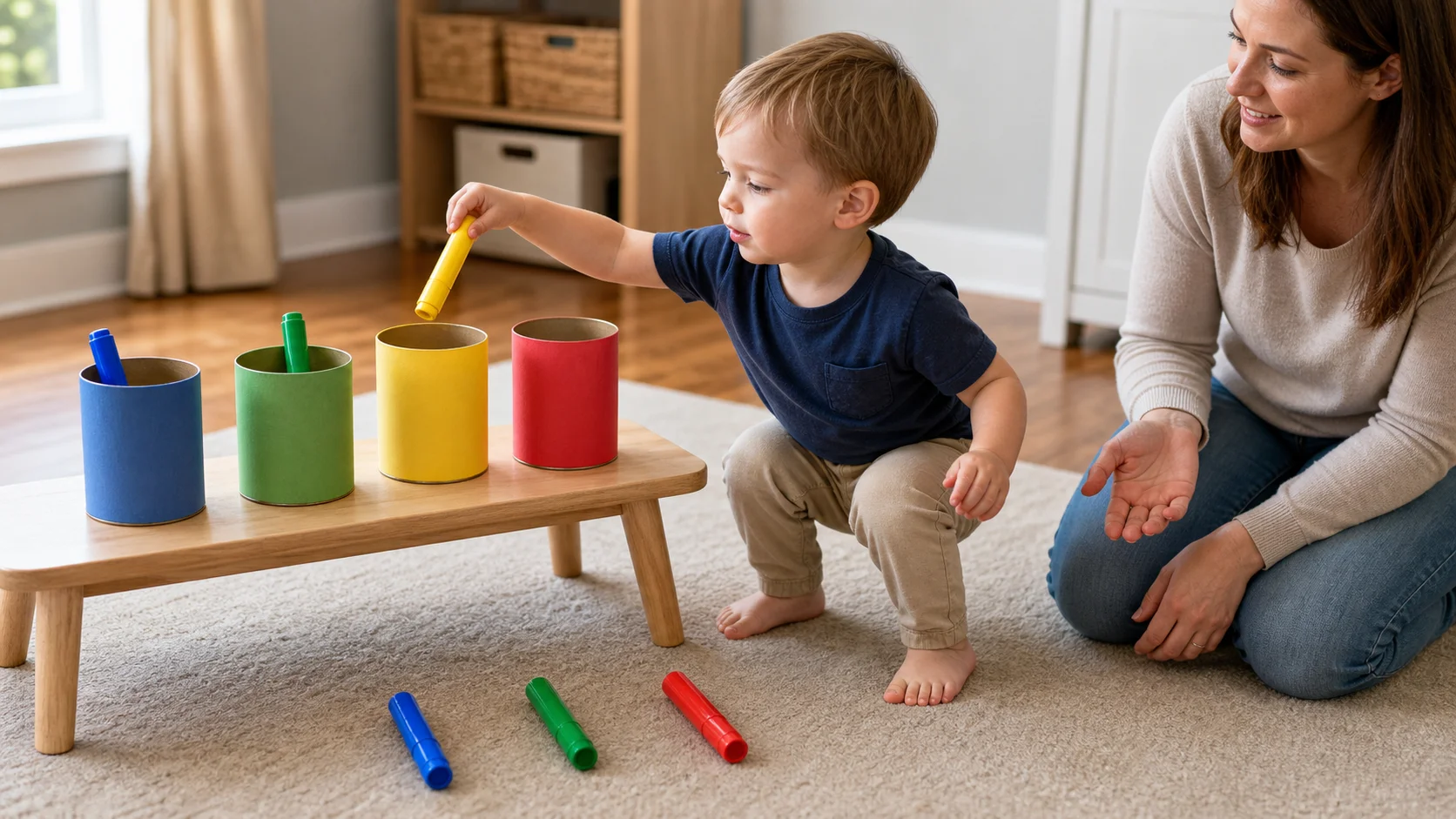
A toddler squatting to pick up a colored marker from the floor beside a low table with matching colored cans.
Fine motorChange Body Level`Indoor

Tin Can Color Squat.

Colored cans and markers turn one squat, one stand, and one matching drop into a quick indoor game.

Play time
5+ min
Age
2-3 years
Energy
Medium
Mess
Low
Effort
Low
Where
Indoor
Start here

The recipe.

Low parent effort
5 things

What you need

  • 3 to 5 colored markers
  • 3 to 5 tin cans or sturdy cups with matching colors
  • 1 low table or other stable raised surface
  • 1 child
  • 1 adult
5 min minimum

Setup

Then start the loop
Step 01
On a low table, line up 3 to 5 colored cans or sturdy cups with the matching colors facing your child.
Step 02
On the floor right in front of the table, place the matching markers in a short loose row so your child can squat for one without stepping on the others.
Step 03
Stand your child facing the table and stay beside them so you can point to the target can, steady the pace, or stop after one good turn.
Pick one up.
The loop

How play unfolds.

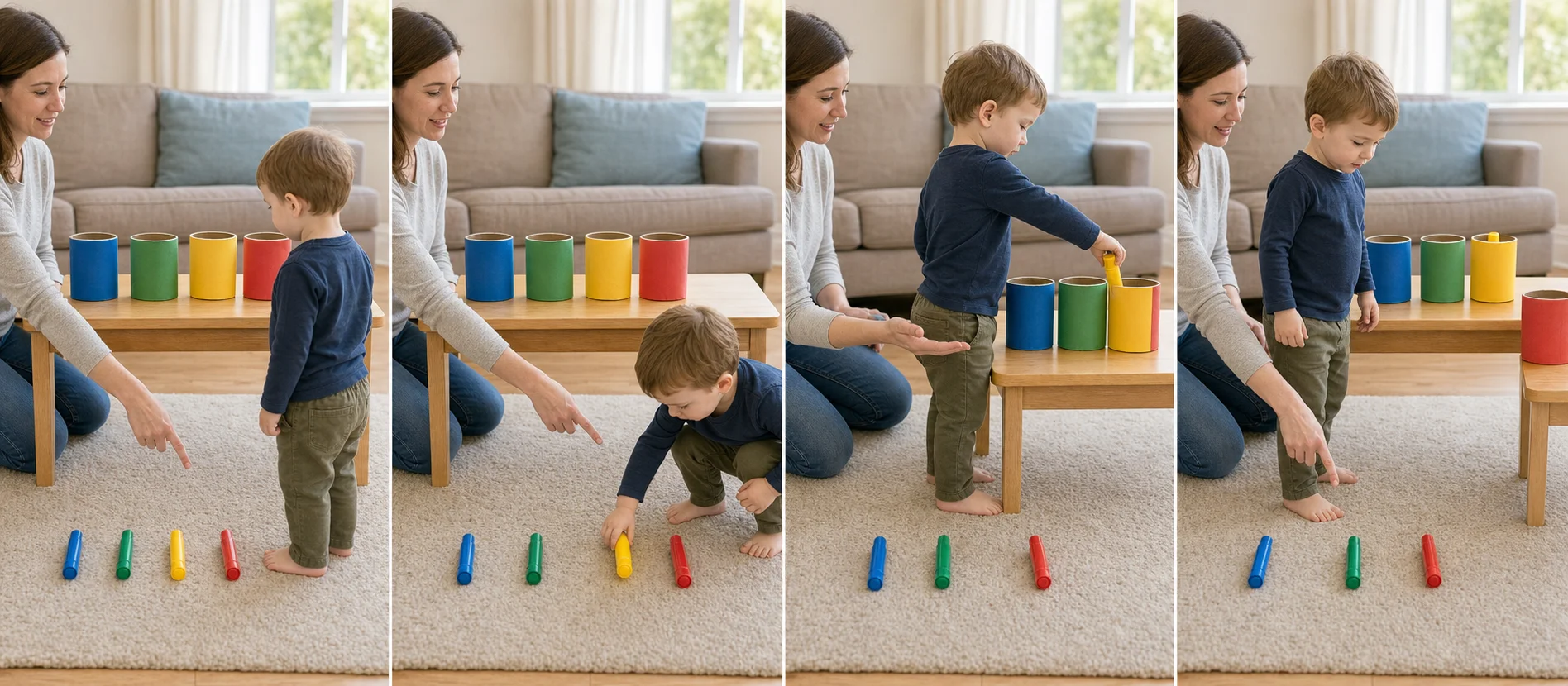
A multi-panel sequence showing a child picking up one marker, standing, dropping it into the matching can, and resetting for another turn.
  1. 01
    Point to one marker and say, `Find the same color.`
  2. 02
    Let your child squat for the marker, stand back up, and drop it into the matching can or cup.
  3. 03
    Cue the next marker and repeat for a few calm turns, or stop after one good squat-and-drop match.

Safety Check

  • Check tin cans for sharp edges and wobble before you start. Use sturdy cups instead if the cans do not feel safe.
  • Stay close so your child does not pull on the table for balance or lose footing during the repeated squat-and-stand turns.
  • Keep markers large enough and supervised if your child still mouths small items.
Supporting the play

What to say in the moment

Match what you say to what you see.

Prompt ladder
Level 1 (Start)
Pick one up.
Level 2 (Keep going)
Match the color.
Level 3 (Stretch)
Bend, stand, drop.
Level 4 (Extend)
Find your own match.
If your child seems...
What you'd see
Focused
What to do
Say
Find the same color.
Add
After the drop, use one learning prompt such as `Which one is red?`
Extend
Pause before pointing so the child scans the row first.

Make it easier

Younger end
  • -Use the two most different colors first, such as red and blue, before bringing in closer-looking colors.
  • -Place the markers in a short line instead of a tight pile so the next choice is easier to see.
  • -Start with the nearest can in the row so the first stand-and-drop turns feel simple.

Make it harder

Older end
  • +Wait one beat before pointing so the child tries to find the matching can alone.
  • +Spread the markers across two or three small floor spots so each squat starts from a slightly new place.
  • +After each drop, let the child choose which color to hunt next before the next squat begins.

If it's not working

If you see
If child ignores it
Start with two obvious color pairs, point to the target can, and help through the first full turn.
If you see
If child misuses it
If the markers start getting thrown or the cans turn into banging toys, keep only one marker on the floor at a time and hold the rest back.
If you see
If child gets frustrated
Count one correct squat-and-drop as enough, praise that success, and stop before balance or matching starts to fall apart.
Skill spotlight
Squat And Stand Control`

Squatting down and standing back up for one matching turn, Putting one marker into the right color can

This helps your child move the body down and back up for one small job while keeping track of where the object belongs. That shows up in cleanup, helper jobs, and other quick floor-to-table routines.

  • The squat-and-stand loop gives your child a clear whole-body job, not just a table-top color sort.
  • Matching one marker to one can keeps the color choice simple and visible through the whole turn.
  • The drop into the can gives each round a clear ending, which makes the routine easier to repeat.
Real-world transfer
  • Picking toys or clothes up from the floor and putting them in the right spot
  • Following a short `pick it up and put it here` direction
  • Staying organized through one small cleanup or helper turn