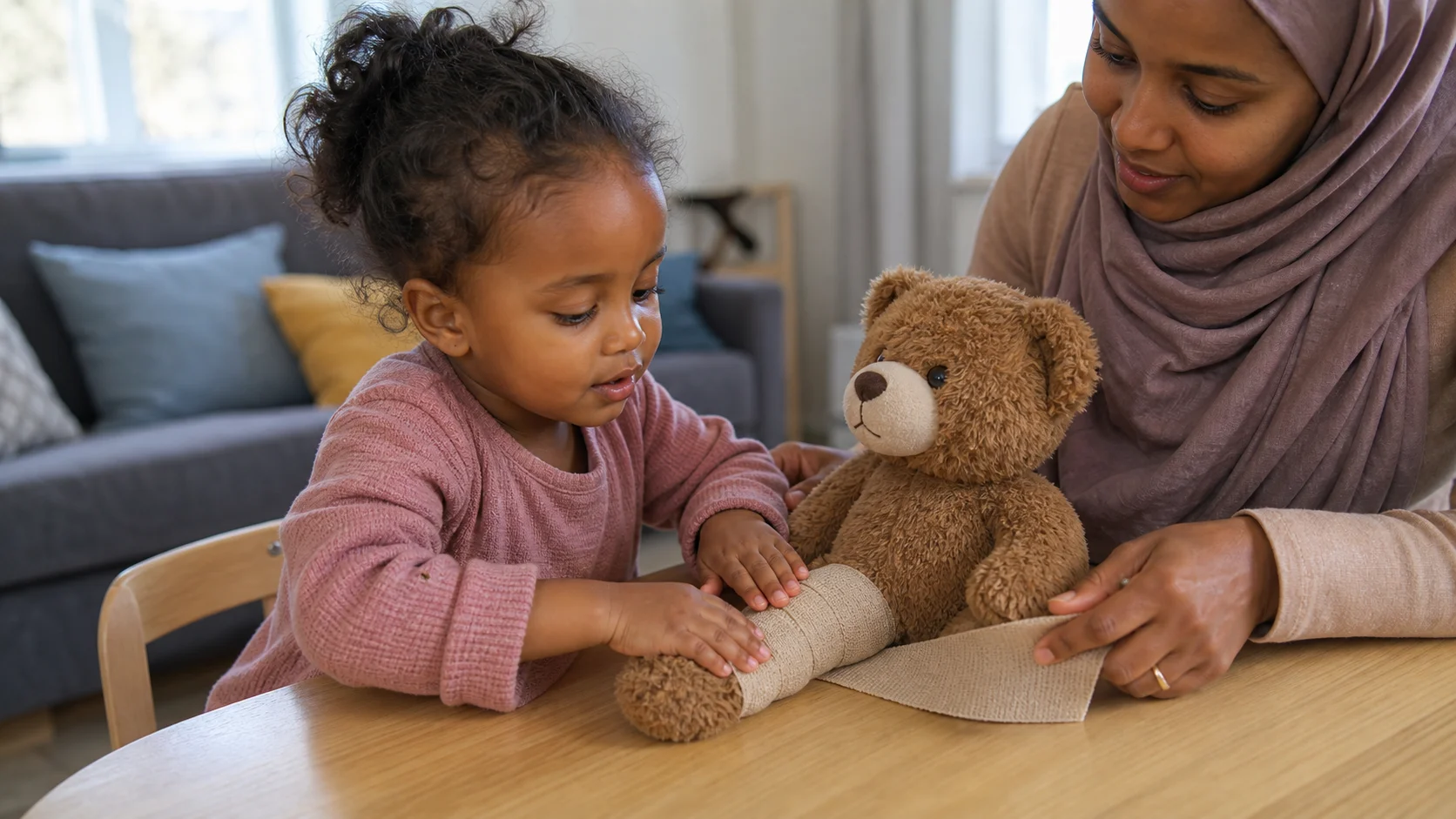
A toddler holding a soft wrap strip around a teddy bear's leg while a grown-up steadies the bear at a low table.
Skill builderRepeat Loop`Indoor

Teddy Cast Wrap.

A teddy bear and a soft wrap strip turn pretend care play into one short repeatable helper routine.

Play time
5+ min
Age
2-3 years
Energy
Low
Mess
Low
Effort
Low
Where
Indoor
Start here

The recipe.

Low parent effort
4 things

What you need

  • 1 teddy bear or other stuffed animal with 1 easy-to-wrap leg
  • 1 short soft wrap strip, such as a self-stick bandage, ace bandage strip, or folded cloth strip
  • 1 child
  • 1 adult
5 min minimum

Setup

Then start the loop
Step 01
On the floor or at a low table, place the teddy in front of your child with one leg turned toward their hands.
Step 02
Beside that leg, place the short wrap strip and keep most of the loose end controlled so it is easy to start.
Step 03
Beside your child, sit close enough to steady the teddy, help start the wrap, and end after one calm turn if needed.
Wrap teddy.
The loop

How play unfolds.

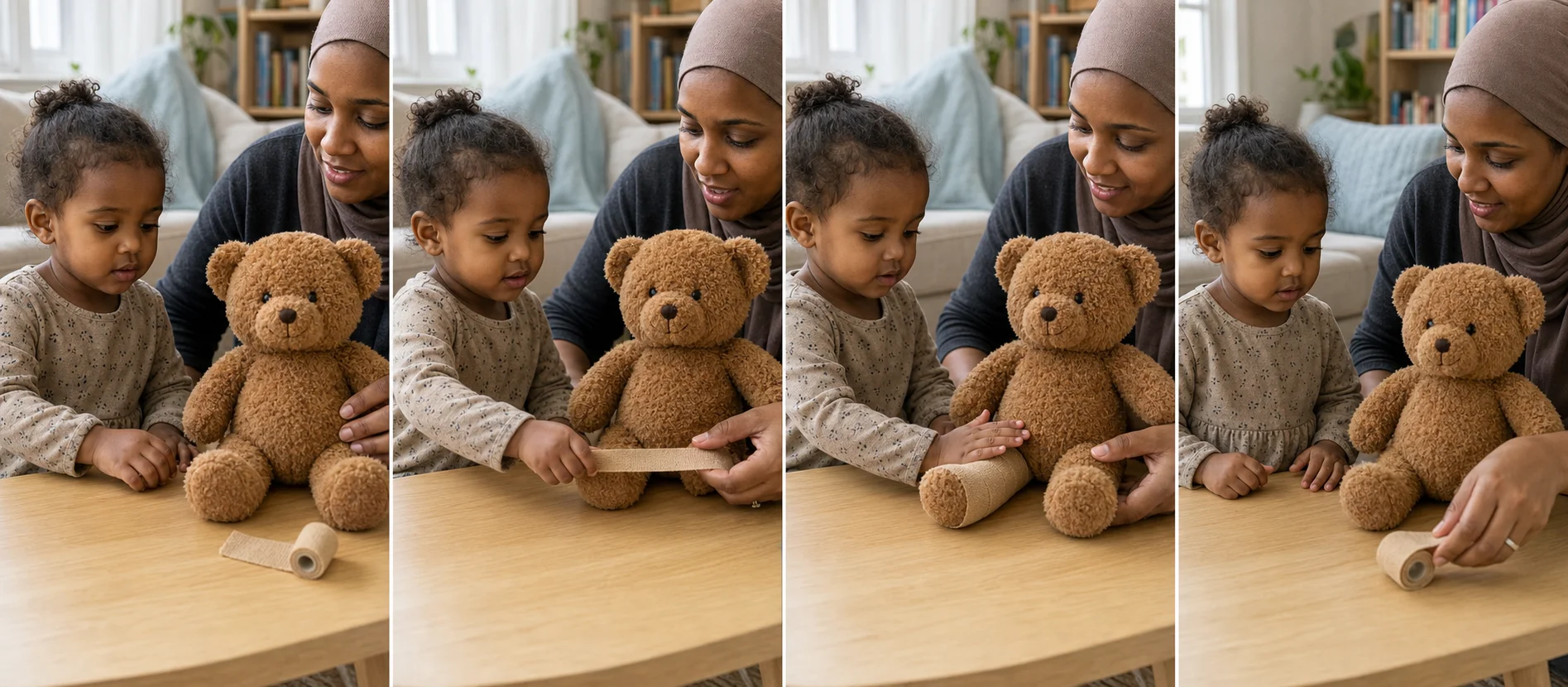
A multi-panel sequence showing a child wrapping teddy's leg, patting the cast smooth, unwrapping it, and starting another turn.
  1. 01
    Start the wrap on one teddy leg and say, `Help teddy.`
  2. 02
    Let your child pull the strip across once or press it down, then pat the cast smooth.
  3. 03
    Say or show `done`, unwrap the leg, and reset the strip.
  4. 04
    Start another turn if your child wants it, or stop after one calm success.

Safety Check

  • Stay close if your child still mouths the wrap or tries to move it onto their own body.
  • Keep the wrap on the stuffed animal only, and stop if the strip starts to tangle, pull tight, or drag.
  • If you use self-stick wrap, rewind it yourself between turns so it does not cling to fingers or clothes.
Supporting the play

What to say in the moment

Match what you say to what you see.

Prompt ladder
Level 1 (Start)
Wrap teddy's leg.
Level 2 (Keep going)
Pat teddy's cast.
Level 3 (Stretch)
One more wrap turn.
Level 4 (Extend)
Help teddy, then done.
If your child seems...
What you'd see
Focused
What to do
Say
Wrap, pat, done.
Add
After the wrap is finished, use one learning prompt such as `Where is teddy's leg?`
Extend
Let your child do the last pull or final pat on the next turn.

Make it harder

Older end
  • +Wait one beat before the final pat so your child has to notice where the wrap landed.
  • +Let your child start the wrap placement on the teddy leg before you finish smoothing it.
  • +Do two calm wrap turns in a row before the longer reset.

If it's not working

If you see
If child ignores it
Do one quick teddy demo yourself, tap the cast, and offer your child the last pat.
If you see
If child misuses it
Keep most of the strip coiled in your hand, leave only the short section needed for one slow wrap, and restart on teddy only.
If you see
If child gets frustrated
Let your child hold the teddy while you do most of the wrap, then offer one simple finish such as `Pat teddy's cast.` before you stop.
Skill spotlight
Medical Visit Practice`

Repeating a short pretend cast-help routine, Keeping the care steps calm and predictable

This helps a child stay with one short care-like sequence, see where the routine starts and ends, and practice a medical-looking step on a toy before it shows up in real life.

  • The same wrap-pat-done order helps your child see where the routine starts and where it ends.
  • Doing the care step on teddy lets your child practice a medical-looking action without putting the wrap on their own body.
  • The short unwrap-and-reset makes repetition predictable, which can keep the play calmer and easier to stop.
Real-world transfer
  • Getting used to a wrap-like care step on a toy before seeing it around their own body
  • Moving through one small care action at a time instead of facing the whole routine at once
  • Joining a short helping routine with a clear end instead of pulling away or rushing off