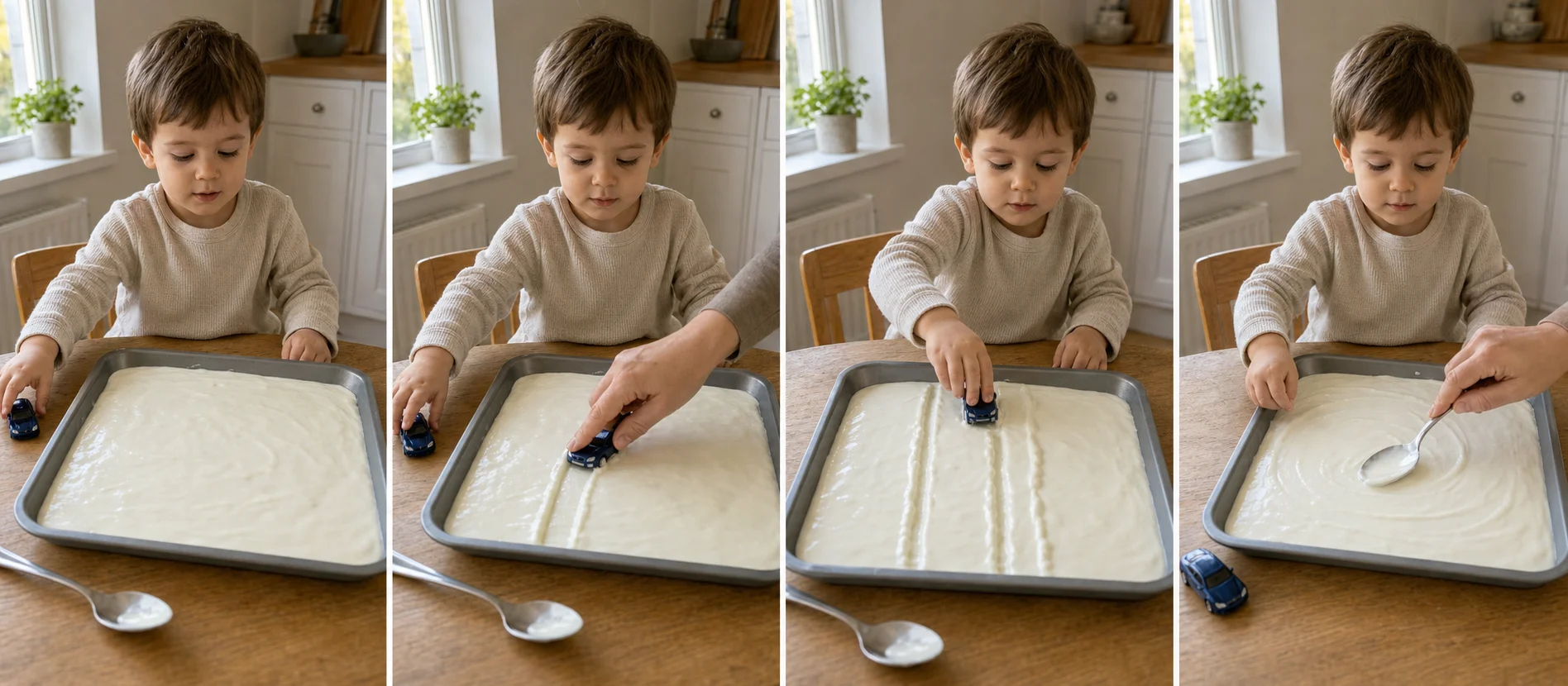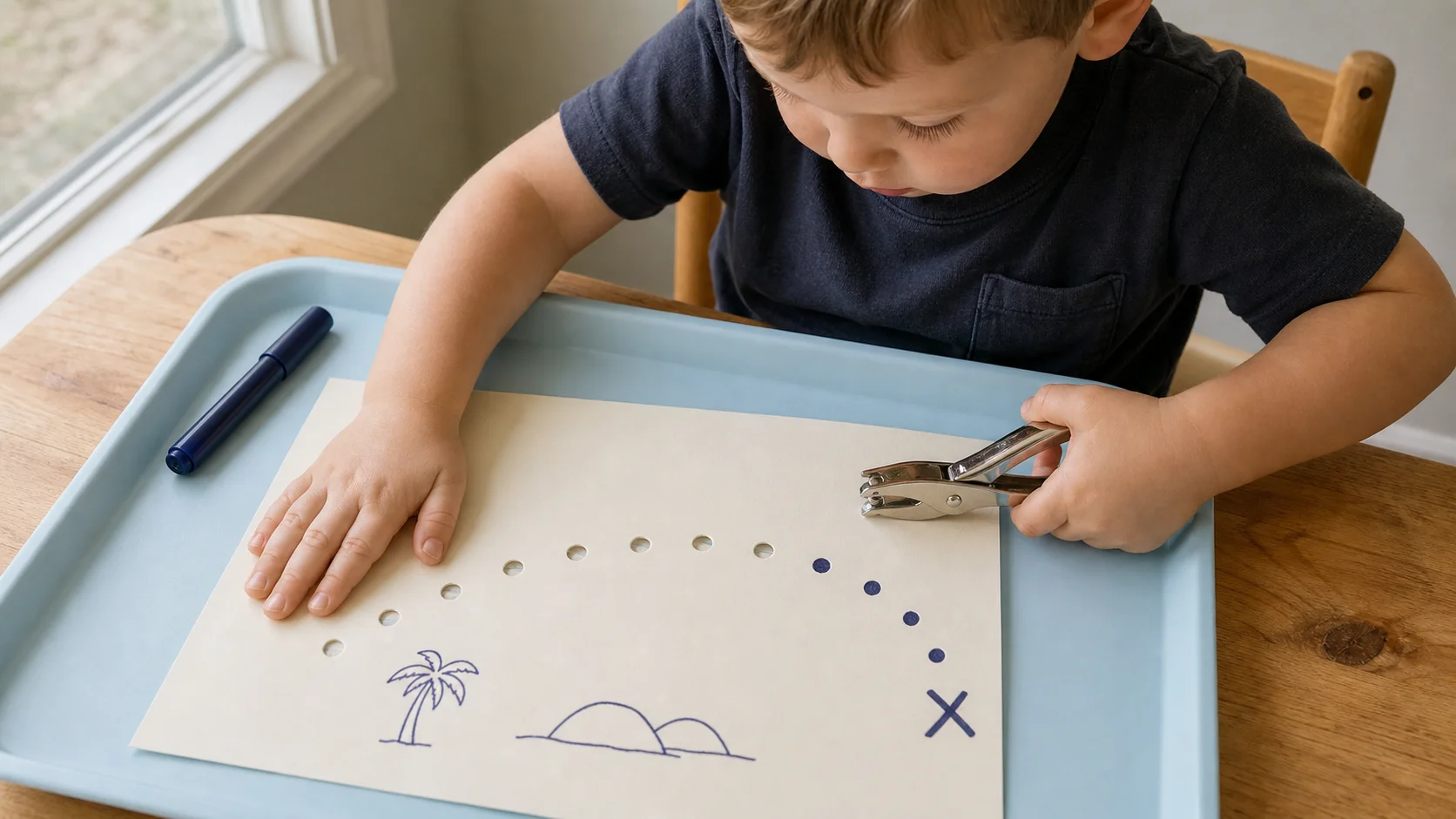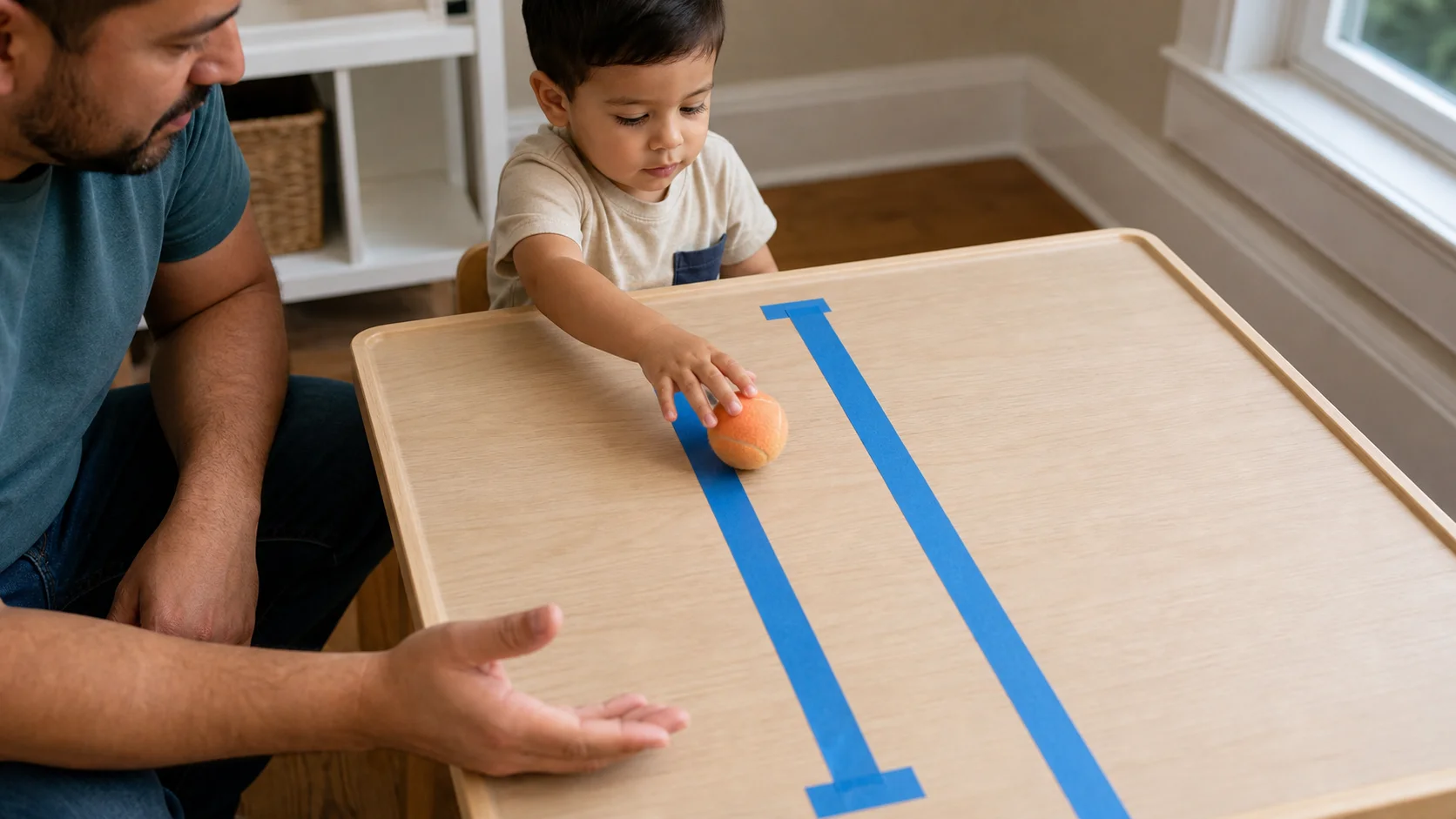
Child rolling a soft ball along a painter's tape lane on a table while a grown-up sits nearby.
ThinkingOT-adjacent supportMove Through PathIndoor

Table Ball Track.

Your child rolls a soft ball along a short tape lane, resets it at the start, and tries again.

Play time
1-3+ min
Age
2-3 years
Energy
Low
Mess
No
Effort
Low
Where
Indoor
Start here

The recipe.

Low parent effort
8 things

What you need

  • 1 soft ball slightly larger than a tennis ball
  • 2 to 4 strips of painter's tape
  • 1 table or tray
  • 1 start mark
  • 1 finish mark
  • Optional: 1 whiteboard pen for a wipe-clean surface
  • 1 adult
  • 1 child
1 min minimum

Setup

Then start the loop
Step 01
On a table or tray at your child's hand height, clear enough space for a short ball path.
Step 02
On the table or tray, place two parallel strips of painter's tape to make one straight lane about 12 to 24 inches long.
Step 03
At the near end of the lane, add a start mark with a small tape tab.
Step 04
At the far end of the lane, add a finish mark with a small tape tab, or use a whiteboard pen only on a wipe-clean surface.
Step 05
On the start mark, place the soft ball.
Step 06
Beside the table, sit or stand close enough to stop the ball if it rolls toward the edge.
Step 07
In front of the start mark, seat or stand your child so one hand can reach the ball without leaning hard.
"Ball on start."
The loop

How play unfolds.

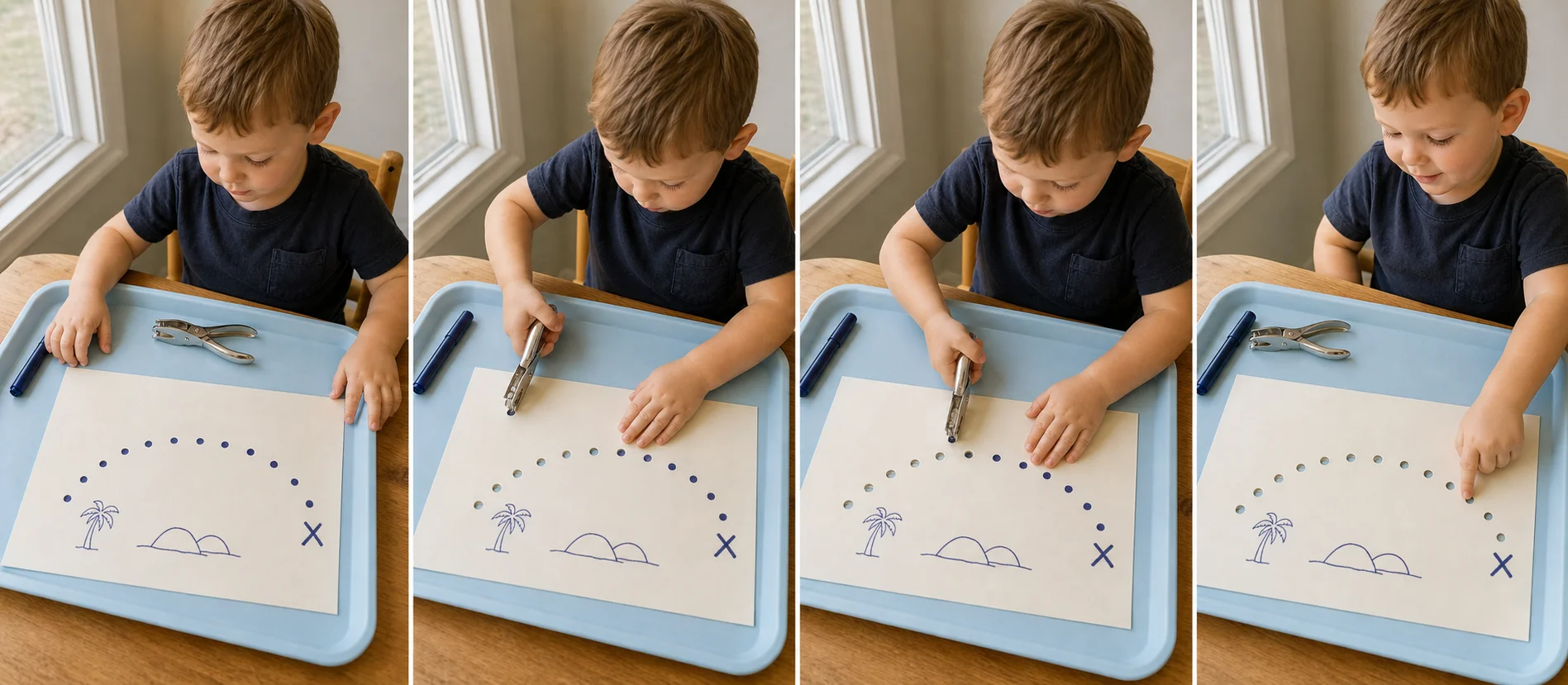
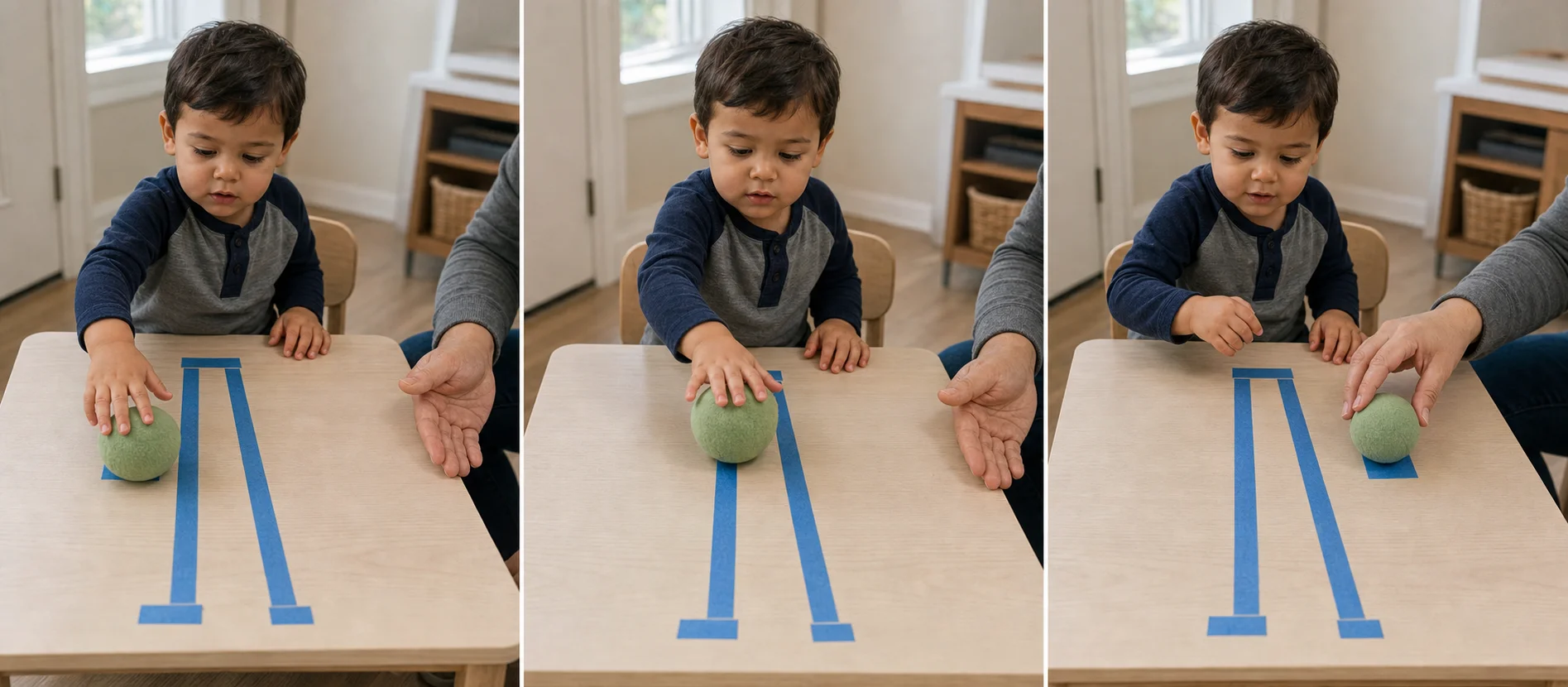
Three-panel sequence showing a ball placed on the start mark, rolled through the tape lane, and reset for another turn.
  1. 01
    Roll the ball slowly from the start mark to the finish mark and say, "Roll to the finish."
  2. 02
    Put the ball back on the start mark and invite your child to roll it.
  3. 03
    If the ball reaches or touches the finish mark, say, "It got there," and slide it back to the start.
  4. 04
    If the ball leaves the path, stop it calmly, place it back at the start, and say, "Slower roll."
  5. 05
    Do 3 short turns, then offer one more turn or finish.

Safety Check

  • Use a soft ball large enough to reduce mouthing risk.
  • Stay close enough to stop throws, mouthing, banging, and edge rolls.
  • Keep the table or tray at a stable hand height so your child does not lean or chase the ball.
  • Press tape flat before play, and use only surface-safe marks.
  • Stop or simplify if your child throws the ball, mouths it, pushes too hard to stay safe, or leaves the table.
Supporting the play

What to say in the moment

Match what you say to what you see.

Prompt ladder
Level 1 (Start)
Put the ball on the start mark and say, "Roll to the finish."
Level 2 (Keep going)
After each reset, point to the lane and say, "Try one slow roll."
Level 3 (Stretch)
When the ball reaches the finish, ask for one more roll that stays inside the tape.
Level 4 (Extend)
Let your child choose whether the next roll starts fast, slow, or super slow.
If your child seems...
What you'd see
Focused
What to do
Say
"It stayed on the track."
Add
Name one place the ball is: "start," "middle," or "finish."
Extend
Invite one same-speed repeat before you reset again.

Make it easier

Younger end
  • -Start with your child's palm already resting on top of the ball.
  • -Let the first child turn be a tiny nudge that only has to move forward.
  • -Use your open hand near the lane edge as a quiet stop wall.

Make it harder

Older end
  • +Ask for one roll that stops with the ball touching the finish mark.
  • +Try one round with your child's other hand.
  • +See whether two rolls in a row can stay between the tape strips.

If it's not working

If you see
If child ignores it
Roll the ball once yourself, make it stop on the finish mark, then hand it back without adding extra directions.
If you see
If child misuses it
If the ball is mouthed, thrown, or banged hard, hold the ball for a pause and restart with, "Roll on the table."
If you see
If child gets frustrated
Widen the lane, move the finish mark closer, or let your child push the ball halfway while you finish the roll.
Skill spotlight
Path Movement

Rolling on a path

This helps your child guide a hand movement toward a clear place, then use what they see to try again more carefully.

  • The taped lane gives your child a visible path, so the job is clear before you say much.
  • Rolling, watching, and resetting help your child practice one controlled hand movement over and over.
  • A miss is easy to repair: stop the ball, place it back at start, and try a slower roll.
Real-world transfer
  • Moving a spoon, crayon, or toy with better control
  • Following a simple path or boundary
  • Trying again after a small miss

Parent questions