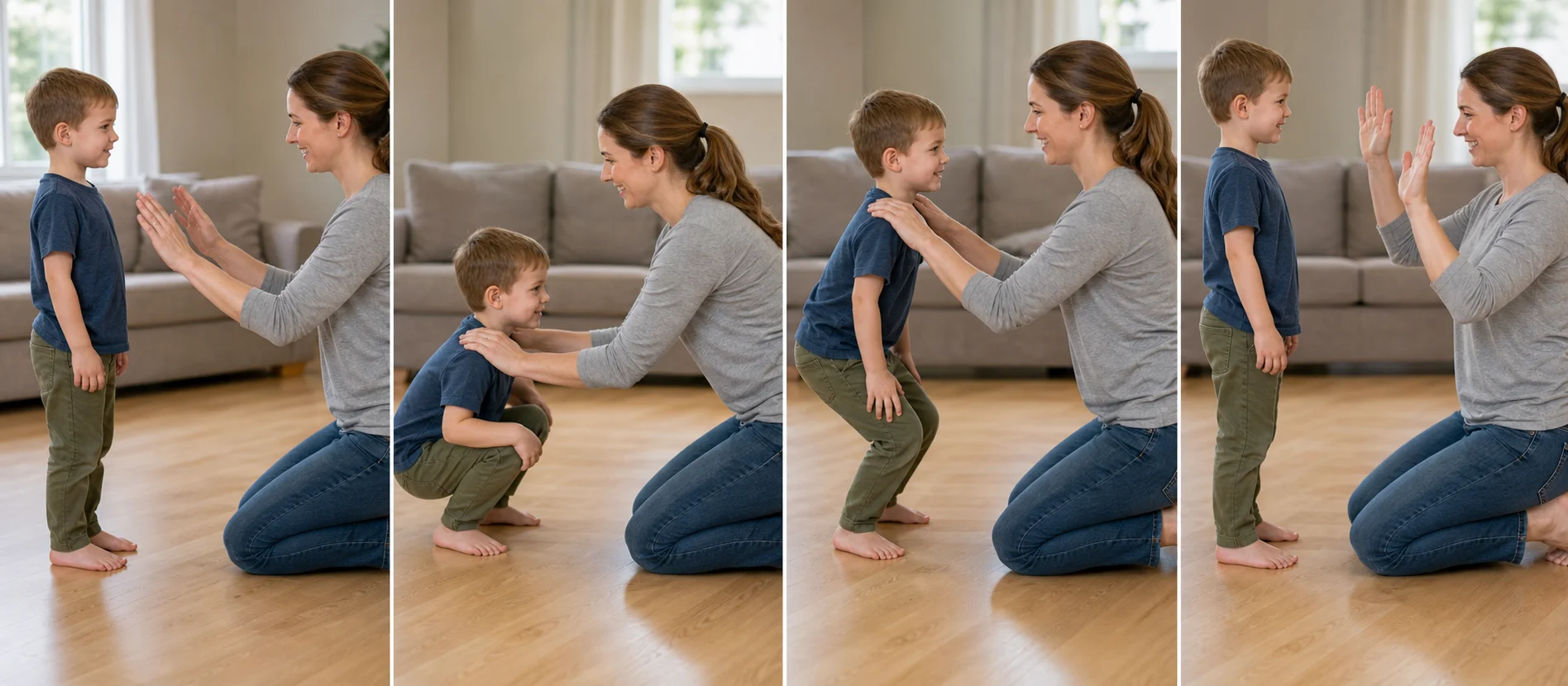
Child crouching on a clear floor while a grown-up gives light shoulder resistance for a superhero stand-up.
Gross motorOT-adjacent supportPush Against ResistanceIndoor Or Outdoor

Superhero Stand-Up.

Give your child one clear job: crouch low, push up through light hands, stand tall, and decide whether to go again.

Play time
2-5+ min
Age
3-5 years
Energy
High
Mess
No
Effort
Medium
Where
Indoor Or Outdoor
Start here

The recipe.

Medium parent effort
3 things

What you need

  • 1 clear floor space
  • 1 adult
  • 1 child
2 min minimum

Setup

Then start the loop
Step 01
On a clear floor spot, move toys, furniture edges, and slippery rugs out of the crouch-and-stand space.
Step 02
In front of your child, stand or kneel so your hands can rest lightly on the tops of their shoulders without pulling them forward.
Step 03
In the clear floor spot, have your child stand facing you with both feet flat.
Step 04
Ask, "Want to do one superhero stand-up?" Start only if your child comes close, crouches, or clearly wants a turn.
Step 05
In the clear floor spot, invite your child to crouch low with feet flat and knees bent.
"Feet ready. Push up."
The loop

How play unfolds.

Sequence showing a child crouch, push up through gentle hands, stand tall, and choose again or all done.
  1. 01
    Crouch a little with your child and say, "Ready, push."
  2. 02
    Place light hands on the tops of their shoulders.
  3. 03
    Let your child push from crouching to standing while you gently slow the movement.
  4. 04
    Release as soon as your child stands and say, "You stood up."
  5. 05
    Ask, "Again or all done?" Repeat only if your child chooses another round.

Safety Check

  • Supervise the whole activity and use only a movement level your child can enjoy safely.
  • Keep your hands light. They should feel like a gentle slow-down, not a push that pins your child down.
  • Release both hands as soon as your child reaches standing.
  • Stop before or during a round if your child says no, pulls away, stiffens, looks scared, wobbles, drops to their knees, twists away, or dislikes shoulder touch.
  • Choose another activity if the floor is slippery, the space is cluttered, your child is already crashing or dysregulated, or your resistance cannot stay light.
  • Keep rounds short. This is not a strength test.
Supporting the play

What to say in the moment

Match what you say to what you see.

Prompt ladder
Level 1 (Start)
"Crouch low, then push up."
Level 2 (Keep going)
"Again or all done?"
Level 3 (Stretch)
"Try a tiny crouch, then push up."
Level 4 (Extend)
"Show me one slow superhero stand-up."
If your child seems...
What you'd see
Focused
What to do
Say
"Ready, push."
Add
"Was that tiny or big?"
Extend
Offer one slow round before asking, "Again or all done?"

Make it easier

Younger end
  • -Start from a half-crouch so the push is shorter.
  • -Resist only for the first half of the stand-up, then release early.
  • -Do one round at a time with a clear "again or all done" choice.

Make it harder

Older end
  • +Ask for one slow stand-up without rushing.
  • +Add a one-beat freeze in the crouch before the push.
  • +Let your child choose whether the next round is tiny, medium, or big.

If it's not working

If you see
If child ignores it
Do one slow stand-up yourself and say, "My turn. Up." Then offer one child turn with no pressure.
If you see
If child misuses it
If your child starts jumping, crashing, or grabbing your arms, go hands-off and reset with, "Feet still, then one push."
If you see
If child gets frustrated
Remove shoulder pressure, let your child stand without resistance, and count that as the win before asking, "Again or all done?"
Skill spotlight
Push Against Resistance

Pushing up against gentle resistance

This helps the child notice where their body is, use force without crashing, and finish a movement before starting again.

  • The crouch-to-stand loop gives your child strong body input without turning the room into a crash zone.
  • Light shoulder resistance lets your child practice using force, then stopping when the round is done.
  • The repeated "again or all done" choice keeps the movement predictable and gives your child a clear exit.
  • A no-material setup makes this easy to try when a child needs movement before the next routine.
Real-world transfer
  • Standing up from the floor with better control.
  • Pushing heavy play objects without crashing.
  • Using short body-pressure games to settle after busy movement.
  • Noticing too much or too little force during rough play.

Parent questions