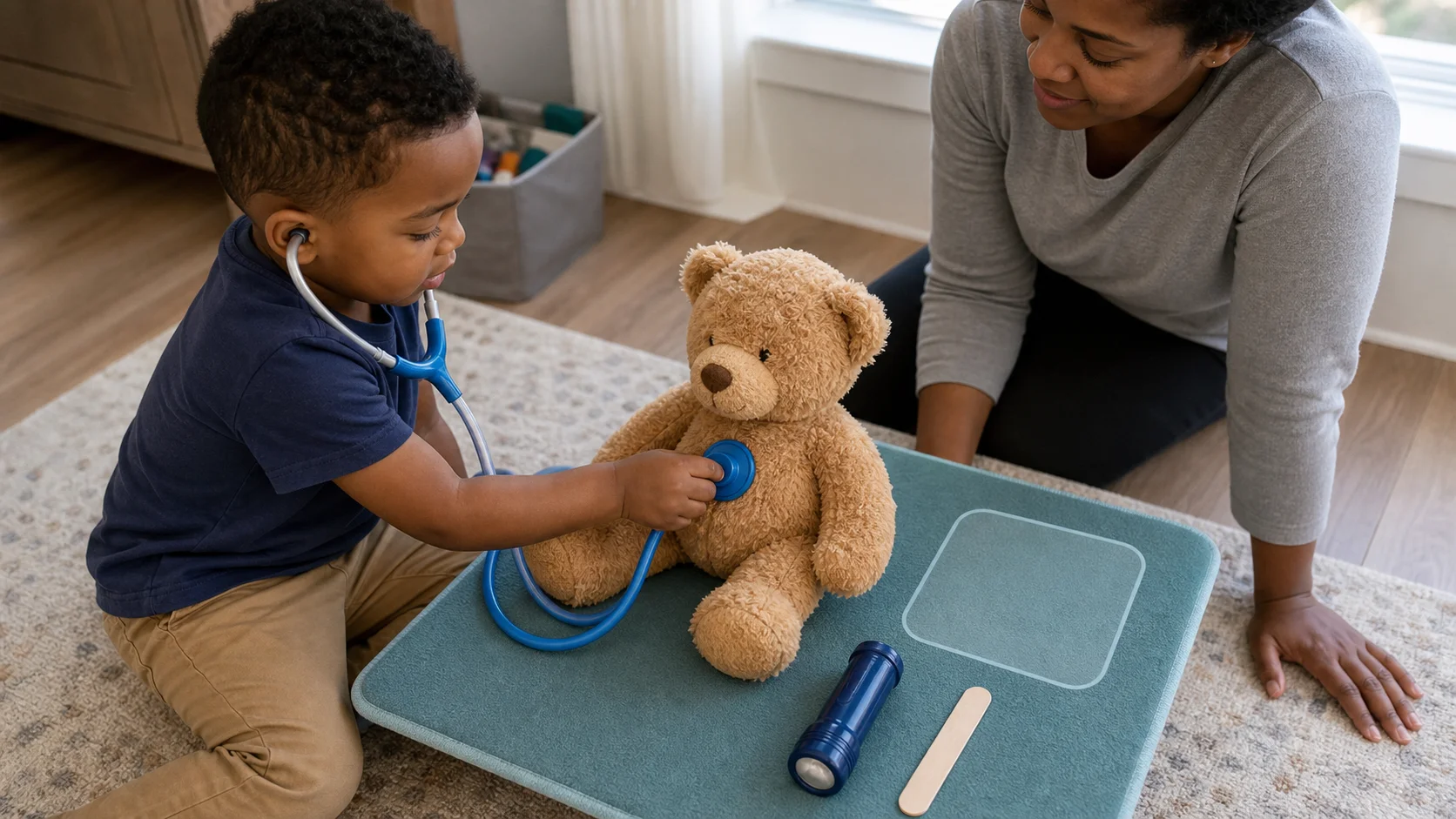
Child using a toy stethoscope on a stuffed animal while doctor tools rest on a clear reset spot.
Skill builderAutism supportSensory-friendly supportFinish And ResetIndoor

Stuffie Checkup.

Your child checks a stuffed animal with one doctor tool, marks the step done, and resets the tool for another calm turn.

Play time
5-10+ min
Age
2-4 years
Energy
Low
Mess
No
Effort
Low
Where
Indoor
Start here

The recipe.

Low parent effort
6 things

What you need

  • 1 stuffed animal or doll
  • 1 toy stethoscope or real stethoscope used only for play
  • 1 small flashlight
  • 1 clean craft stick or toy tongue depressor
  • 1 small mat, tray, or clear table spot
  • 1 adult
5 min minimum

Setup

Then start the loop
Step 01
On a low table, floor mat, tray, or clear table spot, place the stuffed animal or doll in the middle facing your child.
Step 02
Beside the toy patient, place the stethoscope, flashlight, and craft stick or toy tongue depressor in one visible tool area.
Step 03
Next to the toy patient, leave one empty reset spot where tools can go after each check.
Step 04
Beside your child, sit close enough to model one calm check, hold the flashlight, or take back a tool if needed.
Step 05
In the tool area, keep the flashlight off until you are holding it or watching it closely.
"Doctor for stuffie."
The loop

How play unfolds.

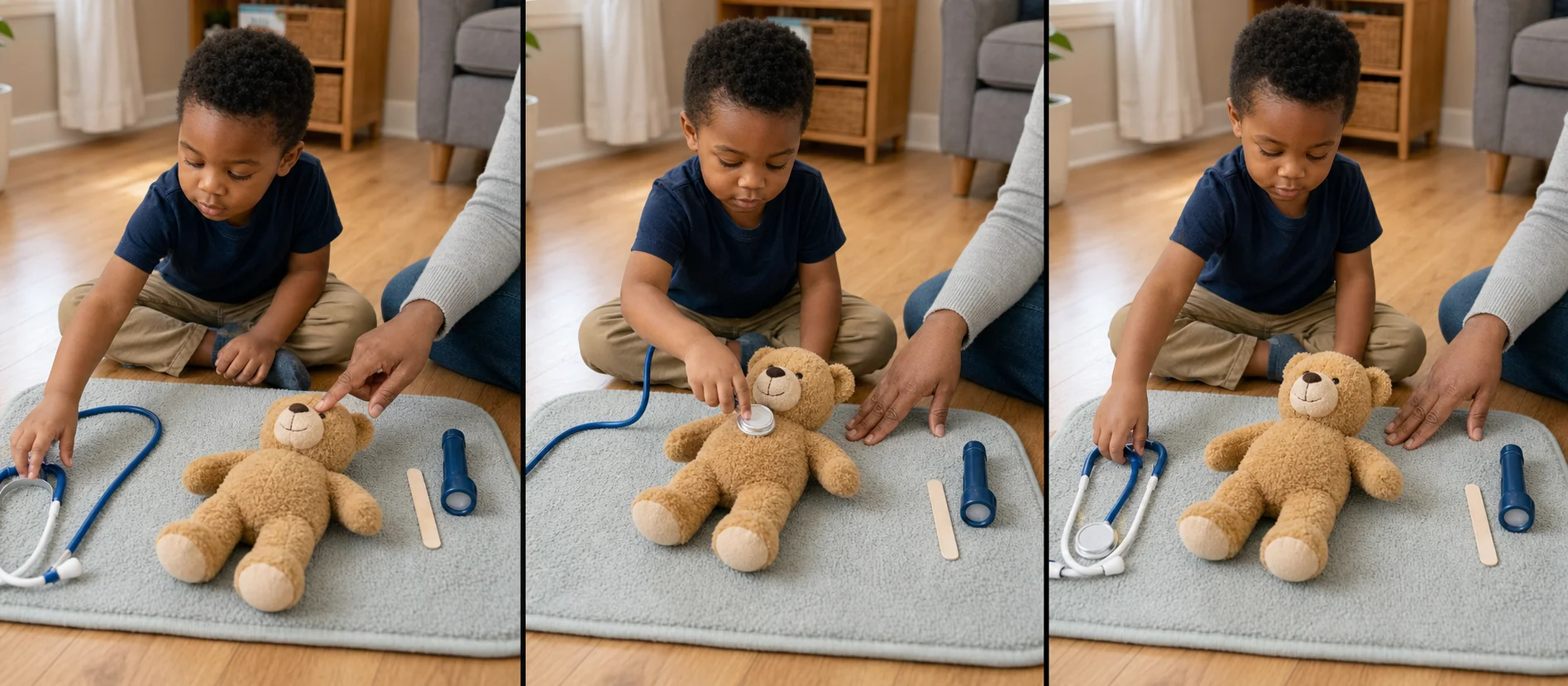
Three-panel sequence showing a child choosing a doctor tool, checking a stuffed animal, and placing the tool on the done spot.
  1. 01
    Offer one tool or one calm choice between two tools.
  2. 02
    Your child uses the tool on one stuffed-animal body part: stethoscope on chest, flashlight near ear or mouth, or craft stick beside the mouth.
  3. 03
    Your child marks the step done with a word, nod, point, or by putting the tool on the reset spot.
  4. 04
    Name the completed step: "Chest done," "Ear done," or "Mouth done."
  5. 05
    Offer one next check on the same toy patient, or say "checkup done" and stop.

Safety Check

  • Keep the flashlight away from eyes. Aim it at the toy, table, or adult hand.
  • Keep craft sticks and toy tongue depressors out of real mouths.
  • Keep stethoscope tubing flat on the play spot between turns. Stop if it wraps, swings, pulls, or goes near a mouth.
  • Do not practice tools on your child's body unless your child clearly asks for that turn.
  • Choose a different activity if doctor tools are too upsetting today.
Supporting the play

What to say in the moment

Match what you say to what you see.

Prompt ladder
Level 1 (Start)
Point to the toy patient and say, "One check, then done."
Level 2 (Keep going)
Offer one calm choice: "Chest or ear?"
Level 3 (Stretch)
After the tool touches the toy, pause for your child to mark "done."
Level 4 (Extend)
Invite one more check on a new body part of the same toy.
If your child seems...
What you'd see
Focused
What to do
Say
"You checked the chest."
Add
Offer one body-part or tool word while your child keeps moving.
Extend
Let your child choose the next body part on the toy.

Make it easier

Younger end
  • -Let your child point to the tool instead of holding it.
  • -Let "done" be a nod, a tool drop, or a tap on the reset spot.
  • -Keep the flashlight off and use it only as a pretend tool.

Make it harder

Older end
  • +Ask your child to choose the next body part before picking up the tool.
  • +Pause after the check so your child initiates the "done" signal.
  • +Have your child return the tool to the reset spot before the next turn starts.

If it's not working

If you see
If child ignores it
Do one complete stuffed-animal check yourself and offer the easiest job: "Can you put the tool in done?"
If you see
If child misuses it
If a tool goes toward eyes, mouths, necks, or swinging hands, take it back calmly and say, "Doctor tools stay gentle with stuffie." Restart with pointing while you hold the tool.
If you see
If child gets frustrated
Remove two tools and keep only the gentlest tool. Let one touch, point, nod, or "done" be the whole checkup.
Skill spotlight
Finish And Reset

Finishing one pretend care step

This helps the child practice a care routine where each step has a clear start, finish, and reset. That same skill matters during doctor visits, cleanup, turn endings, and everyday care routines.

  • The stuffed animal keeps the doctor-tool practice indirect, so your child can try the order without any required body contact.
  • The reset spot gives each check a visible finish instead of letting the routine blur into more tools and more talking.
  • The child can participate with a point, nod, word, gentle touch, or tool reset, which keeps the communication load low.
  • Repeating one small check helps the care routine feel predictable while still letting your child stop after a short win.
Real-world transfer
  • Doctor visits where each step has an end.
  • Moving from one care step to the next.
  • Returning tools or toys after a turn.
  • Saying or showing "done" instead of pushing tools away.

Parent questions