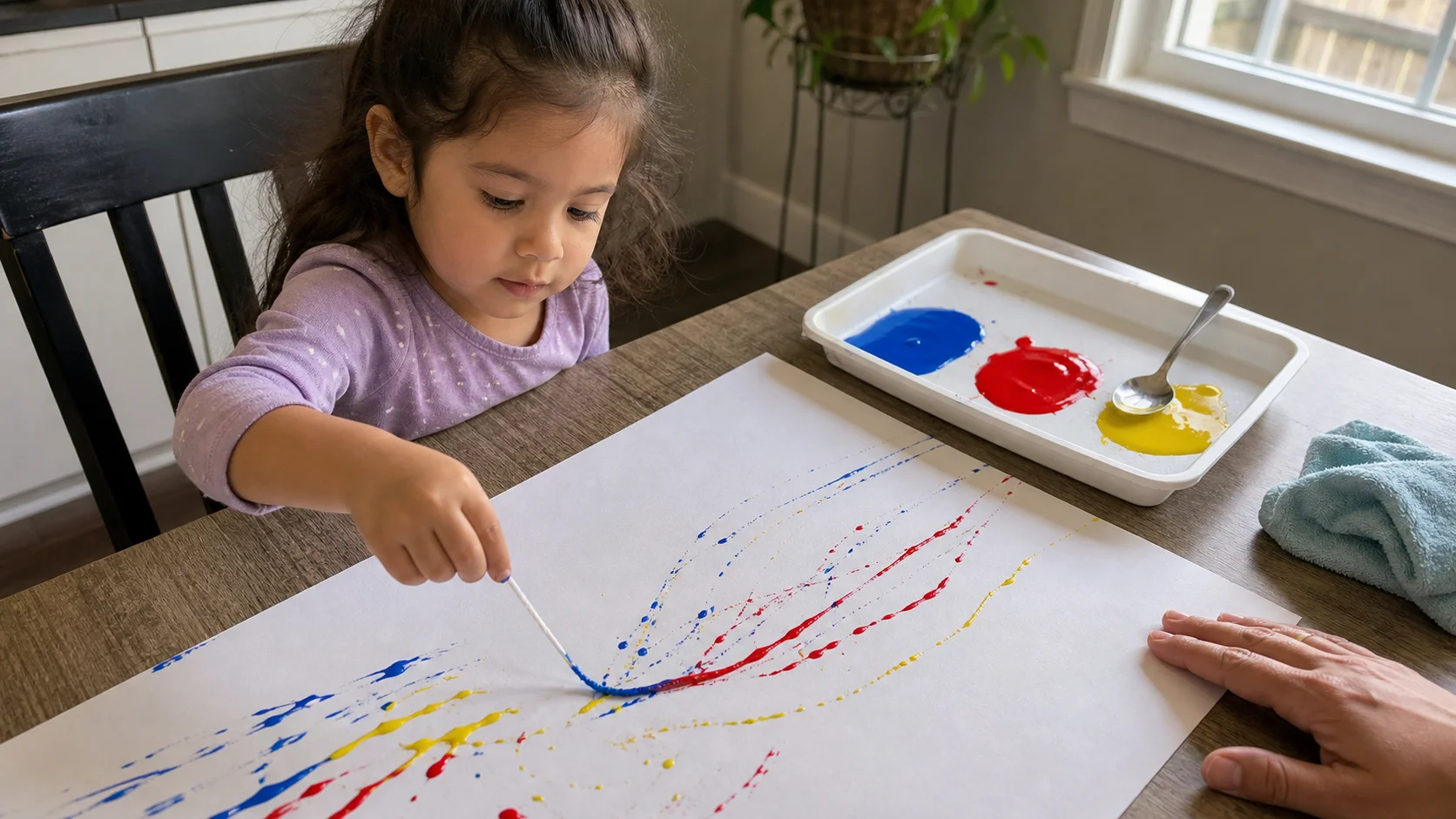
Child pulling the dry end of a paint-coated string across paper while a grown-up keeps the tray nearby.
Fine motorSensory-friendly supportPlace With ControlIndoor

String Pull Painting.

Your child pinches a dry string end, pulls the painty middle across paper, and watches a streaky trail appear.

Play time
5-10+ min
Age
3-5 years
Energy
Low
Mess
Medium
Effort
Medium
Where
Indoor
Start here

The recipe.

Medium parent effort
6 things

What you need

  • 1 large sheet of paper or card
  • 1 shallow tray or washable plate
  • 2 to 3 colors of washable paint
  • 1 spoon
  • 1 short piece of string or wool
  • 1 wipe or damp cloth
5 min minimum

Setup

Then start the loop
Step 01
On a wipeable table spot, place the paper or card flat in front of your child with room for several pulls.
Step 02
Beside or just above the paper, place the tray close enough that your child can reach it without leaning over the paint.
Step 03
On the tray, spoon 2 to 3 small paint puddles in separate spots.
Step 04
In the tray, lay the middle of the string through one paint puddle and leave one dry end hanging over the edge for pinching.
Step 05
Beside you, keep the damp cloth close enough to wipe fingers before paint reaches the mouth, eyes, clothing, or table edge.
Step 06
Before your child's turn, pinch the dry end and show one slow pull across the paper.
"Pull and watch."
The loop

How play unfolds.

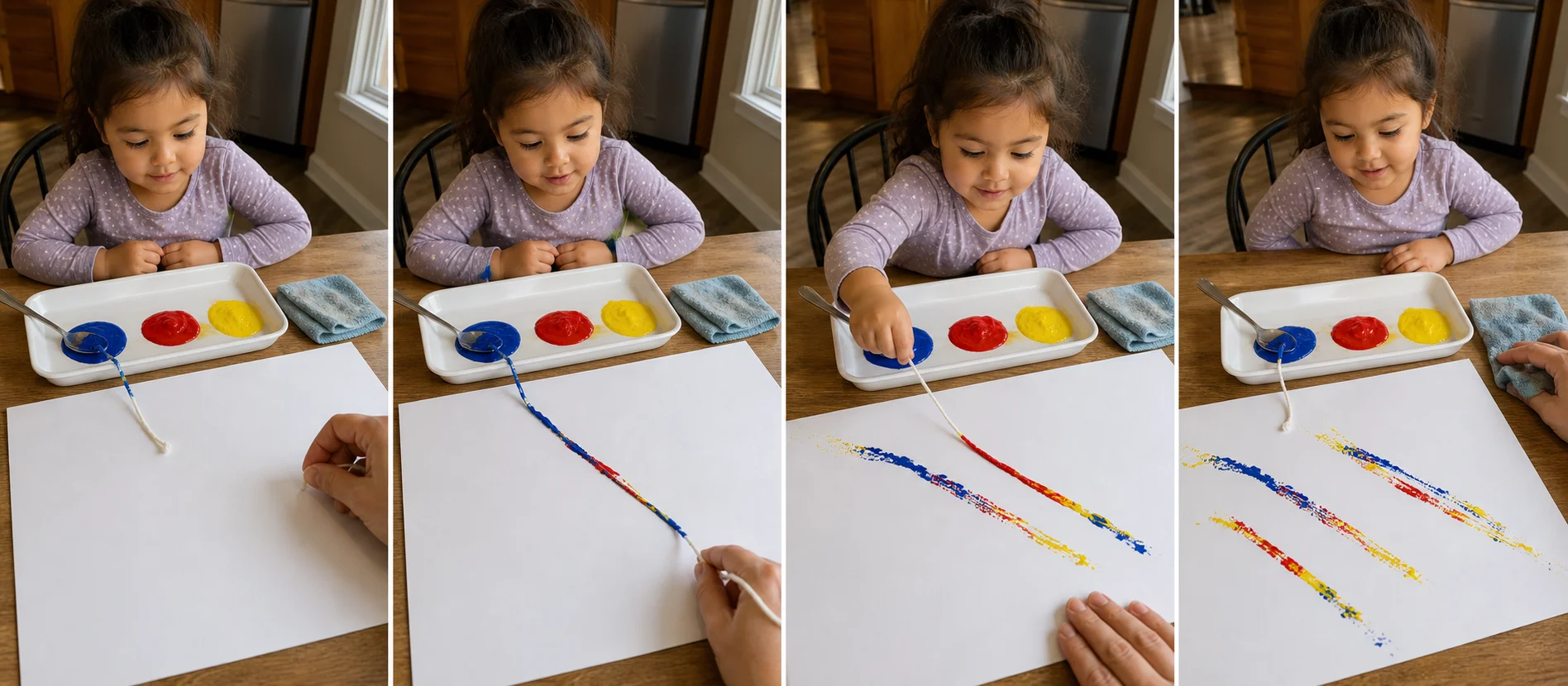
Three-panel sequence showing string loaded in paint, pulled across paper, and reloaded for another trail.
  1. 01
    Pinch the dry end, pull the painted string across the paper, and say, "Pull and watch."
  2. 02
    Hand the dry end to your child and let them pull one trail.
  3. 03
    Notice the trail together, then reload only the painted middle of the string in the tray.
  4. 04
    Repeat in a new direction or color until your child is done or the paper is too wet to pull cleanly.

Safety Check

  • Use washable, child-safe paint and close adult supervision.
  • Keep one end of the string dry and short enough to manage.
  • Stop immediately if paint goes near the mouth or eyes.
  • Pause and reset if the string wraps around fingers, is waved in the air, or starts flicking paint.
  • End early if wet texture, smell, color mixing, or cleanup feels overwhelming for your child.
Supporting the play

What to say in the moment

Match what you say to what you see.

Prompt ladder
Level 1 (Start)
Pull the dry end once and watch the paint trail appear.
Level 2 (Keep going)
Reload the string and make another trail beside the first one.
Level 3 (Stretch)
Choose a long pull or a short pull before the string moves.
Level 4 (Extend)
Pick the final color and lead the last pull.
If your child seems...
What you'd see
Focused
What to do
Say
"Another trail."
Add
Name one color after the pull is already moving.
Extend
Offer a long-pull or short-pull choice for the next turn.

Make it easier

Younger end
  • -Pre-load the painted section so your child starts with only the dry end to manage.
  • -Let your child wrap the dry end around two fingers instead of using a neat pinch.
  • -Use one small paint puddle for a few rounds so color choice does not slow the pull.

Make it harder

Older end
  • +Ask your child to choose across, down, or around before the next pull.
  • +Let your child reload the painted middle of the string while you guard the tray.
  • +Invite your child to stop the string before it reaches the paper edge.

If it's not working

If you see
If child ignores it
Make one dramatic slow pull yourself, point to the trail, and offer one choice: "Blue pull or red pull?"
If you see
If child misuses it
If the string is waved, wrapped around fingers, or brought near the mouth or eyes, pause the turn, wipe hands, and restart with your hand guiding one slow pull.
If you see
If child gets frustrated
Hold the dry end together, pull hand-over-hand once, then let your child finish the last few inches alone. Stop early if the texture feels unpleasant.
If you see
If the string gets too slippery
Wipe fingers, reload only the middle of the string, and offer the dry end again.
If you see
If the paint puddles spread too much
Use less paint on the next reload and count one small trail as a finished turn.
Skill spotlight
Placement Control

Pull-to-mark control

This helps the child guide a small tool with their fingers, aim a movement across a page, and see how hand direction changes a mark. Those same control skills show up in drawing, using craft tools, wiping a spot, and careful table play.

  • Pinching the dry end gives your child small-tool practice without asking for a full hand in paint.
  • Pulling the string shows right away how hand direction changes the mark on the page.
  • Reloading and pulling again keeps the messy part predictable and easy to finish.
  • Stopping when the paper gets too wet gives the activity a natural endpoint.
Real-world transfer
  • Guiding crayons, markers, and brushes.
  • Using fingers to control a small tool.
  • Noticing how hand direction changes a result.
  • Staying with a short messy-play routine.

Parent questions