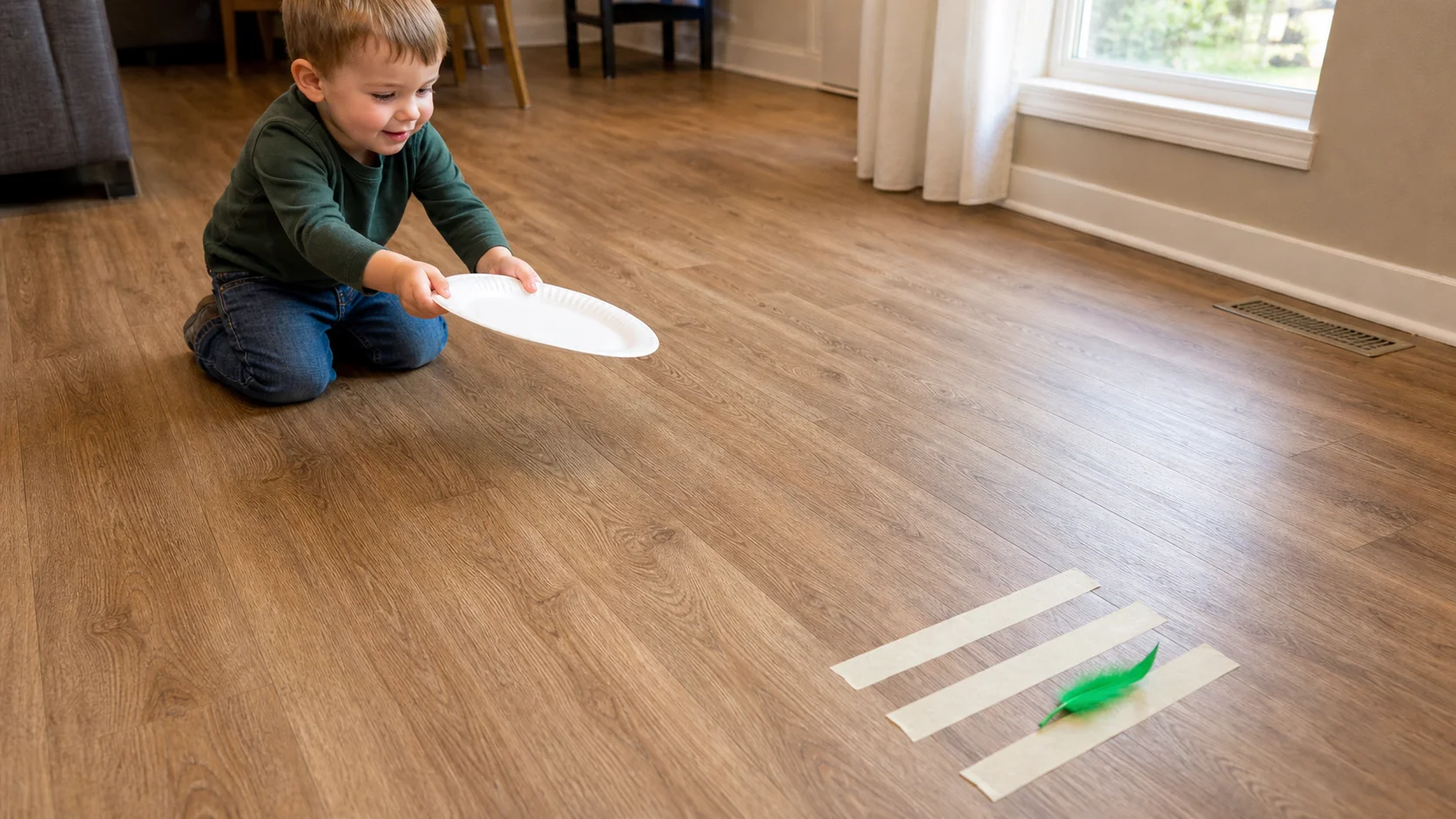
Toddler kneeling on the floor and waving a paper plate so a feather drifts toward a sticky masking-tape landing pad.
Fine motorTwo Hand CoordinationIndoor

Sticky Landing Fan.

Wave a paper plate, drift a feather onto sticky tape, peel it free, and reset for another easy landing.

Play time
5+ min
Age
2-3 years
Energy
Medium
Mess
Low
Effort
Low
Where
Indoor
Start here

The recipe.

Low parent effort
4 things

What you need

  • 3 long strips of masking tape
  • 1 colorful feather
  • 1 paper plate
  • 1 clear indoor floor space
5 min minimum

Setup

Then start the loop
Step 01
On a small indoor floor spot, place 3 long strips of masking tape sticky side up close together to make 1 landing pad.
Step 02
Place the feather on a smooth start spot about 2 feet in front of the landing pad with open floor between them.
Step 03
Set the paper plate beside the feather, kneel or stand beside your child, and test 1 gentle wave so the feather moves and the tape stays flat.
"Wave and fly."
The loop

How play unfolds.

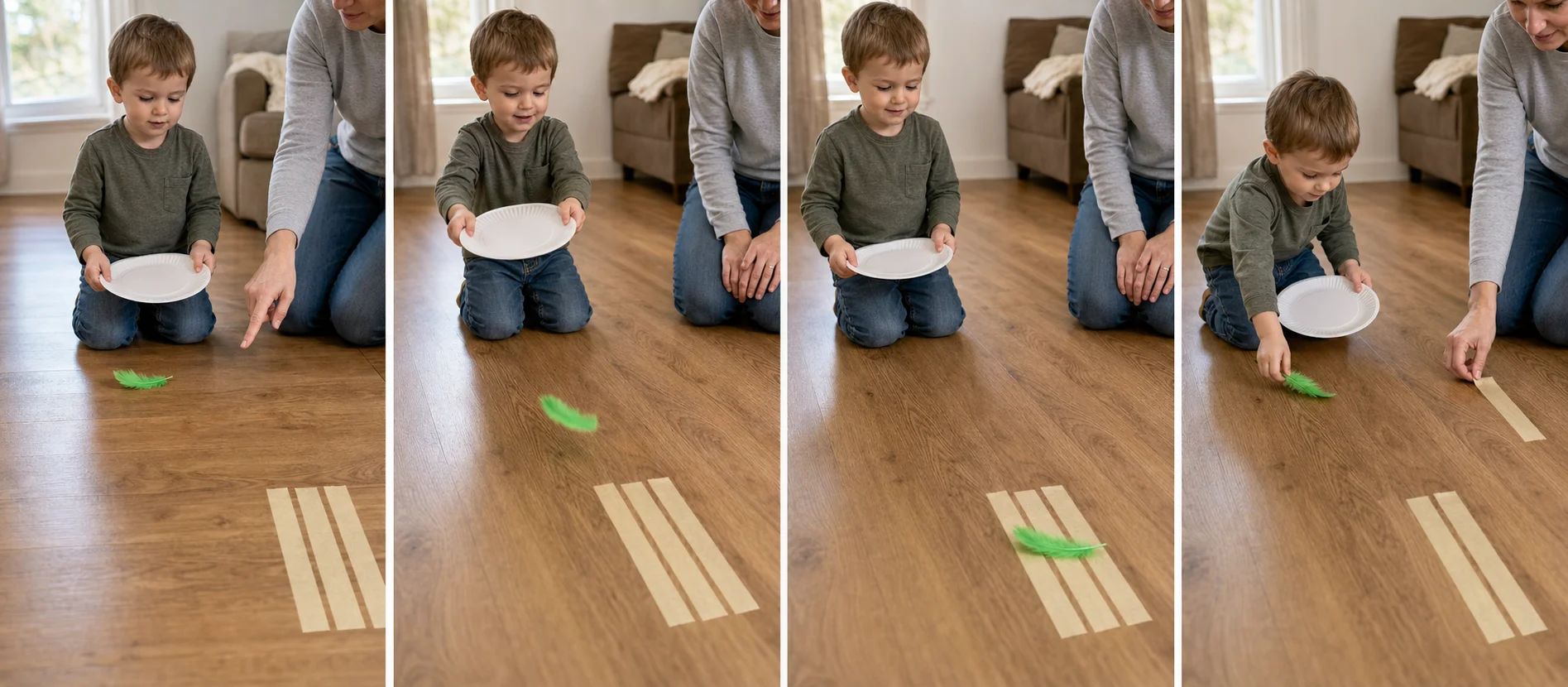
Sequence showing masking tape on the floor, a child waving a paper plate with both hands, the feather landing on the tape, and the child peeling it free to reset.
  1. 01
    Have your child hold the plate with both hands and wave it toward the feather.
  2. 02
    Watch the feather drift toward the sticky landing pad.
  3. 03
    If it reaches the tape, peel it free and place it back on the start spot.
  4. 04
    If it misses, reset it at the same start spot and try again.

Safety Check

  • Stay close and supervise so the feather and tape do not go in the mouth.
  • Keep enough open floor space for the plate to move without hitting furniture or another person.
  • Watch the sticky tape during resets so it does not end up on skin, hair, or clothing.
Supporting the play

What to say in the moment

Match what you say to what you see.

Prompt ladder
Level 1 (Start)
"Wave the plate and make the feather fly."
Level 2 (Keep going)
"Try to land it on the sticky spot again."
Level 3 (Stretch)
"Can you make it land with one calm wave?"
Level 4 (Extend)
"Peel it off and fly it back one more time."
If your child seems...
What you'd see
Focused
What to do
Say
"That feather flew right to the tape."
Add
"Ask, 'Where did it land?' after one good turn."
Extend
"Invite your child to aim for a different strip on the next round."

Make it easier

Younger end
  • -Have your child kneel instead of stand so the feather and landing pad stay in one easy eye line.
  • -Use a shorter up-and-down plate motion close to the child's body instead of a wide arm swing.
  • -After each peel, turn your child back to the same start line so every new turn begins from the same place.

Make it harder

Older end
  • +Ask your child to use a gentler wave so the feather lands without sliding past the tape.
  • +Let your child peel the feather free and reset it at the start spot without adult hands.
  • +Invite your child to aim for a different tape strip on each landing round.

If it's not working

If you see
If child ignores it
Do 1 big fan yourself, let the feather land once, then hand the plate back and say, "Your turn to make it stick."
If you see
If child misuses it
Pause if the plate turns into hitting or the feather or tape heads toward the mouth, then restart with 1 guided slow two-hand wave.
If you see
If child gets frustrated
Move the feather to the easiest clear spot, help with 1 shared landing, and stop after that win if needed.
Skill spotlight
Two-Hand Coordination

Using both hands together to fan the feather with control

This helps your child keep both hands on one shared movement job, change force without dropping the target, and stay with a short start-to-reset routine.

  • The landing pad gives the feather a clear finish point, so your child can see right away whether the wave worked.
  • Holding the plate with both hands turns the game into one shared movement job instead of a string of random swats.
  • Peeling the feather off and resetting it keeps the whole round short enough to repeat without rebuilding the setup.
Real-world transfer
  • Using both hands together on simple tool and art-material jobs
  • Changing movement strength for light objects instead of always going too hard
  • Staying with a short helper routine from start through reset

Parent questions