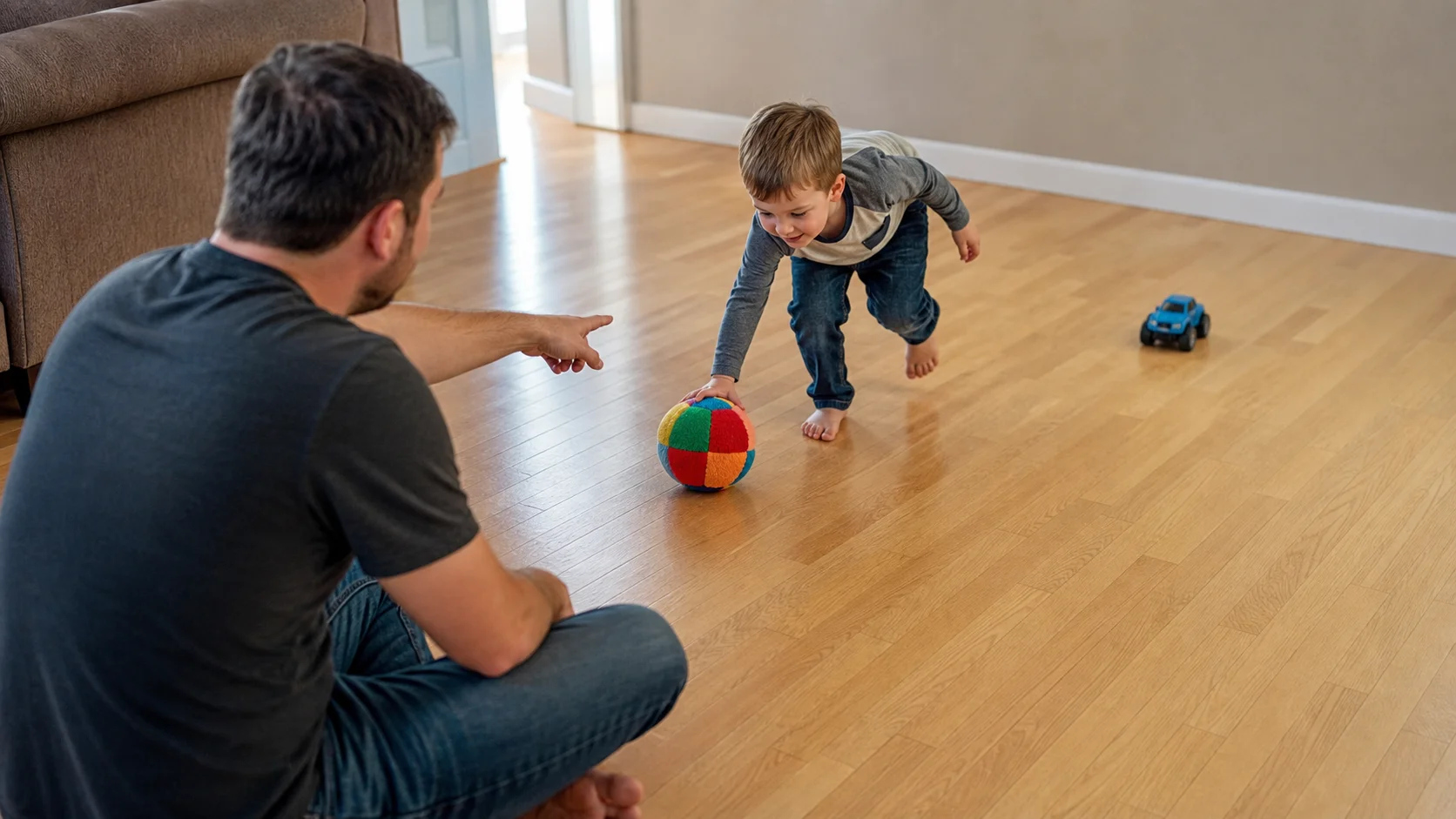
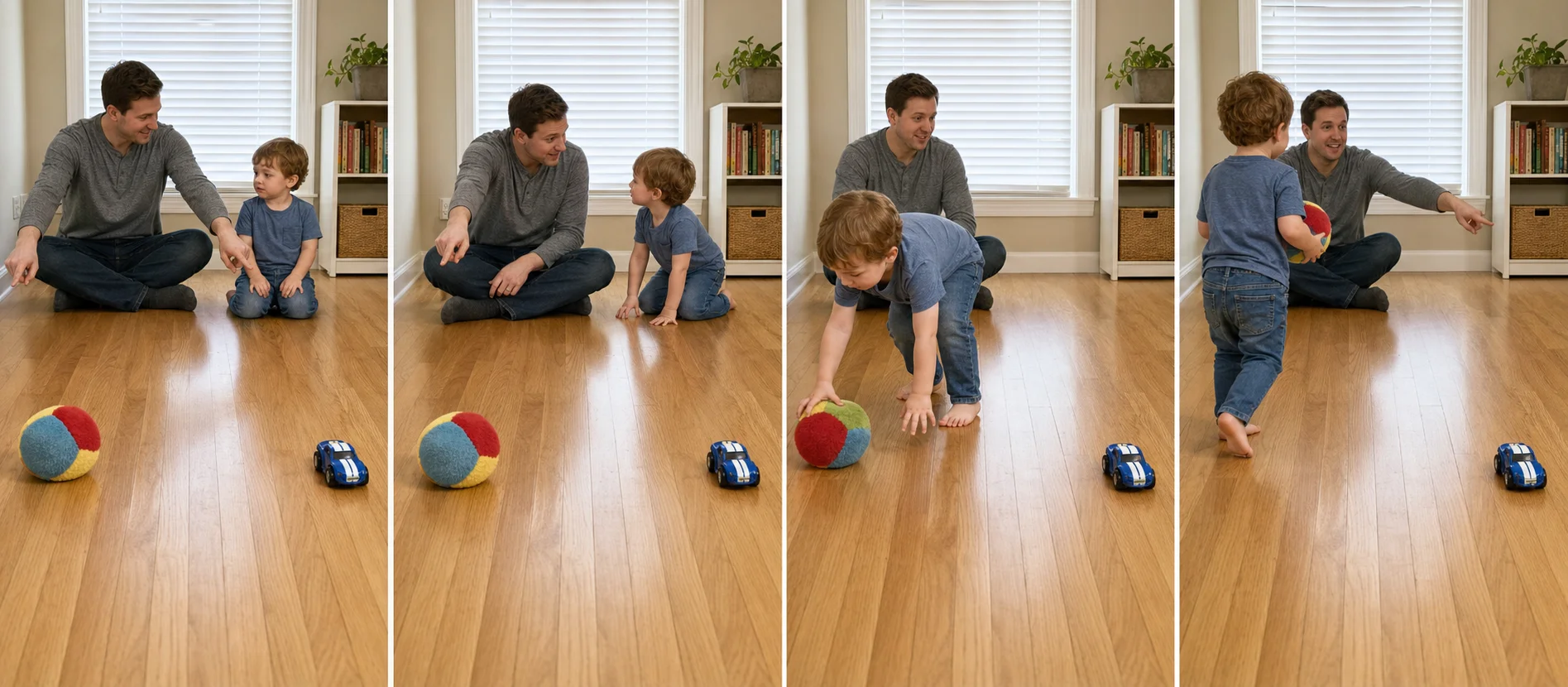
A child racing across a clear floor path toward the toy that matches a beginning sound.
LiteracyBeginning Sound Match`Indoor Or Outdoor Open Movement Space

Sound Race.

Call one beginning sound, let your child race to the matching toy, and reset the toys for another quick round.

Play time
8-10+ min
Age
3 years
Energy
High
Mess
Low
Effort
Low
Where
Indoor Or Outdoor Open Movement Space
Start here

The recipe.

Low parent effort
3 things

What you need

  • 2 stuffed animals or other familiar toys with clearly different beginning sounds
  • 1 additional toy, optional for a harder round
  • 1 open space or safe movement path
8 min minimum

Setup

Then start the loop
Step 01
On the floor or ground, clear a short movement path without toys, cords, furniture legs, rugs, or other tripping hazards.
Step 02
In your hands, hold 2 familiar toys with different first sounds, such as ball and car.
Step 03
With your child watching, name each toy slowly
"b-b-ball" and "c-c-car." Ask your child to say the names with you.
Step 04
On the floor or ground, place the 2 toys about 6 feet apart.
Step 05
At the starting spot, stand with your child a short movement distance from both toys.
Step 06
Before the first round, choose the movement
run if the space is clear, or crawl, tiptoe, or march if running is too much.
"Listen: b-b-b."
The loop

How play unfolds.

A grown-up names two toy sounds, a child races to the matching toy, brings it back, and resets for another round.
  1. 01
    Point to both toys and make the first sound clearly without saying the letter name: "Listen: b-b-b."
  2. 02
    Name the choices with the first sound stretched: "Which toy starts with b-b-b, c-c-car or b-b-ball?"
  3. 03
    Send your child to move to the matching toy, pick it up, and bring it back.
  4. 04
    Repeat the match when the toy returns: "You found b-b-ball. Ball starts with b-b-b."
  5. 05
    Put the toy back in its spot, switch the target sound, and play another round with the same 2 toys.

Safety Check

  • Clear the movement path before play so the child is not stepping over toys, cords, furniture legs, rugs, or other tripping hazards.
  • If indoor running is unsafe or the space is tight, switch to crawling, tiptoeing, marching, or outdoor play.
  • Use ordinary child-safe stuffed animals or toys that are large enough for the child to see and carry safely.
Supporting the play

What to say in the moment

Match what you say to what you see.

Prompt ladder
Level 1 (Start)
"Listen for the first sound, then move to the toy that starts with it."
Level 2 (Keep going)
"Bring it back, hear the sound again, and race to the next one."
Level 3 (Stretch)
"Can you get the match with marching feet this time?"
Level 4 (Extend)
"Now you make the sound and I will race to the toy."
If your child seems...
What you'd see
Focused
What to do
Say
"You heard b-b-b. Ready for a new sound?"
Add
Ask for one toy name before the next race.
Extend
Let your child choose run, crawl, tiptoe, or march for the next round.

Make it easier

Younger end
  • -Place the toys closer together so the choice happens before the movement takes over.
  • -Give the toy names right before the sound prompt.
  • -Use 2 toys whose names start with the same sound so either toy can be correct.

If it's not working

If you see
If child ignores it
Hand them one toy first, say its stretched sound together, then place it down and try one short round.
If you see
If child misuses it
Pause the movement and say, "Bring it back to start." Reset both toys before giving the next sound.
If you see
If child gets frustrated
Use the easier same-sound version so either toy can be correct. Celebrate the sound match and stop after 1 or 2 wins.
Skill spotlight
Beginning Sounds`

Hearing beginning sounds and racing to the match

This helps the child notice that words start with sounds. That makes names, songs, rhymes, and book talk easier to listen to closely.

  • Your child has to listen before moving, so the race rewards hearing the sound instead of guessing fast.
  • Comparing two familiar toy names makes the first sound easier to notice.
  • Bringing the toy back gives every round the same clear reset, which helps the sound-match pattern stick.
Real-world transfer
  • Noticing first sounds in names and favorite objects
  • Joining songs, rhymes, and sound games with more attention
  • Listening before guessing during simple directions