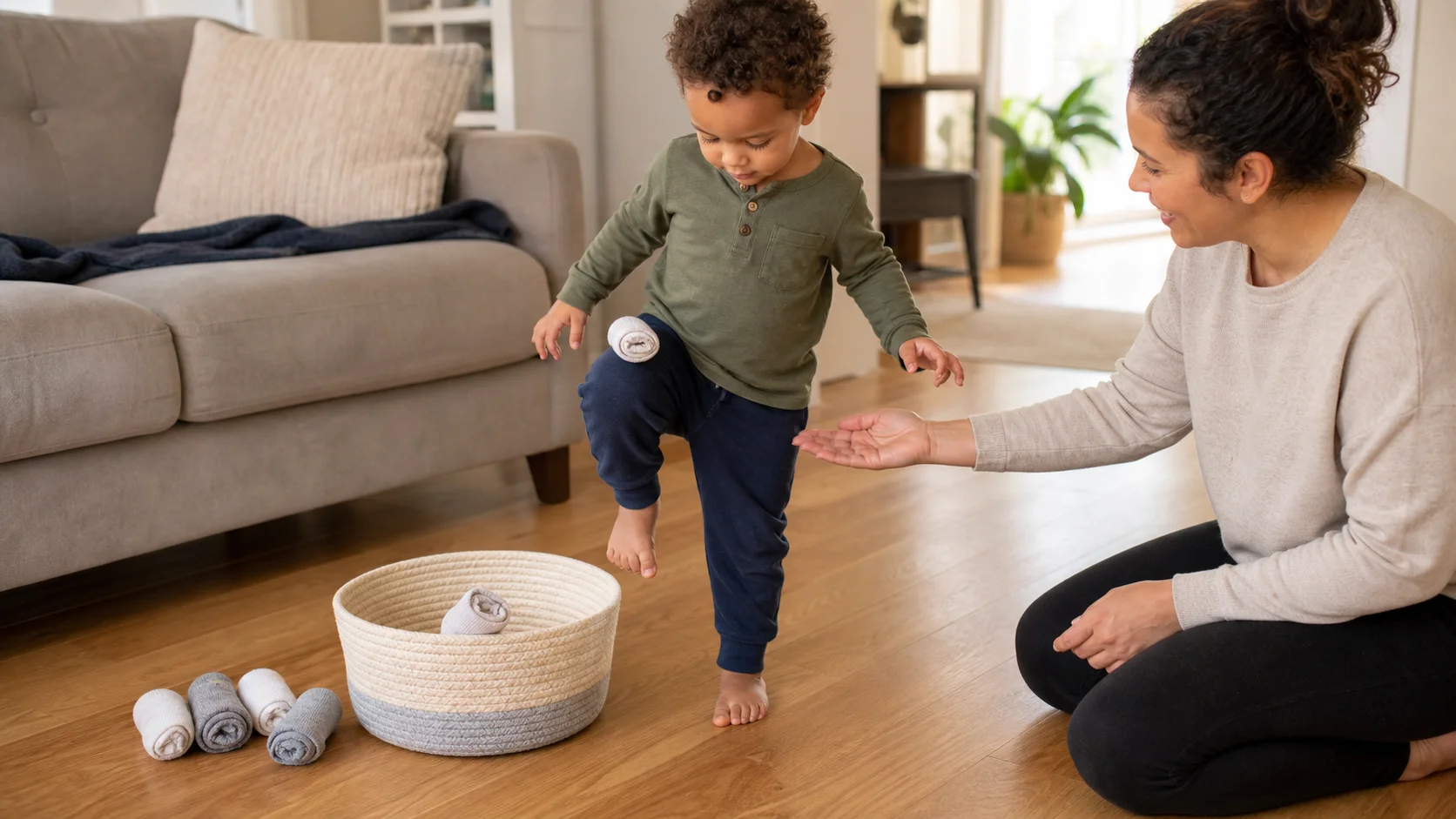
A toddler standing on the floor with a rolled sock balanced on one knee while a basket sits nearby and a grown-up points to the next body spot.
Fine motorStop And StartIndoor

Sock Spot Balance.

A few socks and one basket turn body-part listening into a quick hold-and-drop game.

Play time
5+ min
Age
2-3 years
Energy
Low
Mess
Low
Effort
Low
Where
Indoor
Start here

The recipe.

Low parent effort
4 things

What you need

  • 4 to 6 rolled or folded socks
  • 1 small basket or bowl
  • 1 child
  • 1 adult
5 min minimum

Setup

Then start the loop
Step 01
Place the sock pile and the basket side by side on the floor so your child can reach both without crossing the room.
Step 02
Stand or kneel your child in one open spot where they can lift an arm or tip the chin without bumping furniture.
Step 03
Stay beside your child with one easy body spot ready, such as knee, and be ready to point or pick up dropped socks quickly.
Sock on knee.
The loop

How play unfolds.

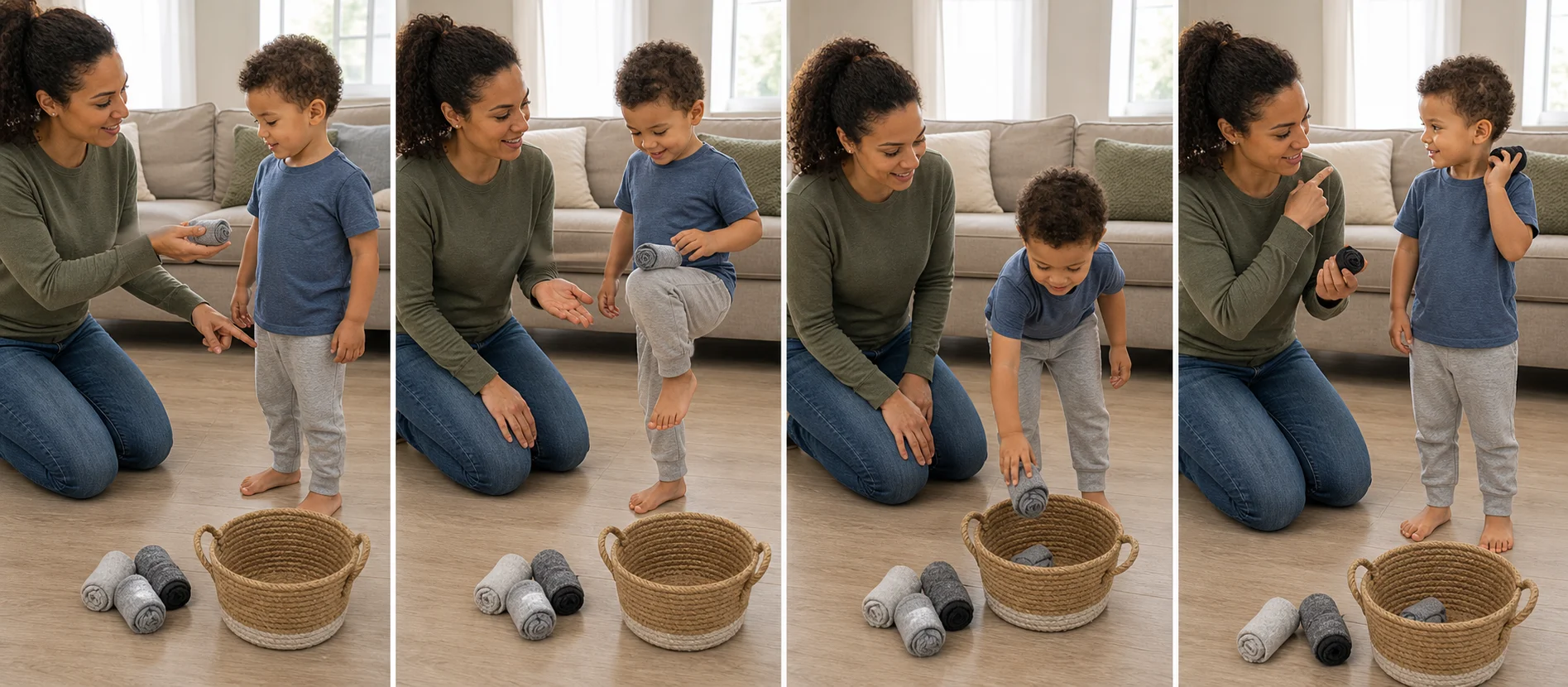
A multi-panel sequence showing a child picking up a sock, balancing it on a named body spot, holding still, and dropping it into a basket.
  1. 01
    Hand your child one sock and name one body spot for the turn.
  2. 02
    Let your child place the sock there and hold still for one short count.
  3. 03
    Have your child drop the sock into the basket.
  4. 04
    Name the next body spot and repeat until the socks are used or your child is done.

Safety Check

  • Stay close if your child still mouths socks, presses fabric over the face, or wobbles during shoulder or under-chin turns.
  • Use socks large enough to stay safe for your child, and pause if the game starts to look unsteady or too silly to control.
Supporting the play

What to say in the moment

Match what you say to what you see.

Prompt ladder
Level 1 (Start)
Knee.
Level 2 (Keep going)
Shoulder.
Level 3 (Stretch)
Under chin.
Level 4 (Extend)
Pick knee or shoulder.
If your child seems...
What you'd see
Focused
What to do
Say
Knee, hold, drop.
Add
After the sock lands, use one light prompt such as `Where is your knee?`
Extend
Offer two familiar body spots and let your child choose the next one fast.

Make it easier

Younger end
  • -Repeat the same body spot for two turns before you switch.
  • -Keep the child in one posture for the whole round, either all standing or all kneeling.
  • -Place each sock straight into your child's open hand instead of asking them to pick from the pile.

Make it harder

Older end
  • +Name the body spot without pointing and wait to see if your child can find it.
  • +Alternate a lower spot and a higher spot, such as knee then shoulder, while keeping the same one-sock turn.
  • +Stretch the hold to a slow count of two before the sock drops into the basket.

If it's not working

If you see
If child ignores it
Put one sock on your own knee or shoulder first, smile, and give the same one-step cue again with just one sock in view.
If you see
If child misuses it
If your child throws, mouths, or presses the sock over the face, pause the turn, take that sock back, and restart with an easy knee or shoulder cue while you stay within arm's reach.
If you see
If child gets frustrated
Switch to the easiest body spot, help guide one sock into place, and end after that one success instead of using the whole pile.
Skill spotlight
Stop And Start Control

Holding still during a simple body-spot balance turn

This helps your child pause the body while one small movement lands in the right place. That matters during dressing, washing, songs, and other quick body-part directions.

  • The game gives your child practice hearing one short cue and turning it into one body movement.
  • Brief holds build stop-and-start control without making the turn feel long or heavy.
  • Dropping the sock in the basket gives each turn a clear ending, so the reset stays easy to follow.
  • Soft socks keep the movement light while your child works on body-part matching.
Real-world transfer
  • Staying still while a grown-up helps with dressing or washing
  • Finding body parts during songs, books, and care routines
  • Carrying out a short `put it here` direction without rushing

Parent questions