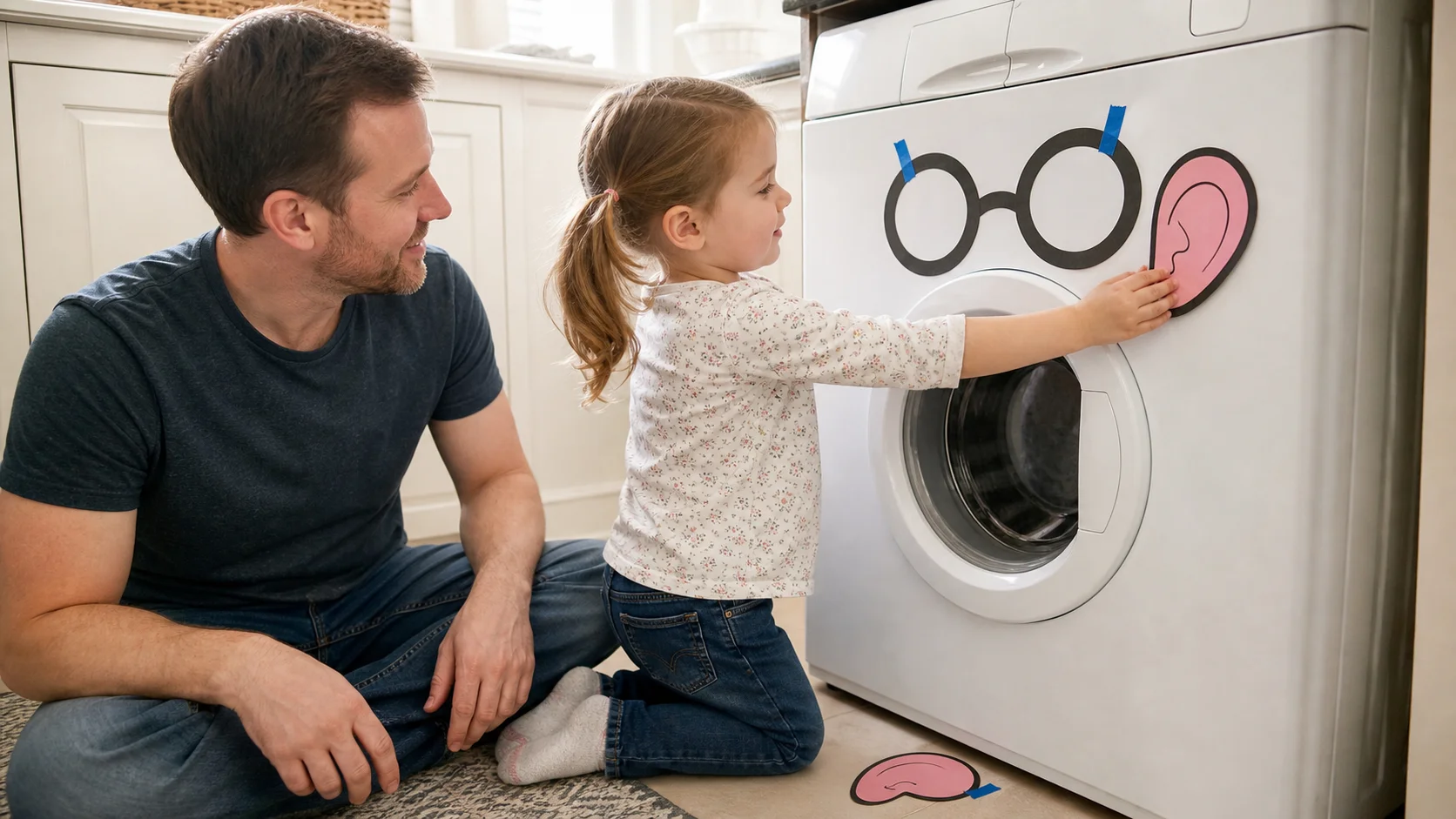
Child beside an adult placing paper glasses on a switched-off washing machine during quiet pretend play.
Skill builderSensory-friendly supportFinish And ResetIndoor

Silly Machine Face.

A quiet appliance gets paper glasses and ears, then your child peels the pieces off for a clear all-done finish.

Play time
5+ min
Age
3-5 years
Energy
Low
Mess
No
Effort
Low
Where
Indoor
Start here

The recipe.

Low parent effort
6 things

What you need

  • 1 switched-off washing machine or 1 unplugged hair dryer
  • 1 pair of paper glasses
  • 2 paper ears
  • 3 small pieces of painter's tape
  • 1 adult
  • 1 child
5 min minimum

Setup

Then start the loop
Step 01
On the floor or a low table, set up one quiet machine
a switched-off washing machine with the door closed, or an unplugged hair dryer laid flat.
Step 02
Keep buttons, doors, cords, heat, and water out of the play area.
Step 03
Cut the paper glasses and two paper ears yourself.
Step 04
Put one gentle painter's tape loop or tab on the back of each paper face piece.
Step 05
Place the paper glasses and ears beside the machine within your child's reach.
Step 06
Sit beside your child and say, "This machine is staying quiet and off for this game."
"Quiet machine wants a face."
The loop

How play unfolds.

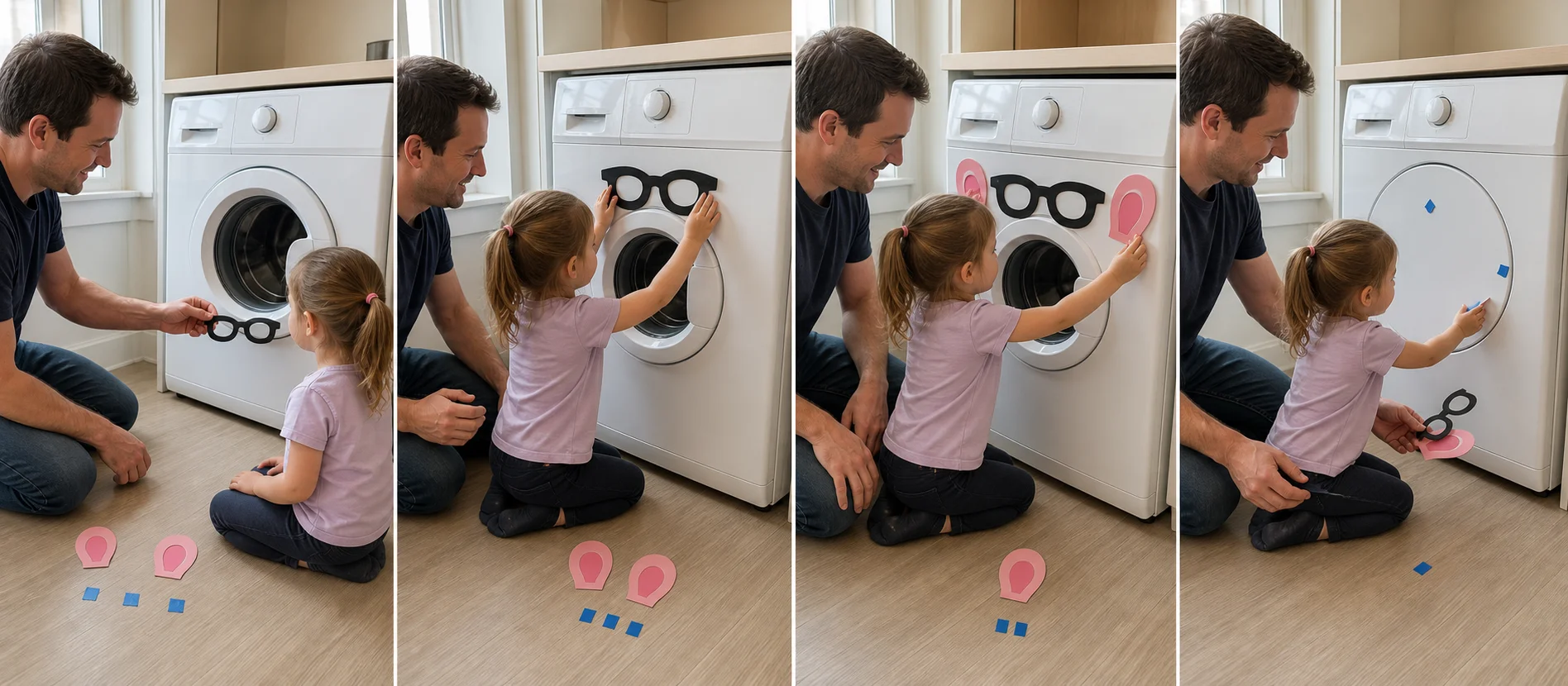
Three-panel sequence showing paper face pieces beside an off appliance, a child pressing on glasses, and the pieces being peeled off to finish.
  1. 01
    Hold one paper face piece against the quiet machine and ask, "Should it get silly glasses?"
  2. 02
    Let your child press it on, point to the spot, watch you place it, or say hello.
  3. 03
    Add one gentle machine line, such as, "Hello, I have funny ears."
  4. 04
    Offer the next choice: add one more piece, move one piece, or peel one off.
  5. 05
    Peel off each piece together and say, "Silly machine is all done and still off."

Safety Check

  • Keep the washing machine switched off or the hair dryer unplugged for the whole activity.
  • Cut the paper pieces yourself.
  • Keep buttons, doors, cords, heat, water, tape, and torn paper under adult control.
  • Do not turn on the real appliance sound during this version.
  • Stop immediately if your child backs away, covers ears, freezes, or seems distressed.
  • Peel tape off slowly so it does not leave residue or pull hard on the appliance surface.
Supporting the play

What to say in the moment

Match what you say to what you see.

Prompt ladder
Level 1 (Start)
Offer one face piece and let your child press, point, or watch.
Level 2 (Keep going)
Ask the quiet machine for one missing part.
Level 3 (Stretch)
Let your child move one piece to make a new silly face.
Level 4 (Extend)
Have the machine ask for help getting ready, then getting all done.
If your child seems...
What you'd see
Focused
What to do
Say
"What part should the quiet machine get next?"
Add
Name the piece after your child chooses it.
Extend
Let your child move one piece before adding another.

Make it easier

Younger end
  • -Use only the glasses for the first round, then add ears if your child is still calm.
  • -Let your child decorate the side of the appliance instead of reaching toward buttons or the door.
  • -Count watching, pointing, or one fingertip press as a full turn.

Make it harder

Older end
  • +Ask your child to choose top, side, or middle before placing a piece.
  • +Let your child fix the silly face by moving one piece that looks wrong.
  • +Remove the pieces in a chosen order, such as ears first or glasses first.

If it's not working

If you see
If child ignores it
Put one face piece on yourself, use one brief silly voice, then offer only one choice: "Ear or all done?"
If you see
If child misuses it
Move their hand back to the paper piece and say, "Tape goes on the paper. Buttons stay closed."
If you see
If child gets frustrated
Stop right away, move away from the machine if needed, and let your child choose watching, holding one paper piece, or finishing.
Skill spotlight
Finish And Reset

Finishing a pretend routine

This gives the child a small, controllable way to start, change, and finish near a household sound source.

  • Decorating an appliance that stays off gives your child a clear way to start, change, and finish near it.
  • Pressing and peeling paper pieces creates a real job with a visible all-done ending.
  • Watching, pointing, pressing, or peeling can all count, so the activity does not depend on lots of talking.
Real-world transfer
  • Ending games and cleanup with a clear "all done."
  • Feeling more control near noisy household objects.
  • Using words, pointing, or choices when something feels uncomfortable.
  • Moving away from a stressful sound instead of being pushed through it.

Parent questions