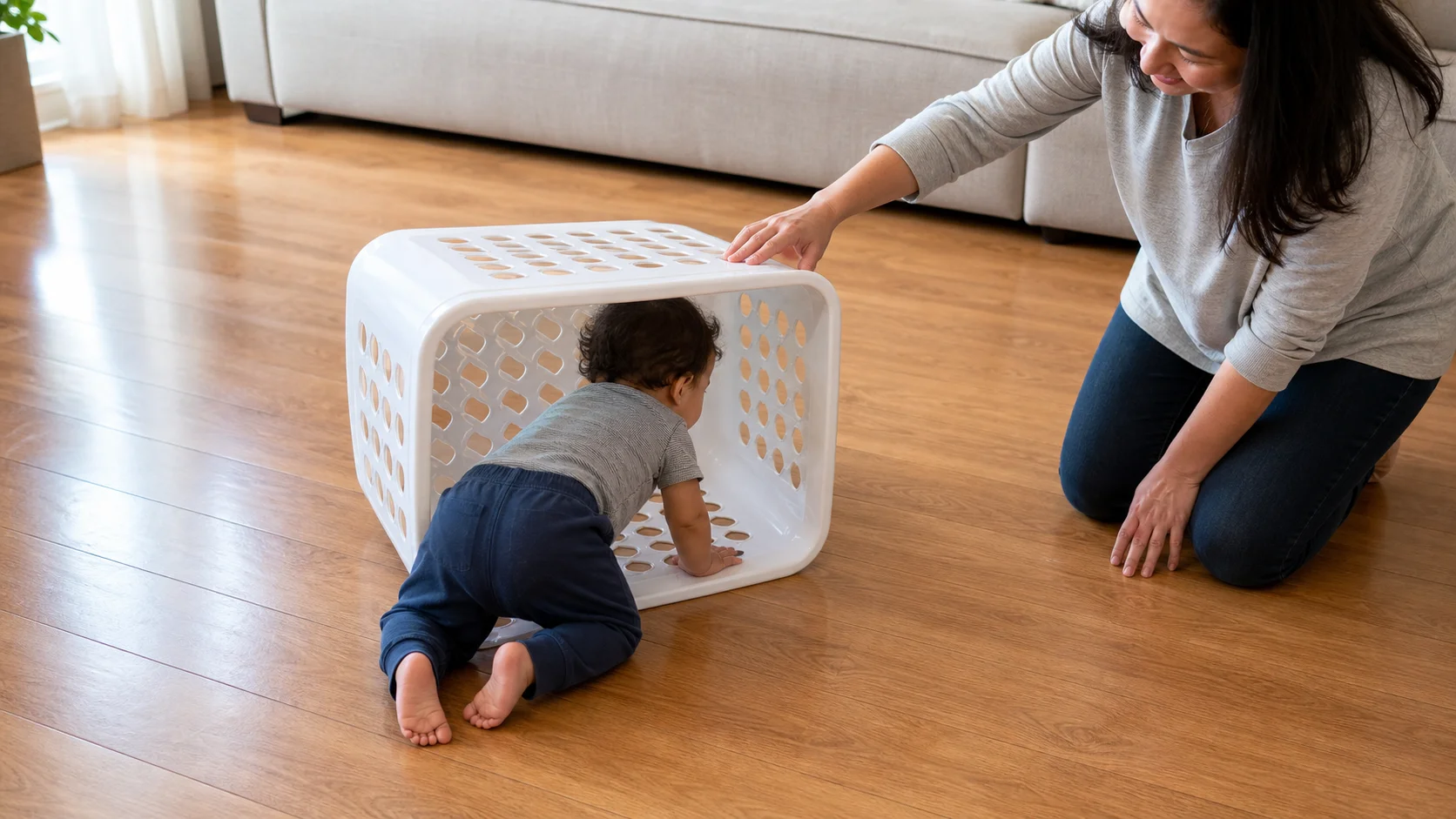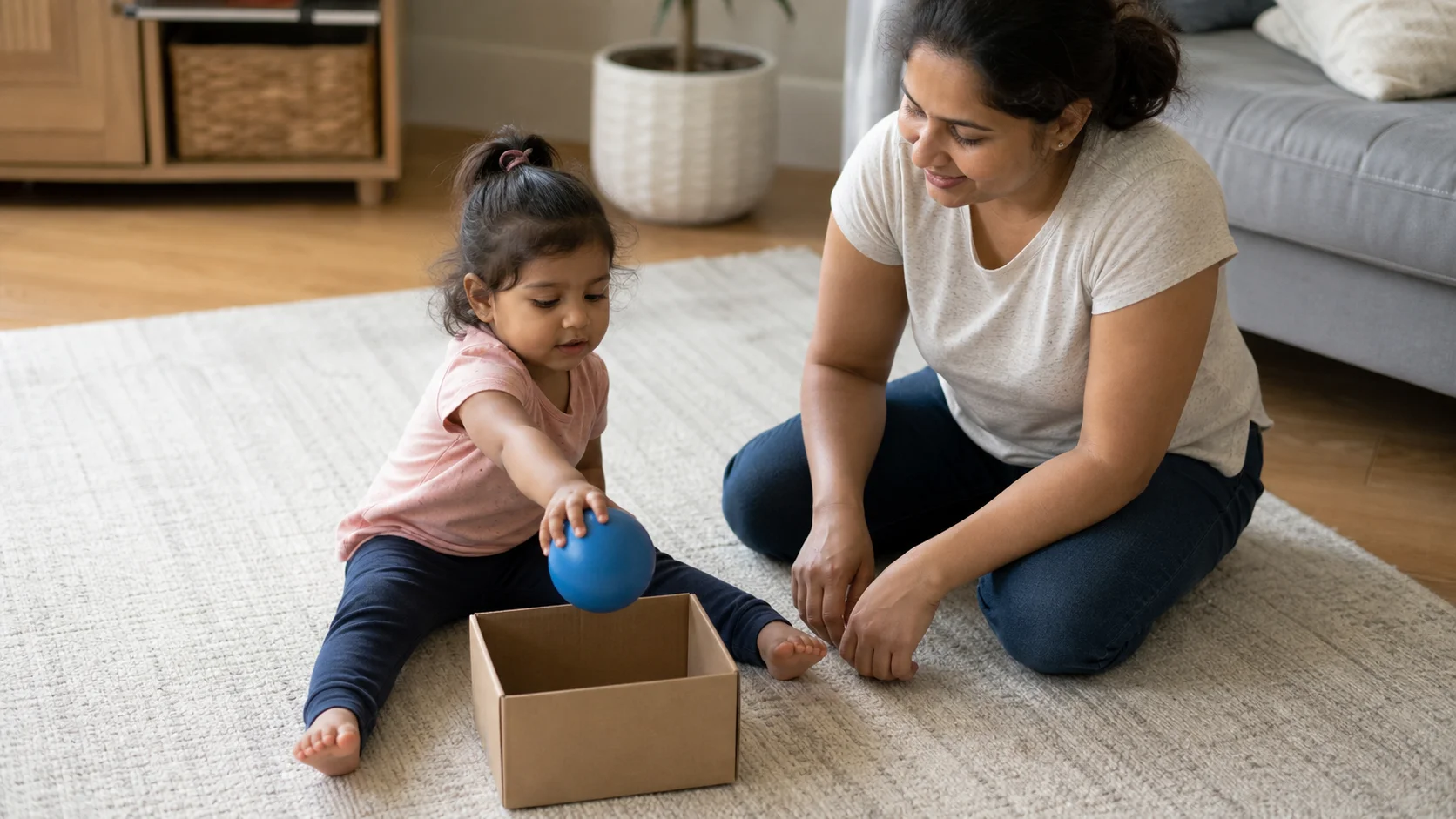
Toddler sitting on the floor beside an adult, reaching for a large ball and dropping it into a nearby box.
Fine motorSensory-friendly supportRelease To TargetIndoor

Side-to-Box Ball Reach.

A one-ball seated reach game where your child picks up a ball from the side and drops it into a close box.

Play time
3-5+ min
Age
2-4 years
Energy
Low
Mess
No
Effort
Low
Where
Indoor
Start here

The recipe.

Low parent effort
5 things

What you need

  • 1 toddler-safe ball that is too large to fit fully in your child's mouth
  • 1 open box or bin
  • 1 clear floor spot
  • 1 adult
  • 1 child
3 min minimum

Setup

Then start the loop
Step 01
On a flat floor spot, clear enough room for your child to sit without bumping furniture edges, sharp corners, or loose rugs.
Step 02
On the floor in front of your child's feet, place the open box so a dropped ball can land inside without careful aim.
Step 03
On the same floor spot, help your child sit facing the box.
Step 04
Beside one hip, place the ball where your child can reach without leaning hard or tipping over.
Step 05
Beside your child, sit or kneel close enough to reset the ball, steady the setup, or stop the turn.
"Reach for ball."
The loop

How play unfolds.

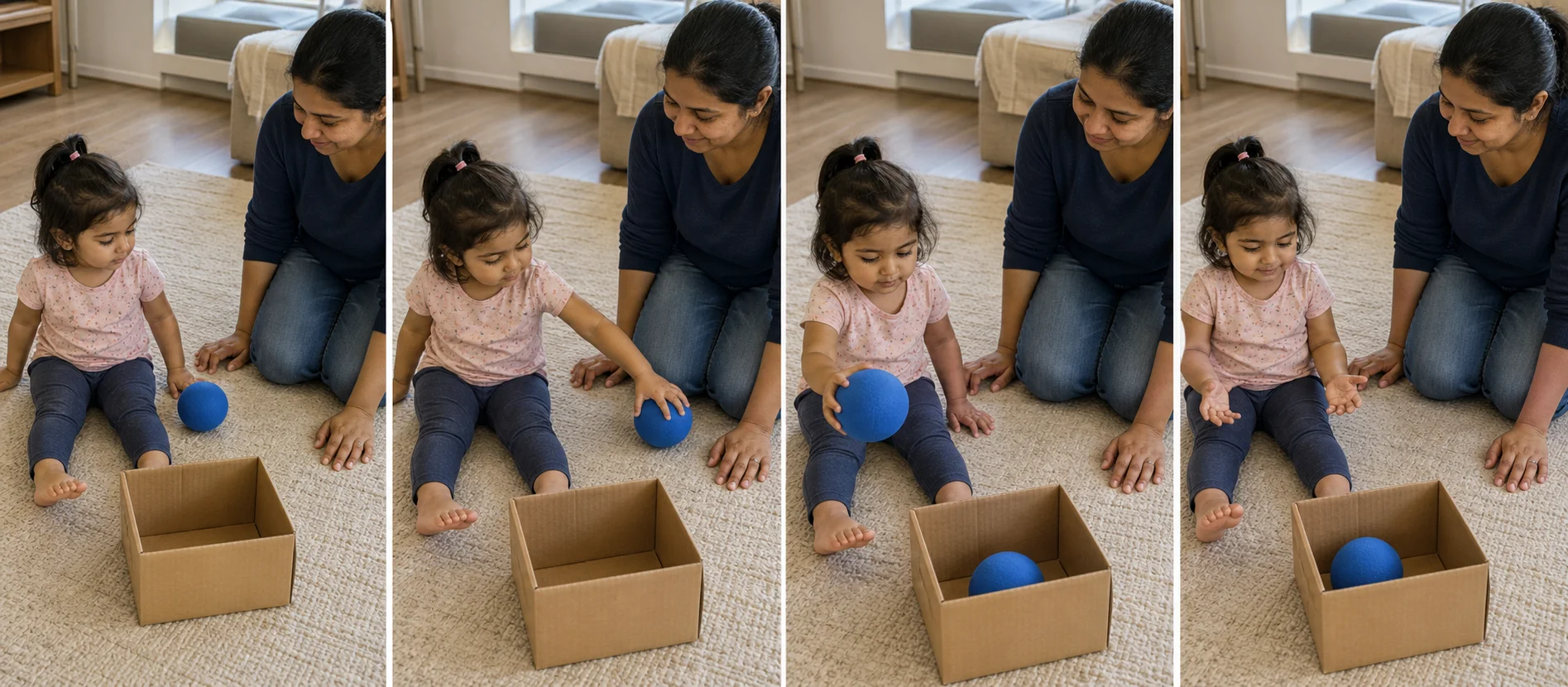
Three-panel sequence showing the ball beside the child, the child reaching from a seated position, and the ball landing in the box.
  1. 01
    Drop the ball into the box once and say, "Side, reach, in."
  2. 02
    Place the ball beside one hip.
  3. 03
    Let your child reach for the ball and drop it into the box.
  4. 04
    Say, "In," then pause.
  5. 05
    Ask, "Again or all done?" Reset the ball beside either hip, or leave it in the box and finish.

Safety Check

  • Use a ball that is too large to fit fully in your child's mouth. Do not use marbles, tiny balls, or loose pieces that could be mouthed.
  • Keep the box close. This is a gentle side reach and drop, not a balance challenge.
  • Keep the activity supervised and child-led. Do not force a reach, side switch, or extra turn.
  • Stop if your child looks dizzy, pale, sweaty, clammy, upset, or tries to move away.
  • Move the ball closer or stop if your child tips, braces hard, leans unsafely, or loses the seated position.
Supporting the play

What to say in the moment

Match what you say to what you see.

Prompt ladder
Level 1 (Start)
Put the ball on the easier side and wait for one reach.
Level 2 (Keep going)
After the drop, reset the ball and say the next side.
Level 3 (Stretch)
Let your child choose left or right before you reset.
Level 4 (Extend)
Add a slow freeze after the ball lands before the next turn.
If your child seems...
What you'd see
Focused
What to do
Say
"Side, reach, in."
Add
Name the side once while the ball is moving.
Extend
Let your child point to the next side before you reset.

Make it easier

Younger end
  • -Keep the box centered and close while you use fewer side switches.
  • -Count a touch-and-slide into the box as a successful turn.
  • -Pause longer after each drop so your child can sit steady again.

Make it harder

Older end
  • +Place the ball one hand-width farther to the side while your child still sits steadily.
  • +Ask your child to choose the next side before you move the ball.
  • +Try one quiet drop that lands without bouncing out.

If it's not working

If you see
If child ignores it
Move the ball a little closer to the front, model one slow drop, and count watching as the turn.
If you see
If child misuses it
If the ball is thrown, hold the box closer and say, "Drop in." If throwing keeps going, put the ball away and stop.
If you see
If child gets frustrated
Move the ball closer, offer your hand under theirs only if they accept it, or finish with one easy drop from in front.
Skill spotlight
Release Control

Seated side reach and target drop.

This helps a child keep the body steady while one hand reaches away from the middle, then bring the object back to a clear target. That shows up in floor play, cleanup, dressing, and simple helping jobs.

  • Reaching to the side and returning to the box helps your child practice moving one hand while staying seated.
  • Dropping the ball into a clear target builds release control without adding small pieces or mess.
  • The pause after "In" gives the game a natural stop-and-reset moment.
Real-world transfer
  • Reaching for toys while staying seated
  • Putting small items into a bin during cleanup
  • Bringing a hand back to the middle during dressing or table play
  • Using a calm stop-and-reset after a movement turn

Parent questions