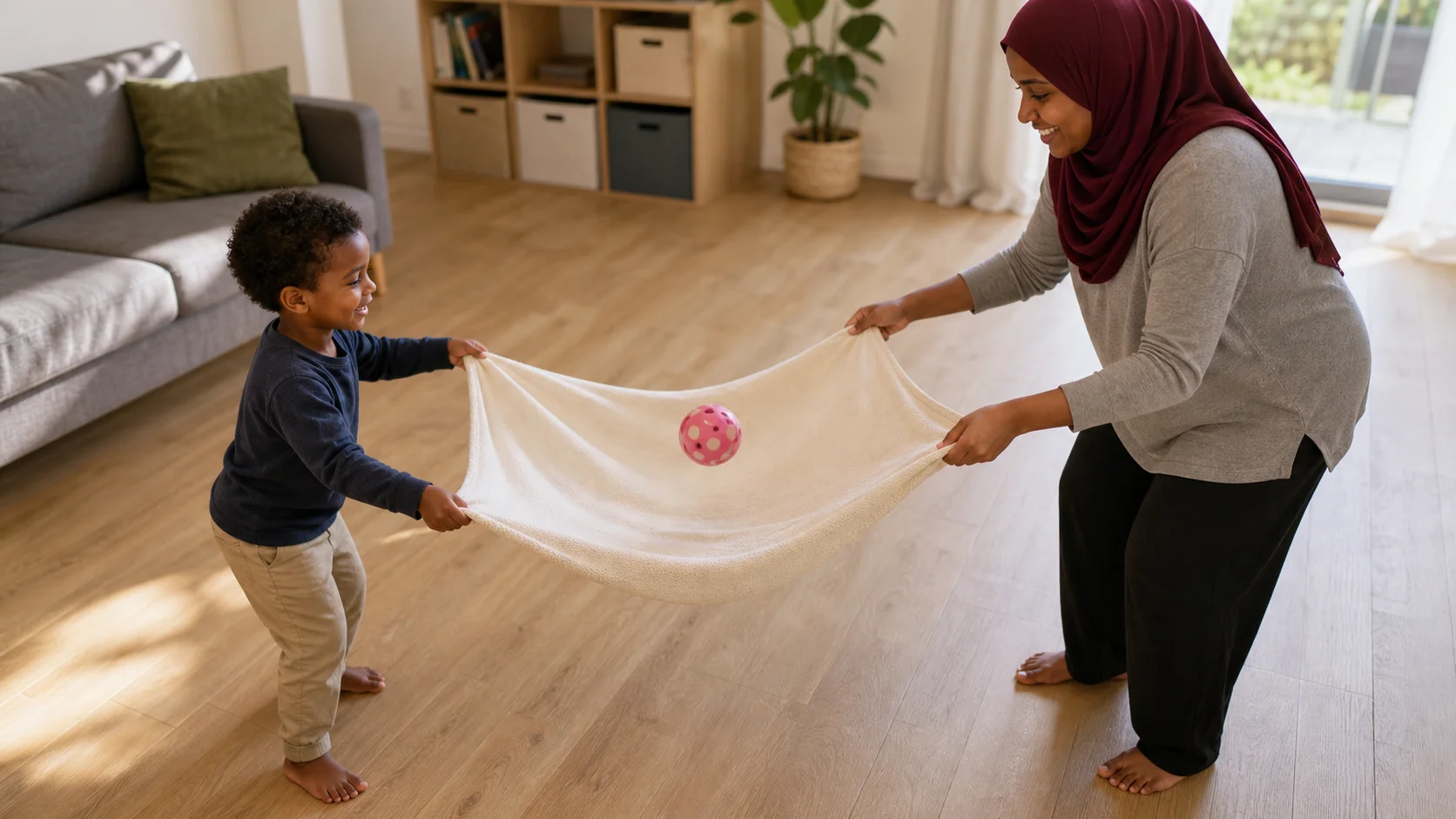
A grown-up and preschool child holding a small sheet together while a lightweight ball bounces in the middle.
Fine motorStop And StartIndoor Or Outdoor

Sheet Parachute Bounce.

Hold a small sheet together, bounce a lightweight ball on top, and reset for another easy round.

Play time
5-15+ min
Age
3-5 years
Energy
Medium To High
Mess
Low
Effort
Medium
Where
Indoor Or Outdoor
Start here

The recipe.

Medium parent effort
4 things

What you need

  • 1 small blanket or sheet that 2 people can hold open like a parachute
  • 1 lightweight ball
  • 1 grown-up
  • Optional: additional family members to hold other edges
5 min minimum

Setup

Then start the loop
Step 01
Clear an open floor spot or flat outdoor spot so the sheet can move without hitting furniture, walls, or other people.
Step 02
Stand across from your child with the sheet stretched open between you and low enough for both of you to hold without stepping on it.
Step 03
Set the lightweight ball near the middle of the sheet so it stays put until you lift together.
"Hold tight."
The loop

How play unfolds.

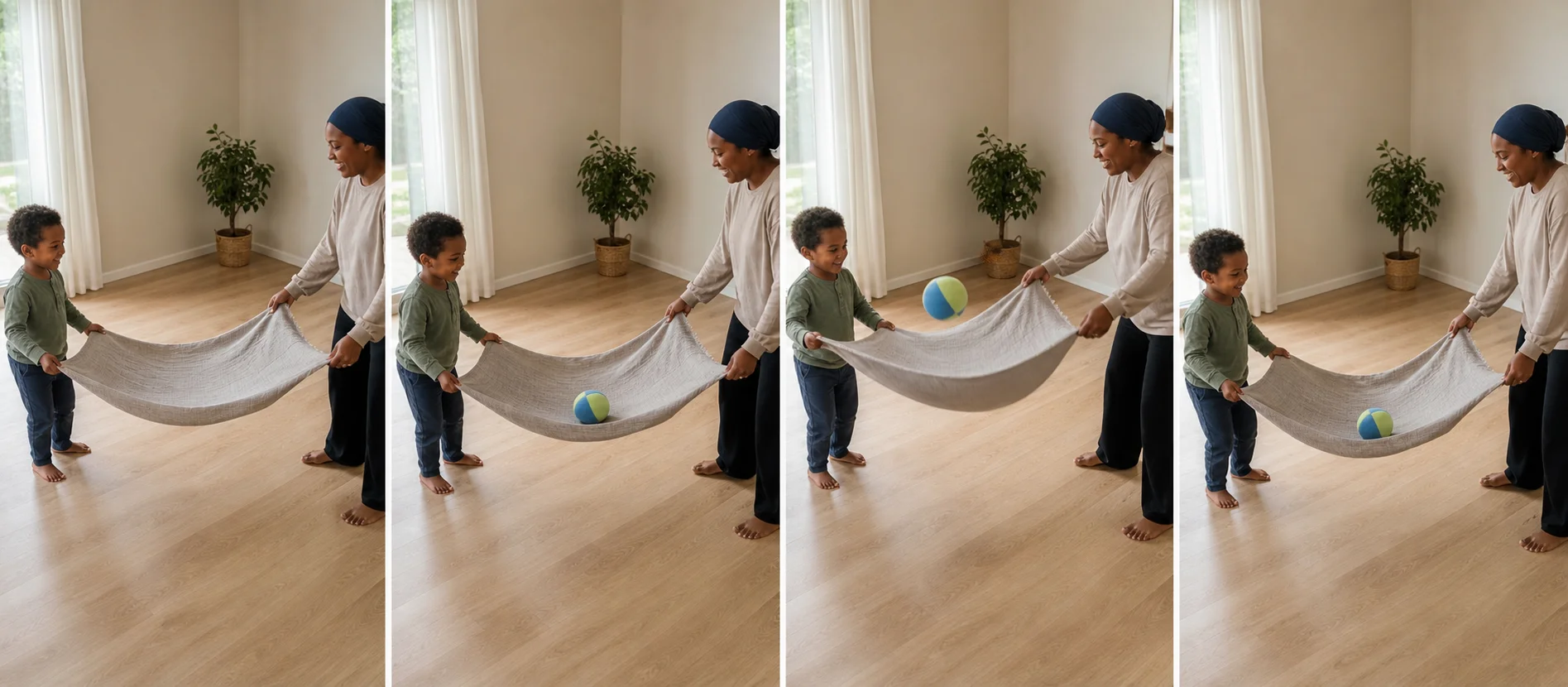
Four panels showing a grown-up and child stretching a sheet open, placing a light ball in the middle, bouncing it together, and lowering the sheet to reset.
  1. 01
    Hold the sheet together and say, "Let's bounce the ball."
  2. 02
    Lift and lower the sheet to make one or more small bounces.
  3. 03
    Adjust together to keep the ball on top, then let it settle back toward the middle.
  4. 04
    Reset for another short round and repeat while the game stays controlled.

Safety Check

  • Use a lightweight ball only.
  • Keep enough open space around the sheet so no one backs into furniture, walls, or hard objects.
  • Stop if the game turns into whipping the sheet, body crashing, crowded pulling, or out-of-control popping that sends the ball toward faces.
Supporting the play

What to say in the moment

Match what you say to what you see.

Prompt ladder
Level 1 (Start)
"Bounce the ball."
Level 2 (Keep going)
"Up, then down."
Level 3 (Stretch)
"Can we keep it on?"
Level 4 (Extend)
"Ready, steady... bounce."
If your child seems...
What you'd see
Focused
What to do
Say
"You kept the ball on."
Add
Try one more short round before stopping.
Extend
Let the ball bounce a little higher on the next round.

Make it easier

Younger end
  • -Use one very light ball and keep every bounce small.
  • -Do one bounce per round instead of several in a row.
  • -Stand close together so the sheet stays easier to control.

Make it harder

Older end
  • +Try to keep the ball on the sheet for three bounces in a row.
  • +Pause before the next bounce and wait for your child to look back at the ball.
  • +Take one small step in and one step back while keeping the ball on top.

If it's not working

If you see
If child ignores it
Do one bounce yourself, let your child watch the ball pop up, and then invite them to grab an edge.
If you see
If child misuses it
Lower the sheet, say, "Small bounces," and restart with one gentle pop-up only.
If you see
If child gets frustrated
Keep the sheet lower, do one tiny bounce at a time, and stop after one successful round.
Skill spotlight
Stop And Start

Starting and stopping shared whole-body movement with control

This helps a child match body timing to another person, stop movement before it turns chaotic, and stay with a simple shared action from start to finish.

  • Early. Your child may need you to lead every lift and may let go after one bounce.
  • Later. Your child helps control the bounce size and waits for the next round instead of rushing ahead.
  • Middle. Your child holds on through several small bounces and stops when you lower the sheet.
Real-world transfer
  • Joining simple movement games with another person
  • Slowing the body when a shared game changes or stops
  • Following short action cues during songs, cleanup, and family play