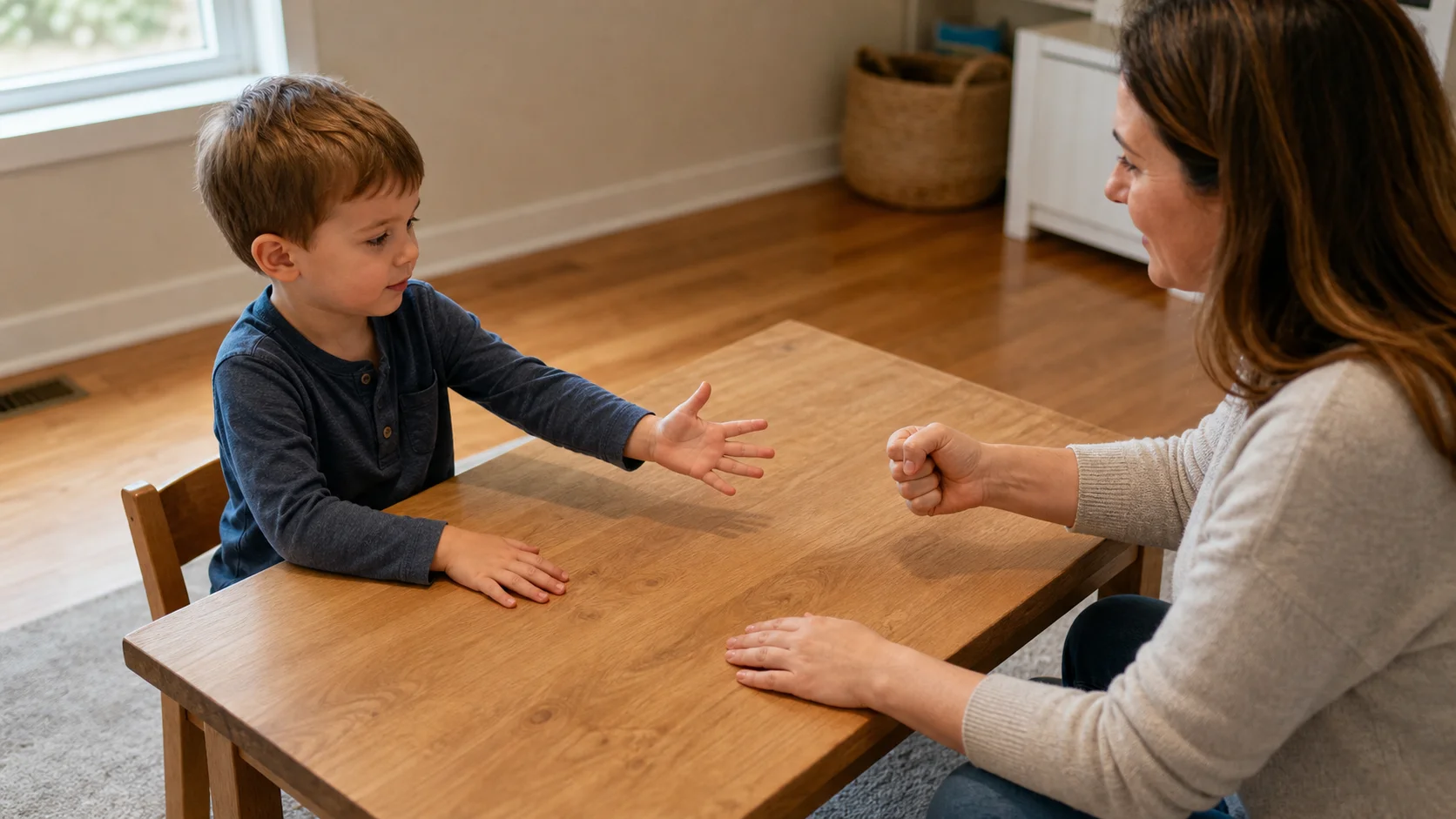
A grown-up and toddler facing each other with hands ready for a rock paper scissors reveal.
ThinkingSensory-friendly supportOT-adjacent supportVisual Same`Indoor

Rock Paper Reveal.

A no-material hand reveal game where your child shows a shape, checks same or different, and opens hands to reset.

Play time
1-3+ min
Age
3-4 years
Energy
Low
Mess
No
Effort
Low
Where
Indoor
Start here

The recipe.

Low parent effort
3 things

What you need

  • 1 adult
  • 1 child
  • 1 clear sitting or standing spot
1 min minimum

Setup

Then start the loop
Step 01
On the floor or at a low table, clear a small spot where you and your child can face each other.
Step 02
In that spot, sit or stand close enough for your child to see your hands.
Step 03
In front of your body, hold both empty hands where your child can see them.
Step 04
Before the first turn, slowly show rock, paper, and scissors once.
Step 05
Tell your child that wiggly or almost-right hand shapes count.
"Hands ready."
The loop

How play unfolds.

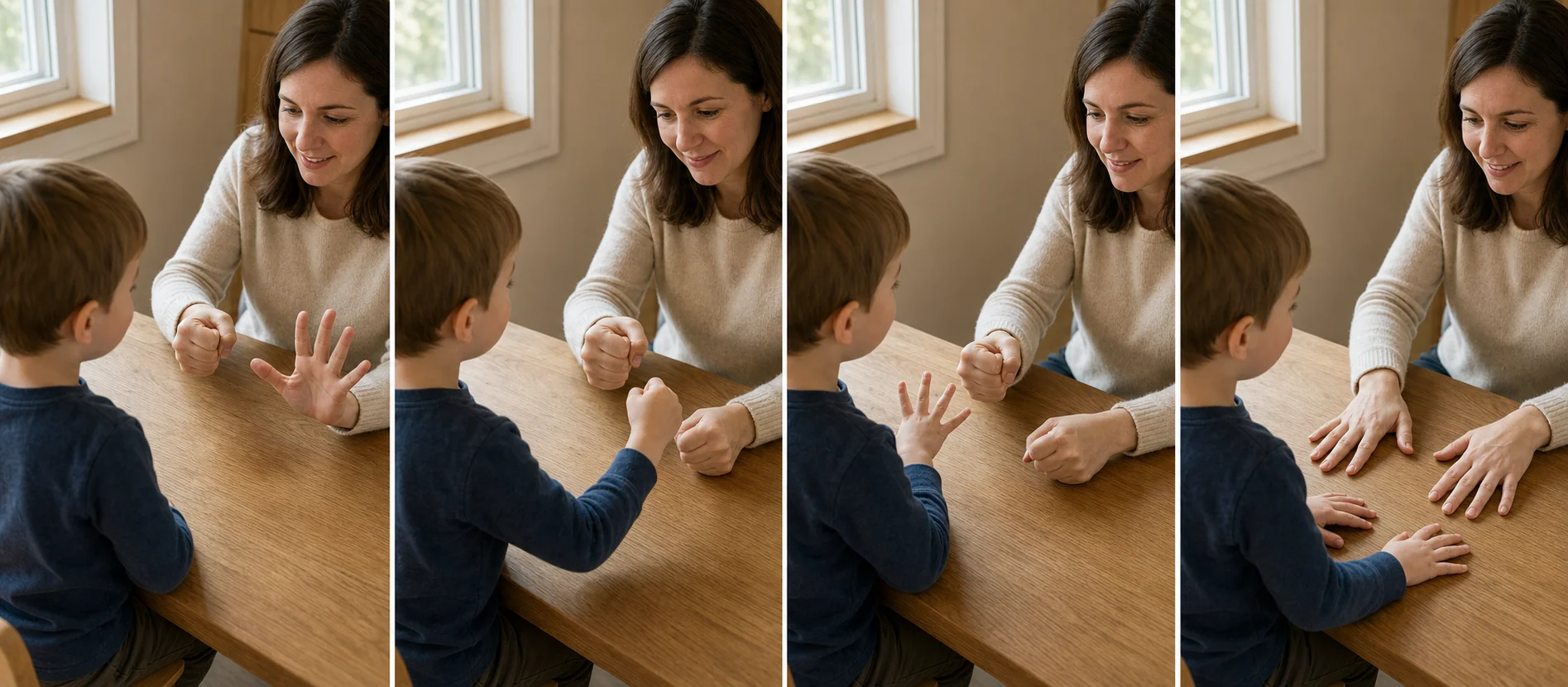
A sequence showing a toddler watching hand-shape examples, revealing a hand shape, comparing same or different, and opening hands to reset.
  1. 01
    Say, "Rock, paper, scissors, show," and reveal one hand shape together.
  2. 02
    Name whether the two hands are the same or different.
  3. 03
    Count the turn if your child shows a shape, watches your reveal, copies you, or resets with you.
  4. 04
    Open both hands, then play another reveal or say "all done."

Safety Check

  • Stop if your child hides hands, pulls away, rubs fingers, says no, or looks uncomfortable.
  • Stop if the game turns into grabbing, poking, or hands near faces or eyes.
  • Offer firm hand pressure only if your child already likes that kind of input.
  • Do not force exact finger positions.
Supporting the play

What to say in the moment

Match what you say to what you see.

Prompt ladder
Level 1 (Start)
Show one clear rock hand and wait for any hand response.
Level 2 (Keep going)
Count down the same way each round and pause on "show."
Level 3 (Stretch)
Ask your child to notice whether the two hands are same or different.
Level 4 (Extend)
Let your child lead one countdown while you follow their reveal.
If your child seems...
What you'd see
Focused
What to do
Say
"Again, same words."
Add
Name the shape after the hands are shown.
Extend
Let your child choose whether you copy or surprise them.

Make it easier

Younger end
  • -Hold your revealed hand still for a longer look before naming it.
  • -Let your child reveal after you instead of at the same time.
  • -Count a wrist, fist, open hand, or loose two-finger shape as a valid turn.

Make it harder

Older end
  • +Have your child say "same" or "different" before you say it.
  • +Ask your child to make the next round match your shown hand.
  • +Switch who starts the countdown after two calm rounds.

If it's not working

If you see
If child ignores it
Reveal your own hand shape twice and let your child only call out "same" or "different" before inviting a hand shape.
If you see
If child misuses it
Put both hands flat on the table or in laps and restart with "show, then open." Stop if grabbing, poking, or hands near faces continue.
If you see
If child gets frustrated
Drop scissors, play only rock and paper, or stop after one calm reveal.
Skill spotlight
Visual Matching`

Same-or-different hand matching

This gives the child a tiny back-and-forth game for noticing visual details, using hands on purpose, and restarting without a big cleanup or rule load.

  • The countdown gives your child a short wait with a clear finish.
  • Comparing two revealed hands turns the game into a same-or-different matching job.
  • Opening hands after each turn gives the activity a simple reset.
  • Accepting loose shapes keeps the focus on noticing and trying, not perfect fingers.
Real-world transfer
  • Noticing matching shapes, pictures, socks, or toys.
  • Copying small hand motions in songs, play, and routines.
  • Waiting for a short shared cue.
  • Opening and relaxing hands after a focused hand action.