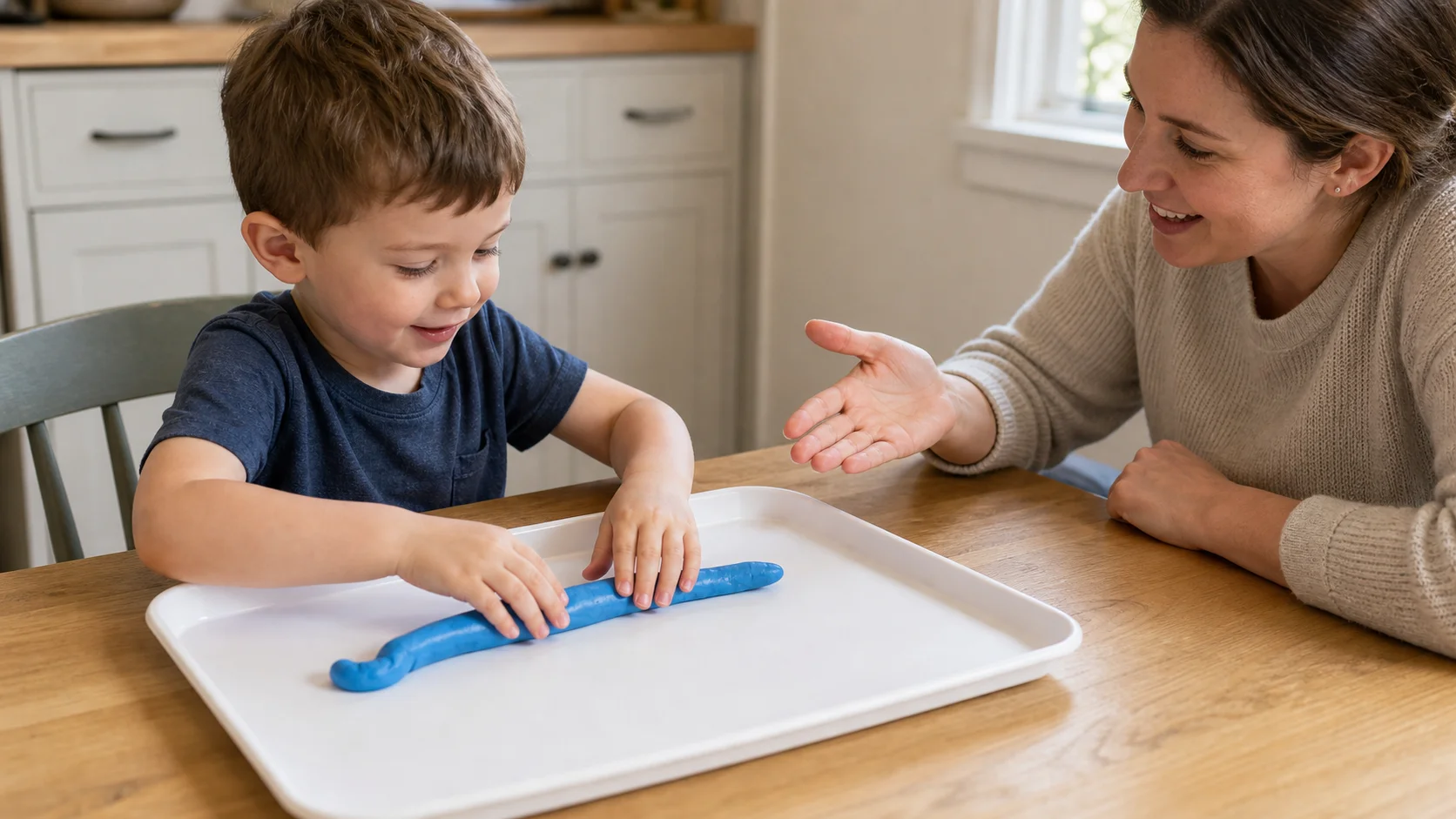
A child shaping a soft putty lump on a tray while a grown-up watches.
Fine motorSensory-friendly supportOT-adjacent supportSqueeze And ReleaseIndoor

Putty Charades.

Shape one soft lump into a pretend prop, let the grown-up guess, then squash it flat and make another.

Play time
5-10+ min
Age
2-4 years
Energy
Low
Mess
Low
Effort
Low
Where
Indoor
Start here

The recipe.

Low parent effort
4 things

What you need

  • 1 soft lump of therapy putty or playdough
  • 1 tray, placemat, or clear tabletop work spot
  • 1 adult
  • 1 child
5 min minimum

Setup

Then start the loop
Step 01
Set a tray, placemat, or clear tabletop spot where your child can keep both hands on the putty.
Step 02
Put one soft lump of therapy putty or playdough in the middle of the work spot.
Step 03
Sit beside or across from your child so you can see each shape and remove the putty quickly if needed.
Step 04
Warm the putty in your hands if it feels stiff, or switch to softer playdough.
Step 05
Before the first turn, show how the lump squashes flat and rolls back together after a guess.
"Your turn to make one."
The loop

How play unfolds.

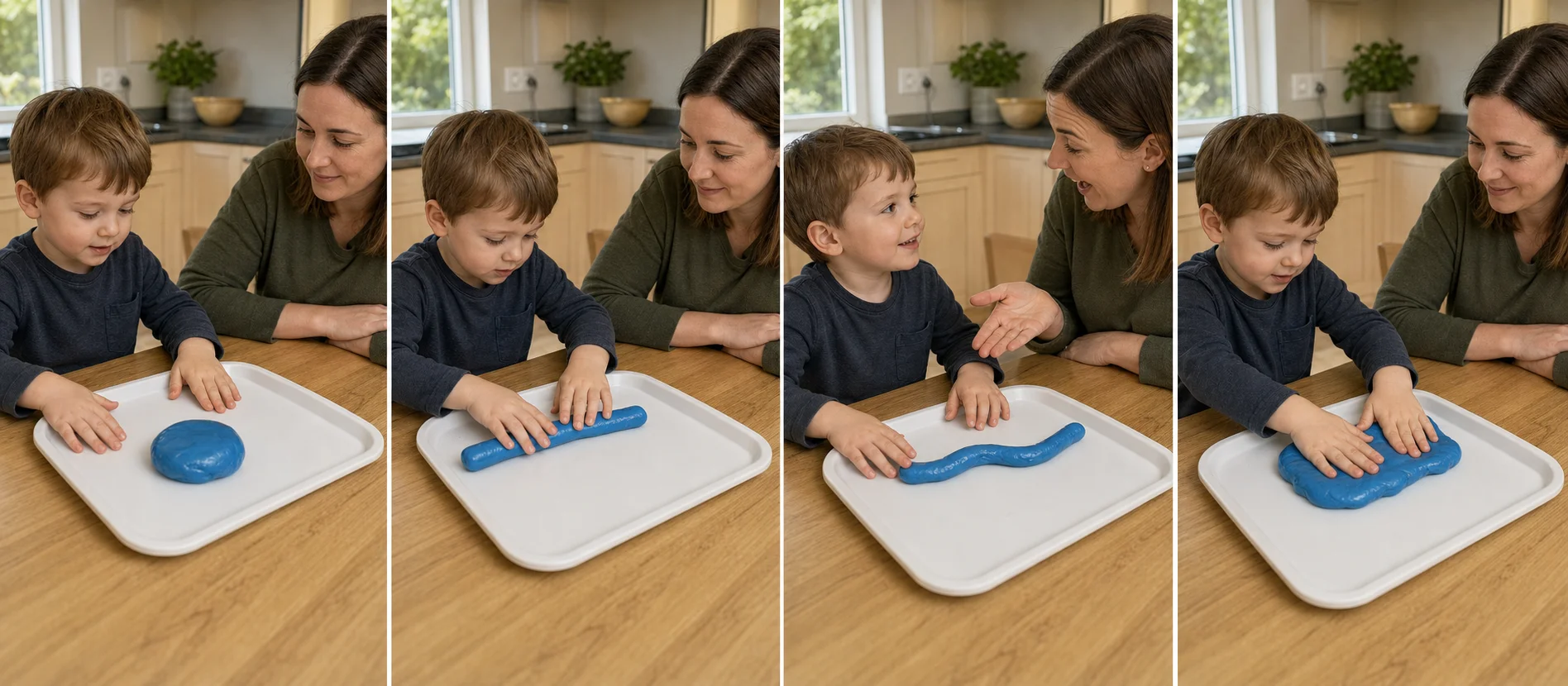
A sequence showing putty shaped into a simple prop, shown for a guess, squashed flat, and rolled back into a lump.
  1. 01
    Make a simple prop from the putty, such as a snake, ball, pizza, or phone.
  2. 02
    Say, "I made something. Guess what it is."
  3. 03
    Let your child guess, point, nod, or squash your shape, then hand them the lump.
  4. 04
    Say, "Your turn to make one," and let your child squeeze, press, roll, or pinch one pretend prop.
  5. 05
    Make one friendly guess when your child shows the shape, even if it is unclear.
  6. 06
    Let your child squash or roll it back into one lump, then repeat or stop after one full turn.

Safety Check

  • Supervise the whole activity.
  • Keep the putty or playdough on the work spot.
  • Use one large lump. Stop and remove tiny pieces if the lump breaks apart.
  • Stop if your child mouths, chews, swallows, throws, or smears the putty.
  • Switch to softer playdough if the putty is too firm for your child to change without strain.
  • Keep putty off carpet, sleeves, and soft furniture because it can pick up lint or stick.
Supporting the play

What to say in the moment

Match what you say to what you see.

Prompt ladder
Level 1 (Start)
Make one flat shape and let your child squash it.
Level 2 (Keep going)
Ask your child to make one shape for you to guess.
Level 3 (Stretch)
Guess once, then invite your child to change the same lump into a new prop.
Level 4 (Extend)
Take turns making the adult guess after every squash.
If your child seems...
What you'd see
Focused
What to do
Say
"Hold it still. I am looking."
Add
"I guess it is a phone."
Extend
"Can you make it bigger?"

Make it easier

Younger end
  • -Guess from the action instead of the shape if the object is unclear.
  • -Let your child answer with a nod, point, sound, or one word.
  • -Keep the waiting time short by guessing right after your child shows the shape.

Make it harder

Older end
  • +Let your child decide when the adult is allowed to guess.
  • +Ask for one small change before the reset, such as longer, flatter, or rounder.
  • +Have your child remember the last prop before making the next one.

If it's not working

If you see
If child ignores it
Make one funny prop yourself, let your child squash it, and count that as the first turn.
If you see
If child misuses it
Bring the putty back to one large lump on the work spot and say, "Putty stays on the tray. Squeeze or squash." Stop if mouthing, throwing, or tiny pieces continue.
If you see
If child gets frustrated
Switch from "make something" to one clear option, such as "make a snake" or "make a ball," or start the shape and let your child press the final mark.
Skill spotlight

Hand strength

This gives the child practice using finger and hand strength to shape, hold, show, and reset a small object during play. Those same hand actions support everyday jobs like buttons, zips, tool use, and later writing.

  • Squeezing, rolling, pinching, and squashing the same lump gives your child repeated hand-strength practice.
  • Showing the shape for one guess adds a clear social turn without requiring full sentences.
  • The squash-and-reset ending makes every attempt usable, even when the shape looks like a blob.
  • Keeping one soft lump on one work spot gives tactile play a clear boundary.
Real-world transfer
  • Using enough hand pressure for dough, crayons, and small toys
  • Building finger strength for buttons, zips, and other dressing jobs
  • Holding an object still while another person looks
  • Finishing a short play routine and starting it again

Parent questions