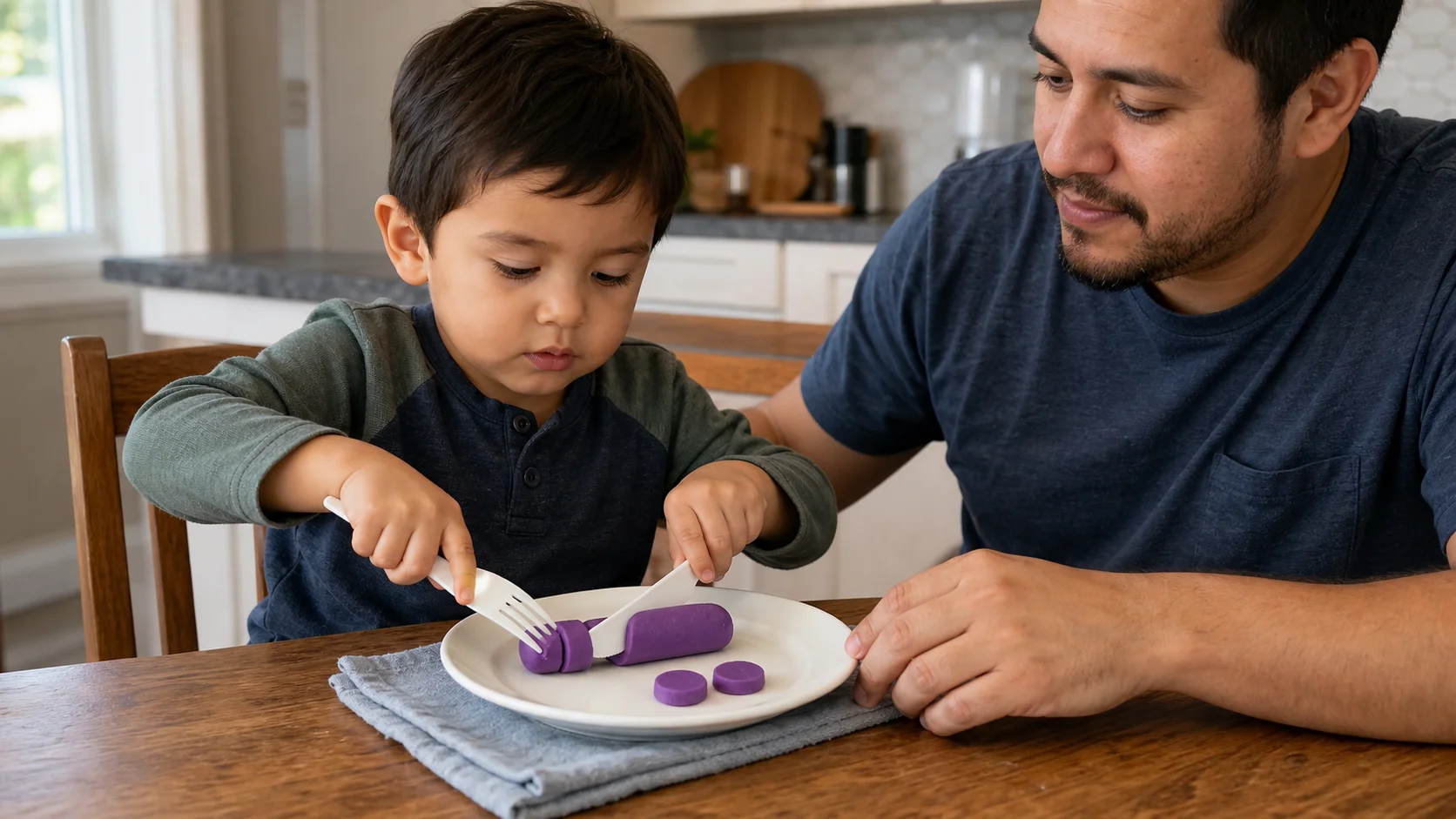
A toddler using a child-safe fork and knife to cut a short playdough sausage on a small plate while a grown-up sits close beside the table.
Fine motorTwo Hand CoordinationIndoor

Playdough Sausage Slice.

One playdough sausage turns fork-and-knife practice into a calm slice, drop, and reset game.

Play time
5+ min
Age
2-3 years
Energy
Low
Mess
Low
Effort
Low
Where
Indoor
Start here

The recipe.

Low parent effort
6 things

What you need

  • 1 playdough sausage
  • 1 child-safe fork
  • 1 child-safe knife
  • 1 small plate or tray
  • 1 child
  • 1 adult
5 min minimum

Setup

Then start the loop
Step 01
At a stable table between meals, place the plate or tray in front of your child with one finger-length playdough sausage in the middle.
Step 02
Put the fork on the non-cutting side and the knife on the cutting side. If the plate slides, anchor it with a non-slip mat or damp cloth before you start.
Step 03
Sit beside your child close enough to supervise every cut. If the tools are hard to hold, switch to a thicker or easier-grip fork or knife before the first slice.
Fork holds.
The loop

How play unfolds.

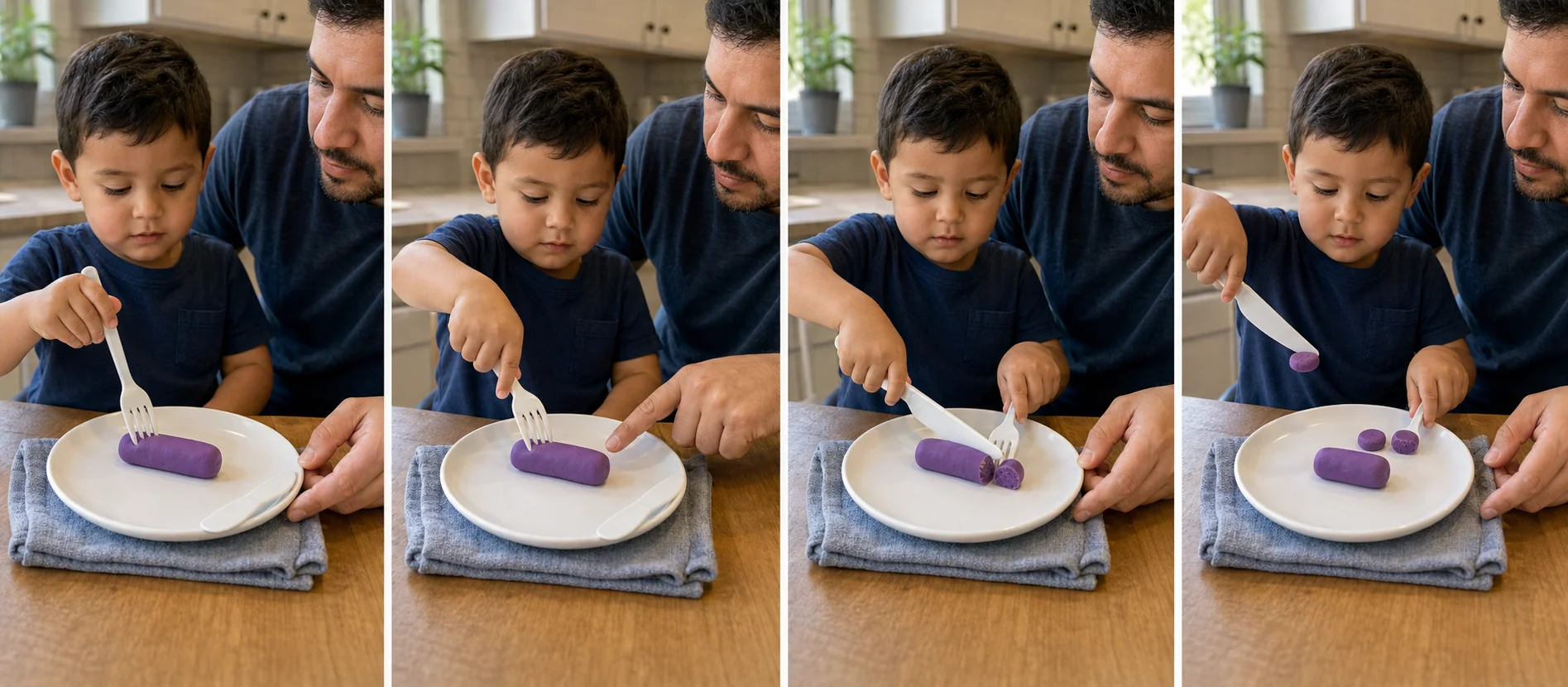
A multi-panel sequence showing a child holding a playdough sausage with a fork, sawing off a piece with a child-safe knife, dropping the slice onto the plate, and resetting for another cut.
  1. 01
    Show one slow cut by pressing the fork into the playdough, resting your index fingers along the backs of the utensils, and saying, `Fork holds. Knife saws.`
  2. 02
    Let your child press the fork in, saw off one small piece with the knife, and drop the slice onto the plate.
  3. 03
    Reset the sausage and fork for the next cut.
  4. 04
    Repeat for a few calm slices, or stop after one clear hold-and-saw success.

Safety Check

  • Stay beside your child for every cut and take the utensils back if they start getting waved, dropped on purpose, or mouthed.
  • If the plate or tray slides, stop and fix it before the next cut so your child does not jab harder with the knife.
  • End after one clear success if the cutting starts to feel frustrating or unsafe.
Supporting the play

What to say in the moment

Match what you say to what you see.

Prompt ladder
Level 1 (Start)
Hold it still with the fork.
Level 2 (Keep going)
Saw one little slice.
Level 3 (Stretch)
Drop the piece on the plate.
Level 4 (Extend)
Give the sausage one more cut.
If your child seems...
What you'd see
Focused
What to do
Say
Nice hold. You cut it.
Add
Use one learning prompt after the slice lands, such as `Same or different?` while looking at the new piece.
Extend
Turn the plate slightly and offer the next cut right away.

Make it easier

Younger end
  • -Flatten the sausage a little before the round so the knife gets through faster.
  • -Keep every cut in the same middle spot so the hold-and-saw pattern feels predictable.
  • -Let your child do the drop while you finish the last bit of the cut.

Make it harder

Older end
  • +Pause after `Fork holds` and wait to see if your child starts sawing without the second cue.
  • +Have your child move the cut piece to the far side of the plate after each slice.
  • +Let your child turn the sausage to choose the next cutting spot before starting.

If it's not working

If you see
If child ignores it
Do one side-by-side cut together, then let your child do only the fork-hold part or only one small sawing motion before you stop.
If you see
If child misuses it
If your child waves the utensils, drops them repeatedly, or mouths the playdough, pause the turn, take the utensils back, and restart with one adult-led demo or end the activity.
If you see
If child gets frustrated
Switch to thicker cutlery, add the finger-placement sticker, or guide one cut hand-over-hand, then finish after that one successful slice.
Skill spotlight
Two-Hand Coordination

Using both hands together for one cutlery job, Keeping one hand steady while the other hand saws

This helps a child keep one hand steady while the other hand does a different job, which matters for cutting soft foods, steadying bowls, and other table tasks that need both hands together.

  • Holding with the fork while sawing with the knife gives each hand a different job and helps your child keep both jobs going together.
  • Soft playdough gives enough resistance to feel like cutting without the pressure of a real meal.
  • Slice, drop, and reset turns one cut into a repeatable table routine your child can understand quickly.
Real-world transfer
  • Cutting softer foods with less frustration
  • Holding one item steady while the other hand works at the table
  • Using both hands together for simple kitchen or helper play

Parent questions