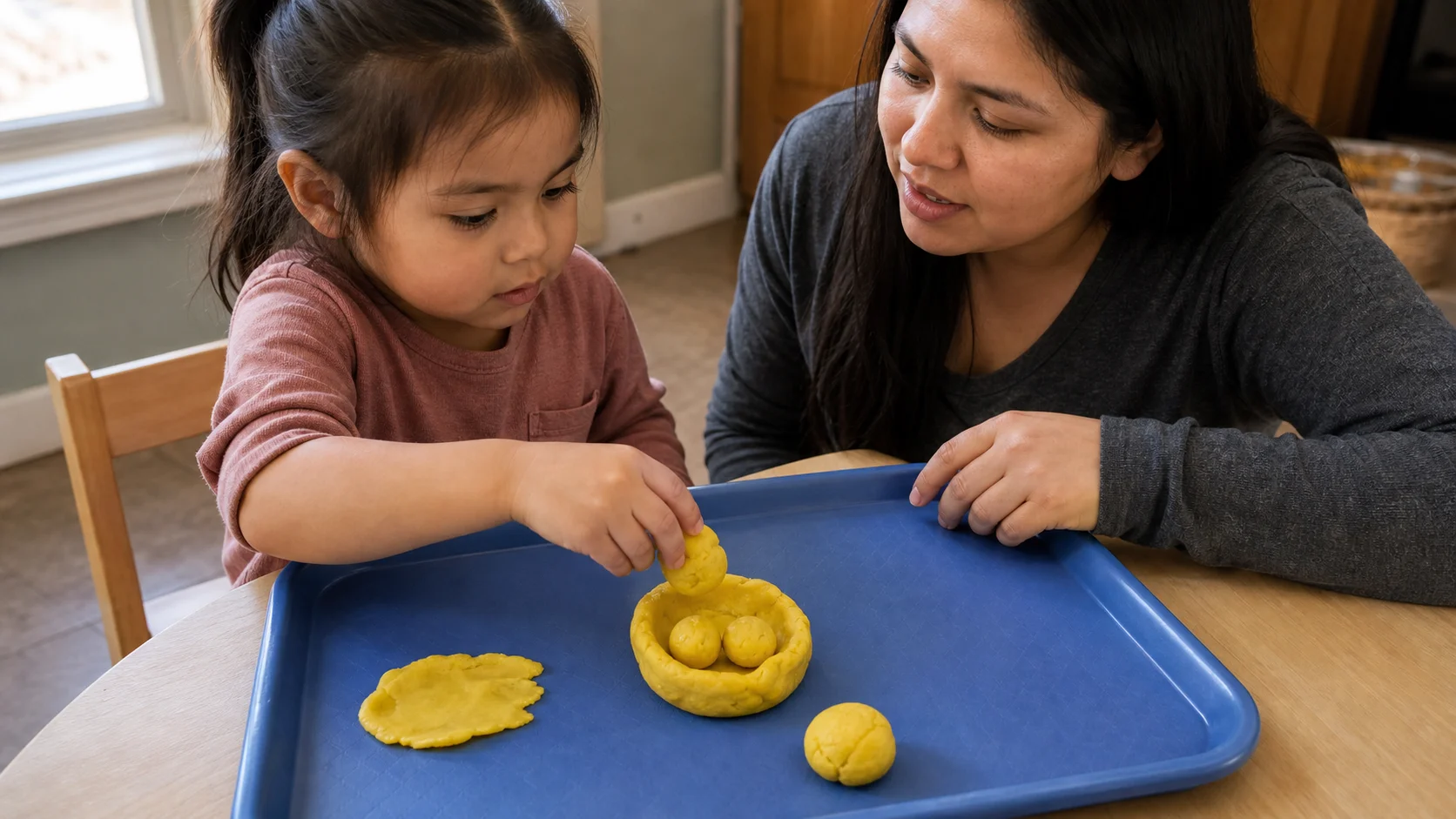
A child shaping a small playdough basket and dough eggs on a tray.
Fine motorOT-adjacent supportSqueeze And ReleaseIndoor

Playdough Egg Basket.

Press, pinch, roll, drop, and squash one dough ball into a repeatable basket-and-egg game.

Play time
5-10+ min
Age
3-4 years
Energy
Low
Mess
Low
Effort
Low
Where
Indoor
Start here

The recipe.

Low parent effort
4 things

What you need

  • 1 tray, placemat, or washable table surface
  • 1 palm-size ball of playdough or therapy putty
  • 1 adult
  • 1 child
5 min minimum

Setup

Then start the loop
Step 01
On a tray, placemat, or washable table surface, clear one work area directly in front of your child.
Step 02
In the center of the work area, place one palm-size ball of playdough or therapy putty.
Step 03
Beside your child, sit close enough to model with your own hands without holding or steering your child's hands.
"Thumb in."
The loop

How play unfolds.

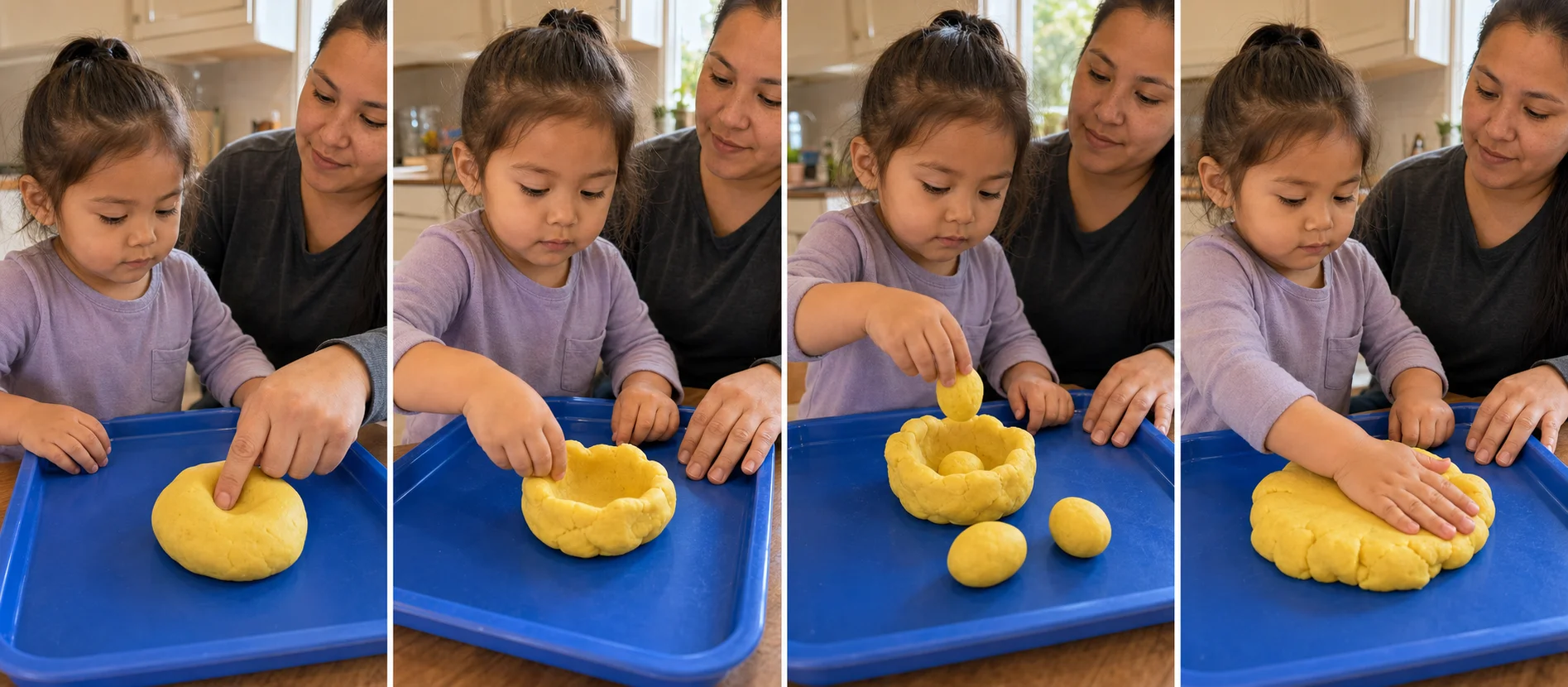
A sequence showing a child pressing a thumb hole, pinching the rim, rolling eggs, dropping them in, and squashing the dough to reset.
  1. 01
    Model one quick round: press a thumb hole, pinch a basket rim, roll one egg, drop it in, then squash everything back into a ball. Say, "Press, pinch, roll, drop. Your turn."
  2. 02
    Let your child press a hollow into the dough and pinch part of the edge into a little basket.
  3. 03
    Help your child roll a few dough eggs with thumb and fingertips, then drop them into the basket.
  4. 04
    Say, "Basket full," then let your child squash the basket and eggs back into one ball for another round.

Safety Check

  • Supervise closely if your child mouths non-food materials.
  • Keep rolled eggs large enough for your child to pick up easily, because tiny dough pieces can become mouthing or choking concerns.
  • Treat therapy putty as a play material, not food or taste-safe sensory material.
  • Stop or reset if the dough is thrown, mouthed, or spread outside the tray.
Supporting the play

What to say in the moment

Match what you say to what you see.

Prompt ladder
Level 1 (Start)
Press one thumb in and make a little nest.
Level 2 (Keep going)
Pinch one tiny wall around the nest.
Level 3 (Stretch)
Roll one egg and drop it in.
Level 4 (Extend)
Fill the basket, squash it, and build again.
If your child seems...
What you'd see
Focused
What to do
Say
"You are making the wall taller."
Add
"Count the egg after it lands."
Extend
"Try one slow egg and one fast egg."

Make it easier

Younger end
  • -Use a wider, shallow thumb hole so the basket does not need tall sides.
  • -Let your child pinch only one side of the rim before adding an egg.
  • -Roll one larger egg so it is easier to grasp and less tempting to mouth.

Make it harder

Older end
  • +Ask your child to roll each egg with fingertips instead of the whole palm.
  • +Build a basket that can hold three eggs before it gets squashed.
  • +Try pressing with one thumb and pinching with the other hand.

If it's not working

If you see
If child ignores it
Make one egg yourself, drop it in with a quiet "plop," then offer the dough ball back without adding more instructions.
If you see
If child misuses it
Pause, collect the dough, and restart with one simple job: "Press thumb here."
If you see
If child gets frustrated
Hold the ball steady while your child presses, or make the first shallow thumb dent and let your child pinch one edge.
Skill spotlight
Hand Strength

Thumb-and-fingertip control

This gives your child practice using small hand muscles to control pressure, shape soft material, and let go on purpose.

  • Pressing and pinching the dough gives your child repeated hand-strength practice in a small, visible task.
  • Rolling dough eggs with thumb and fingertips builds control without needing tiny loose parts.
  • Dropping each egg into the basket practices releasing on purpose, not just grabbing.
  • Squashing the basket into one ball gives the activity a clear reset, so repeating feels natural.
Real-world transfer
  • Holding crayons, spoons, and small toys with better finger control.
  • Using enough pressure for buttons, zips, and play tools.
  • Releasing small items into a bowl, cup, or container.
  • Staying with a short hand task from start to reset.

Parent questions