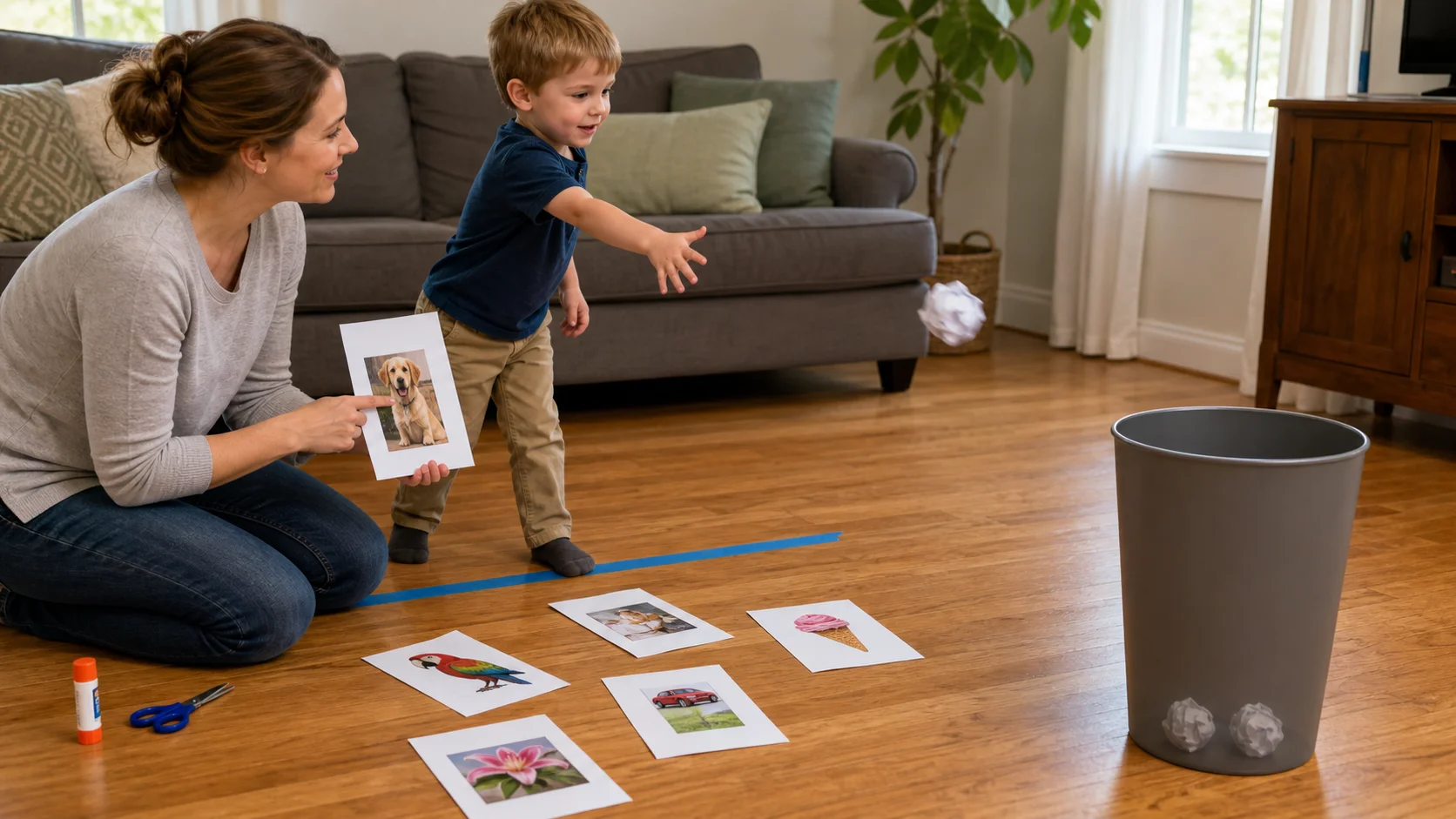
A preschooler crumpling a picture page while a grown-up points toward a tall wastebasket on the floor.
LiteracyObject Name`Indoor

Picture Toss.

Describe a picture, crumple the page, and toss it into a basket for a quick language game with a built-in payoff.

Play time
10-15+ min
Age
3 years
Energy
Medium
Mess
Low
Effort
Medium
Where
Indoor
Start here

The recipe.

Medium parent effort
6 things

What you need

  • A few magazine pictures, with a mix of familiar and newer items
  • Paper, full sheets or half-sheets
  • Scissors
  • Glue
  • Painter's tape
  • Tall wastebasket
10 min minimum

Setup

Then start the loop
Step 01
On a low table or the floor, help your child choose a few magazine pictures.
Step 02
On each sheet or half-sheet of paper, glue one picture so every toss has one clear thing to describe.
Step 03
On the floor, place the tall wastebasket with open space in front of it.
Step 04
On the floor, put a painter's-tape line about 3 to 4 feet from the wastebasket.
Step 05
Near the tape line, scatter the picture sheets so your child can choose one page at a time.
"Picture first."
The loop

How play unfolds.

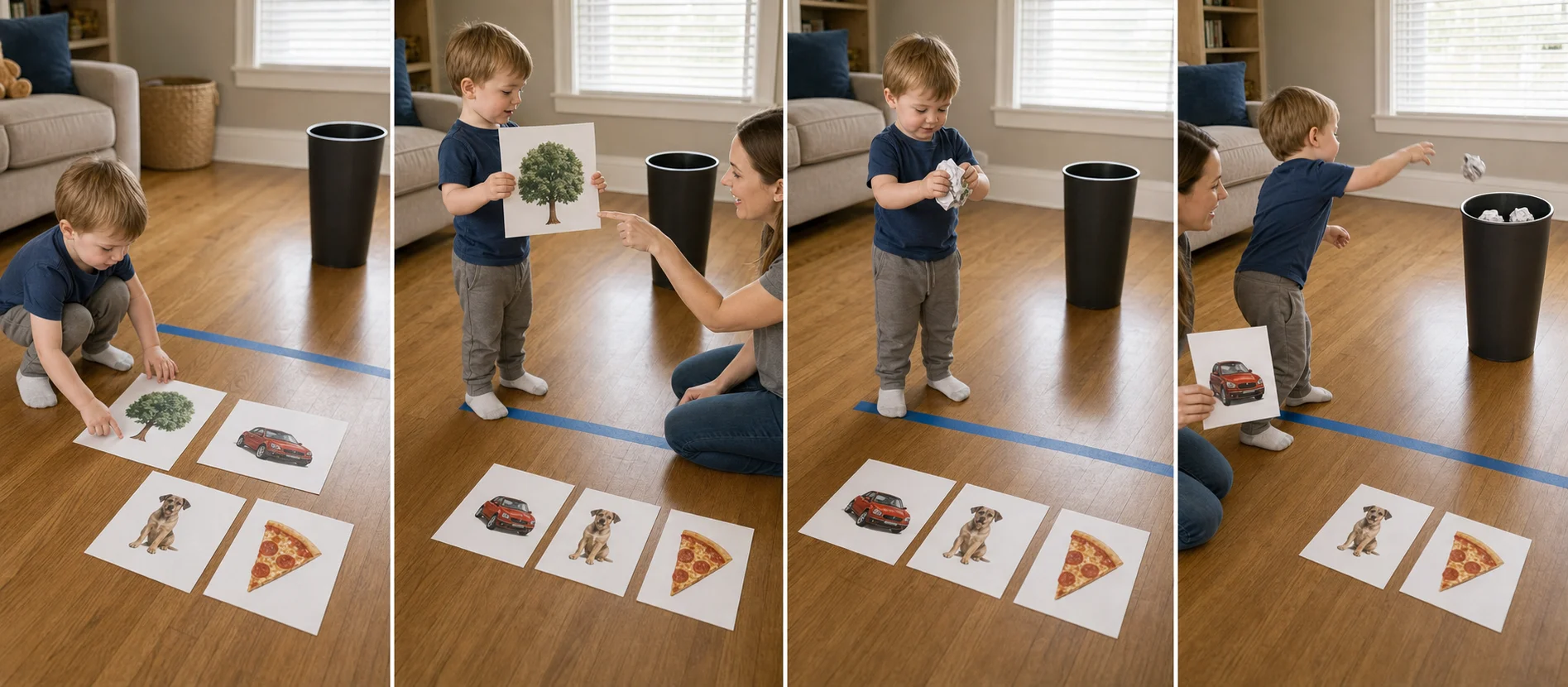
A child choosing a picture, describing it with a grown-up, crumpling the page, and tossing it into a wastebasket.
  1. 01
    Pick up one picture sheet and say, "Tell me about this picture. What do you see?"
  2. 02
    Let your child point, name, or describe what they notice.
  3. 03
    Repeat their idea and add one small detail if they are ready for more words.
  4. 04
    Have your child crumple that same page and toss it into the wastebasket from behind the tape line.
  5. 05
    Say, "Pick another picture," and repeat until the pages are gone or attention fades.

Safety Check

  • Supervise scissors and glue during setup.
  • Put the tape line on a floor surface where your child will not trip or slip while tossing.
  • Keep paper balls aimed at the wastebasket, not at people or fragile objects.
Supporting the play

What to say in the moment

Match what you say to what you see.

Prompt ladder
Level 1 (Start)
"Pick one picture and tell me one thing you see."
Level 2 (Keep going)
"Say one more word before you crumple it."
Level 3 (Stretch)
"Tell me what is happening in this picture."
Level 4 (Extend)
"Tell me where you might see this."
If your child seems...
What you'd see
Focused
What to do
Say
"Choose the next picture."
Add
Keep the toss turn quick.
Extend
Ask one picture question before crumpling.

Make it easier

Younger end
  • -Offer two face-up pictures and ask, "This one or this one?"
  • -Accept pointing, a sound, or one word before you model a short sentence.
  • -Start with familiar pictures so your child can succeed fast.

Make it harder

Older end
  • +Ask for one describing word, such as color, size, or action, before crumpling.
  • +Ask what the pictured object is used for on one round.
  • +Ask where your child has seen that thing before on one round.

If it's not working

If you see
If child ignores it
Pick one funny or familiar picture, describe it in a short sentence, crumple it with a little drama, and invite them to toss that page.
If you see
If child misuses it
If they throw before talking, hold the next page flat and say, "Words first, then toss." Accept pointing or one word before crumpling.
If you see
If child gets frustrated
Move the tape line closer, make the basket the adult's job for one round, or switch to dropping the paper ball into the basket from above.
Skill spotlight
Object Naming`

Naming and describing pictured objects

Naming and describing help a child put words on what they see, add one more detail, and stay in the short back-and-forth used in everyday conversation, book sharing, and asking for things.

  • The picture gives your child one clear thing to name or describe before the movement payoff.
  • Repeating the same talk, crumple, and toss order helps your child stay with a short routine.
  • Your added word or detail stretches the child's idea without turning the turn into a test.
  • The toss gives active children a reason to come back for another language turn.
Real-world transfer
  • Talking about pictures in books
  • Naming things seen on walks or in stores
  • Answering simple questions with more than one word

Parent questions