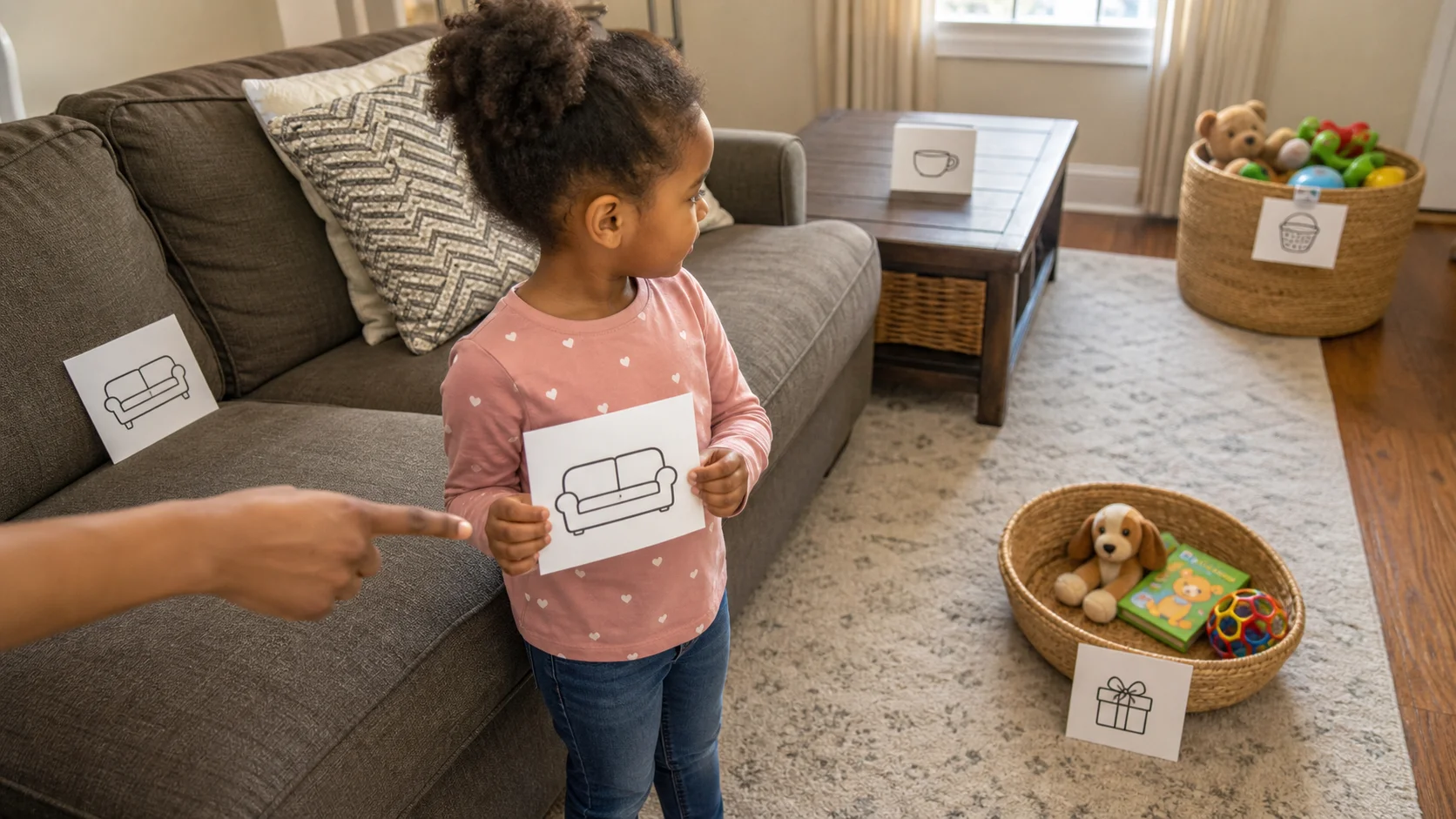
A preschooler holding a picture clue card while a grown-up points toward the next household stop.
LiteracyPrint NoticingIndoor

Picture Clue Hunt.

Follow word-and-picture clues through a short home route until the last card leads to a small prize.

Play time
10-15+ min
Age
4 years
Energy
Medium
Mess
Low
Effort
Medium
Where
Indoor
Start here

The recipe.

Medium parent effort
4 things

What you need

  • Paper
  • Markers or pencils
  • Printed clip art pictures or photos of household items
  • Small prize
10 min minimum

Setup

Then start the loop
Step 01
On paper, make 4 or 5 clue cards. Write a short direction like "Go to the..." and add a clear picture or photo of the household item at the end.
Step 02
Around your home, choose safe stops your child can reach without climbing, opening appliances, touching breakable items, or leaving your sight.
Step 03
At the first stop named by clue 1, place clue 2 where your child can spot it after arriving.
Step 04
Continue the route
put each next clue at the place named by the clue before it.
Step 05
At the final stop, hide the prize where your child can find it by looking, not climbing or reaching into something unsafe.
Step 06
In your hand, keep clue 1 to start the hunt.
"Clue time."
The loop

How play unfolds.

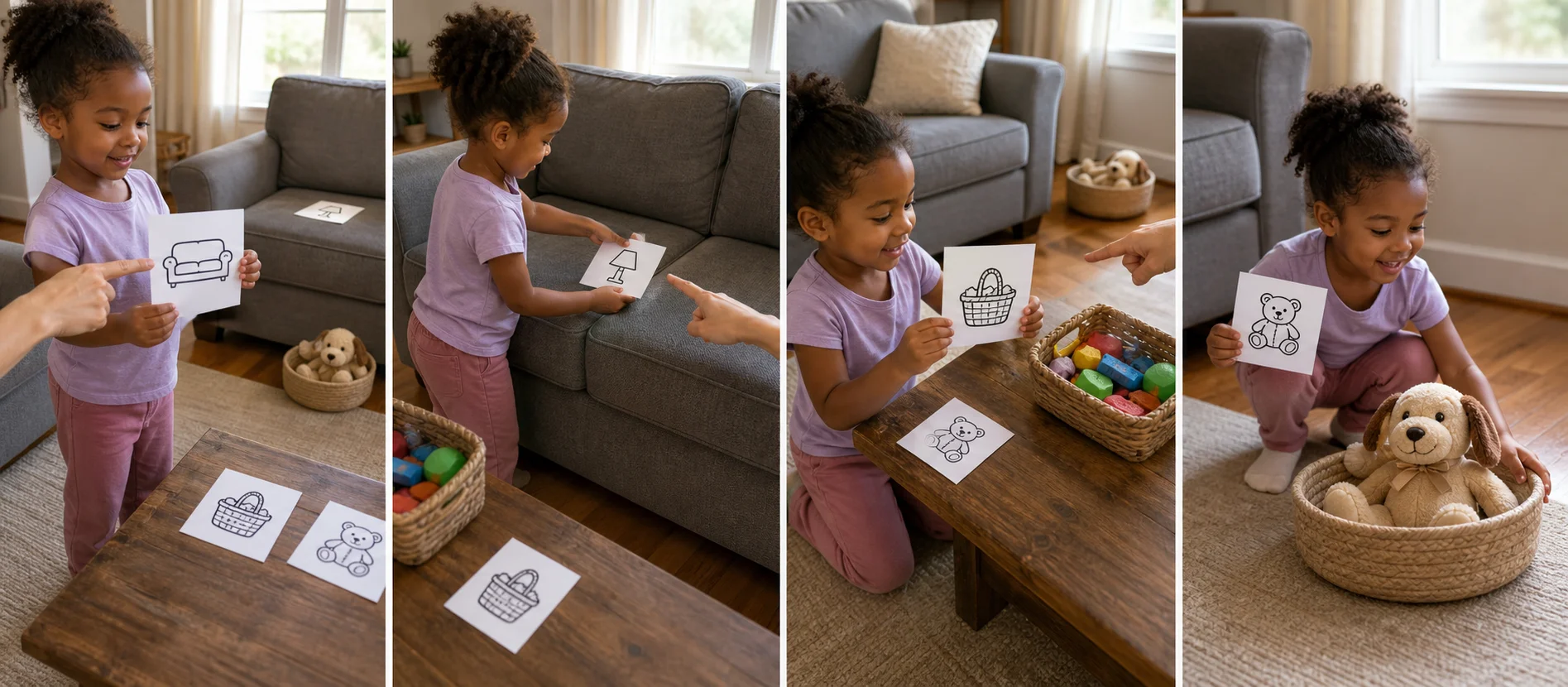
A child reading a picture clue, walking to the matching household item, finding the next card, and discovering the prize.
  1. 01
    Hand your child the first clue and say, "I will read the words, and you read the picture."
  2. 02
    Point-read the words, then pause so your child can name, point to, or guess the pictured place.
  3. 03
    Walk together to that place and let your child find the next clue card.
  4. 04
    Repeat the read, picture, walk, and find pattern until the final stop.
  5. 05
    At the last location, say, "This is the last clue. Look around for the prize."

Safety Check

  • Choose a prize that is too large to choke on.
  • Keep the route away from stairs, fragile shelves, closed rooms, hot appliances, and places where your child has to leave your sight.
  • Make each clue visible enough that your child is not digging, climbing, or pulling objects down to find it.
  • If the prize is food or a tiny novelty item, clean it up right away so it does not become a later choking or mess problem.
Supporting the play

What to say in the moment

Match what you say to what you see.

Prompt ladder
Level 1 (Start)
"Let's read the picture clue and walk to it."
Level 2 (Keep going)
"You found that one. What place is on this card?"
Level 3 (Stretch)
"Point to the word part first, then tell me the picture."
Level 4 (Extend)
"Lead me to the next clue and show me where to look."
If your child seems...
What you'd see
Focused
What to do
Say
"Show me the picture."
Add
Point to one word before the picture.
Extend
Let the child carry the card and choose the walking pace.

Make it harder

Older end
  • +Let the child point to the first word before naming the picture.
  • +Ask the child to remember the previous stop before opening the next clue.
  • +After the prize, let the child use one existing clue card to send you to that spot.

If it's not working

If you see
If child ignores it
Start with one obvious clue and an easy prize location. Read the clue with a playful voice, then walk to the pictured item together.
If you see
If child misuses it
If cards get crumpled, grabbed, or scattered, hold the current clue yourself and let your child touch only the picture before walking.
If you see
If child gets frustrated
Shrink the hunt to 2 or 3 clues, make the next card more visible, and offer a choice like "Is it the couch or the table?"
Skill spotlight
Print Noticing

Noticing that print gives a message

This helps the child notice that marks on a page can send people somewhere or tell them what to do.

  • The clue card gives print a useful job: it tells your child where to go next.
  • Pictures lower the reading load while still keeping attention on the card.
  • The repeated route helps your child practice checking the clue, moving to the place, and finding the next step in order.
Real-world transfer
  • Noticing signs, labels, lists, and notes
  • Understanding that written words can tell people what to do
  • Following simple picture-and-word directions
  • Moving through a short routine in order

Parent questions