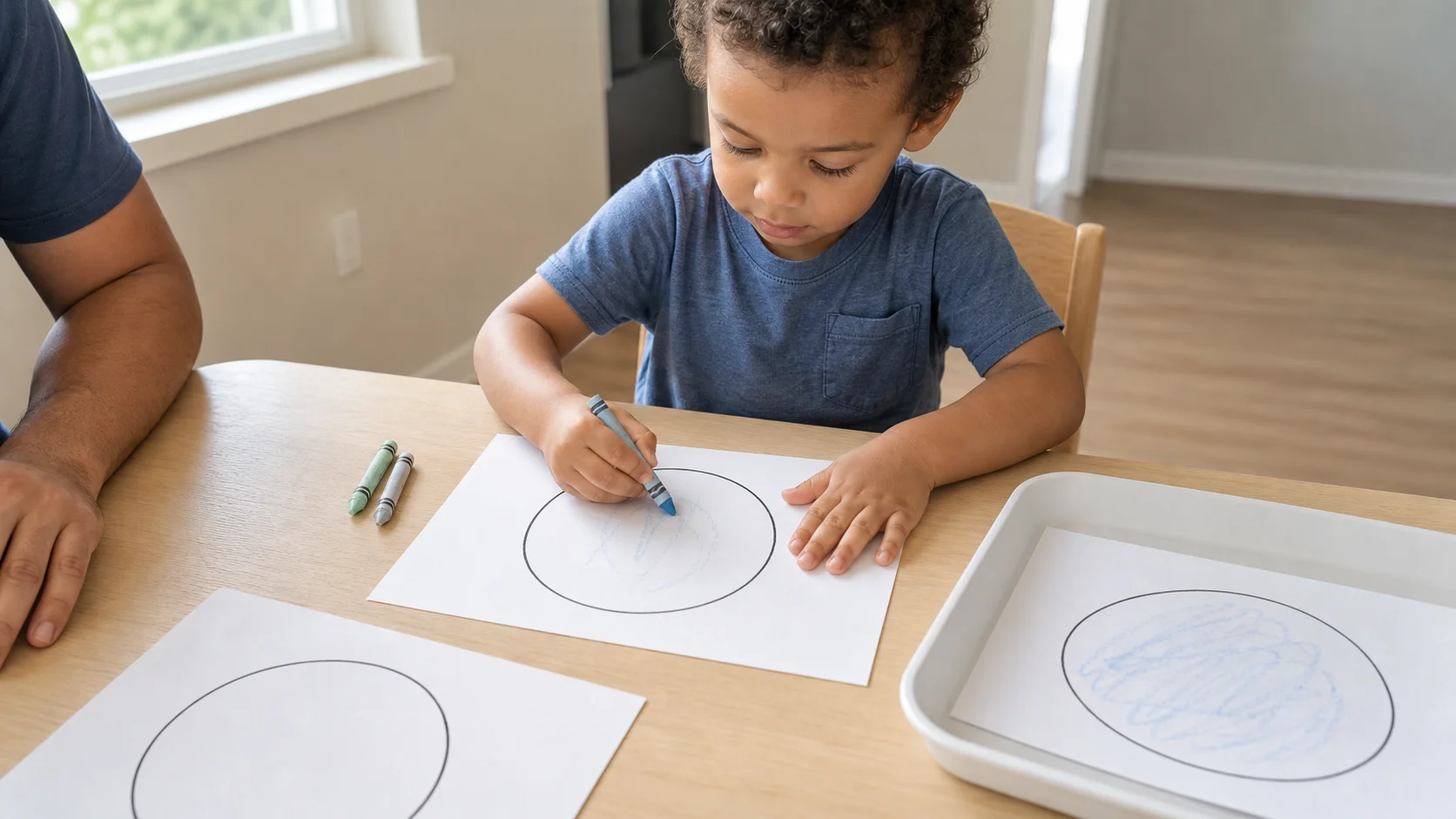
Toddler coloring a simple shape with a pale crayon at a quiet table with a done tray nearby
Skill builderSensory-friendly supportAutism supportFinish And ResetIndoor

Pastel Shape Fill.

One pale crayon, one simple outline, and a done spot make coloring easier to enter and easier to end.

Play time
3-7+ min
Age
2-4 years
Energy
Low
Mess
Low
Effort
Low
Where
Indoor
Start here

The recipe.

Low parent effort
6 things

What you need

  • 2 to 4 sheets of paper with large simple outlines
  • 1 to 3 light-colored crayons or pastel crayons
  • 1 low-busyness table, tray, clipboard, or floor mat
  • 1 clear done spot, folder, or tray
  • 1 adult
  • 1 child
3 min minimum

Setup

Then start the loop
Step 01
In a quiet indoor spot, choose a place where the child will not face a screen, busy shelf, bright window, or clutter pile.
Step 02
On a low-busyness table, tray, clipboard, or floor mat, place one large simple outline page.
Step 03
Beside the paper, place one light-colored crayon or pastel crayon within the child's reach.
Step 04
Near the work surface but outside the child's main view, keep up to two extra pale crayons and one or two extra outline pages.
Step 05
Beside the paper, place the folder, tray, or done spot where the child can slide the page when finished.
Step 06
Sit beside the child without crowding the page.
"Soft color starts here."
The loop

How play unfolds.

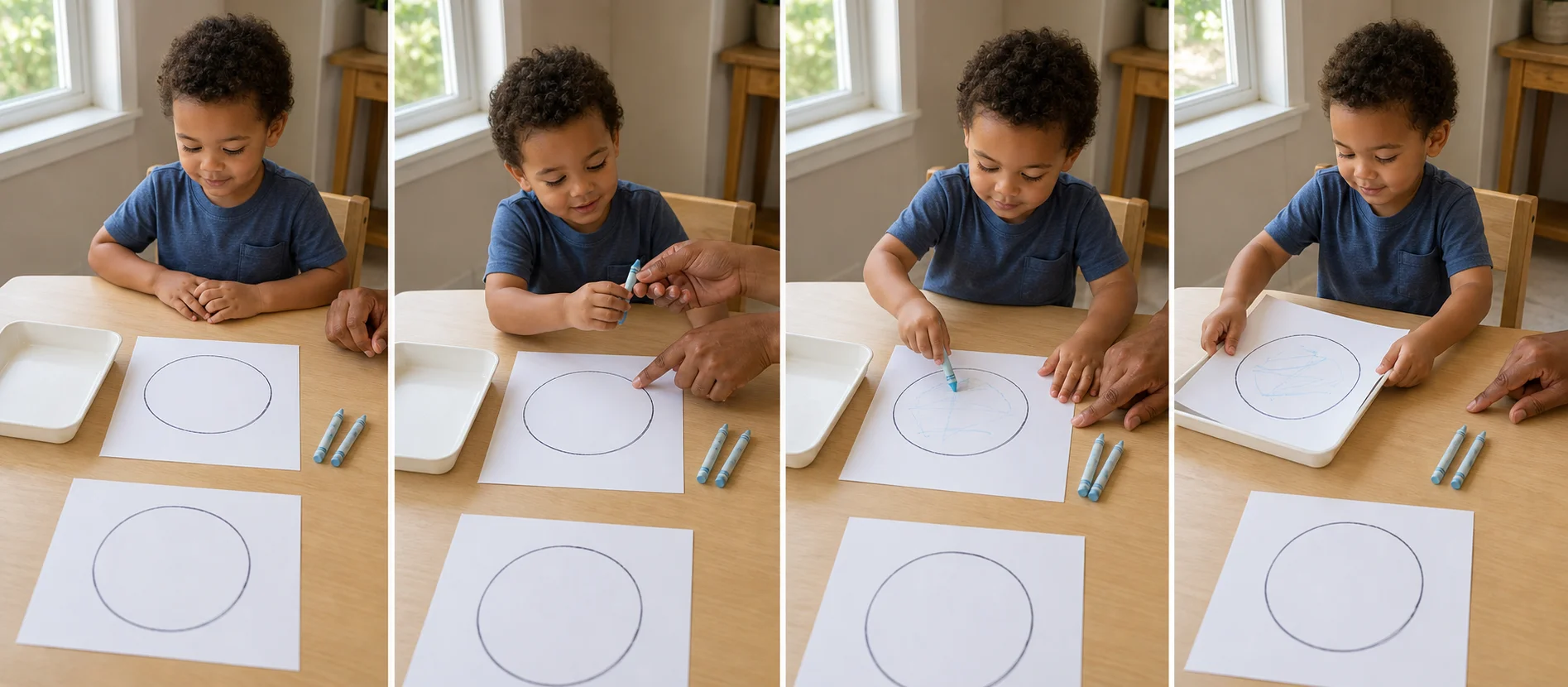
Sequence showing a toddler choosing a pale crayon, marking a simple outline, sliding the page to done, and starting one new page
  1. 01
    Offer the pale crayon and say, "Color anywhere on this shape, then it goes here when you're done."
  2. 02
    Let the child make any mark inside, on, or across the outline while you steady the page if needed.
  3. 03
    Name one visible thing, such as "soft blue" or "long line."
  4. 04
    When the child pauses, pushes the paper away, or says done, point to the done spot and say, "Done goes here."
  5. 05
    Count the round complete when the page is in the done spot. To repeat, clear the finished page and offer one new outline with one pale crayon.

Safety Check

  • Use whole, hand-fitting crayons or pastel crayons and supervise if the child mouths or breaks crayons.
  • Keep the surface low-clutter and away from bright screens, busy displays, and visual distractions.
  • Stop or simplify if the child pushes the page away, avoids the crayon, breaks or mouths the crayon, or seems visually overwhelmed.
Supporting the play

What to say in the moment

Match what you say to what you see.

Prompt ladder
Level 1 (Start)
Put the pale crayon in the child's hand and point to one quiet part of the shape.
Level 2 (Keep going)
Name the mark the child just made and invite one more soft mark.
Level 3 (Stretch)
Ask the child to color a new part of the same outline before sliding it to done.
Level 4 (Extend)
Offer the next plain outline only after the finished page is in the done spot.
If your child seems...
What you'd see
Focused
What to do
Say
"You found the shape."
Add
Name one color, shape, or line the child is already touching.
Extend
Invite one more mark on an empty part of the outline.

Make it easier

Younger end
  • -Rotate the paper so the child can color the closest side without reaching across the page.
  • -Let the child take the crayon from your open palm instead of picking from the table.
  • -Count three calm marks as a finished page when the child needs a shorter round.

Make it harder

Older end
  • +Let the child choose between two pale crayons before the round starts.
  • +Ask the child to fill two different parts of the same outline before moving it to done.
  • +Let the child start the next round by placing the new outline page on the work surface.

If it's not working

If you see
If child ignores it
Start with one adult mark on the edge of the shape, then hand the crayon back and say, "Your turn for one soft line."
If you see
If child misuses it
If the crayon goes in the mouth, gets thrown, or breaks, pause the activity, remove the crayon, and offer one supervised mark or end the round.
If you see
If child gets frustrated
Shrink the job to one line, one dot, or moving the page to the done spot. Count that as a completed round.
If you see
If child wants brighter colors or more materials
Say, "This is the soft-color round," and offer a choice between two pale crayons only.
Skill spotlight
Finish And Reset

Finish-and-reset routine, Calm crayon control

This helps a child practice ending one small task, putting the finished piece where it belongs, and resetting without a messy or loud transition.

  • One visible page and one pale crayon reduce the number of choices your child has to manage.
  • The done spot gives the activity a concrete ending instead of a vague "color more" request.
  • Any calm mark can complete a round, so the child can practice finishing without filling the whole shape.
  • Clearing the finished page before the next one keeps the reset predictable.
Real-world transfer
  • Putting finished artwork away.
  • Ending a table activity without a big cleanup.
  • Moving from one quiet task to the next.
  • Using a simple finished spot for papers, books, or small projects.

Parent questions