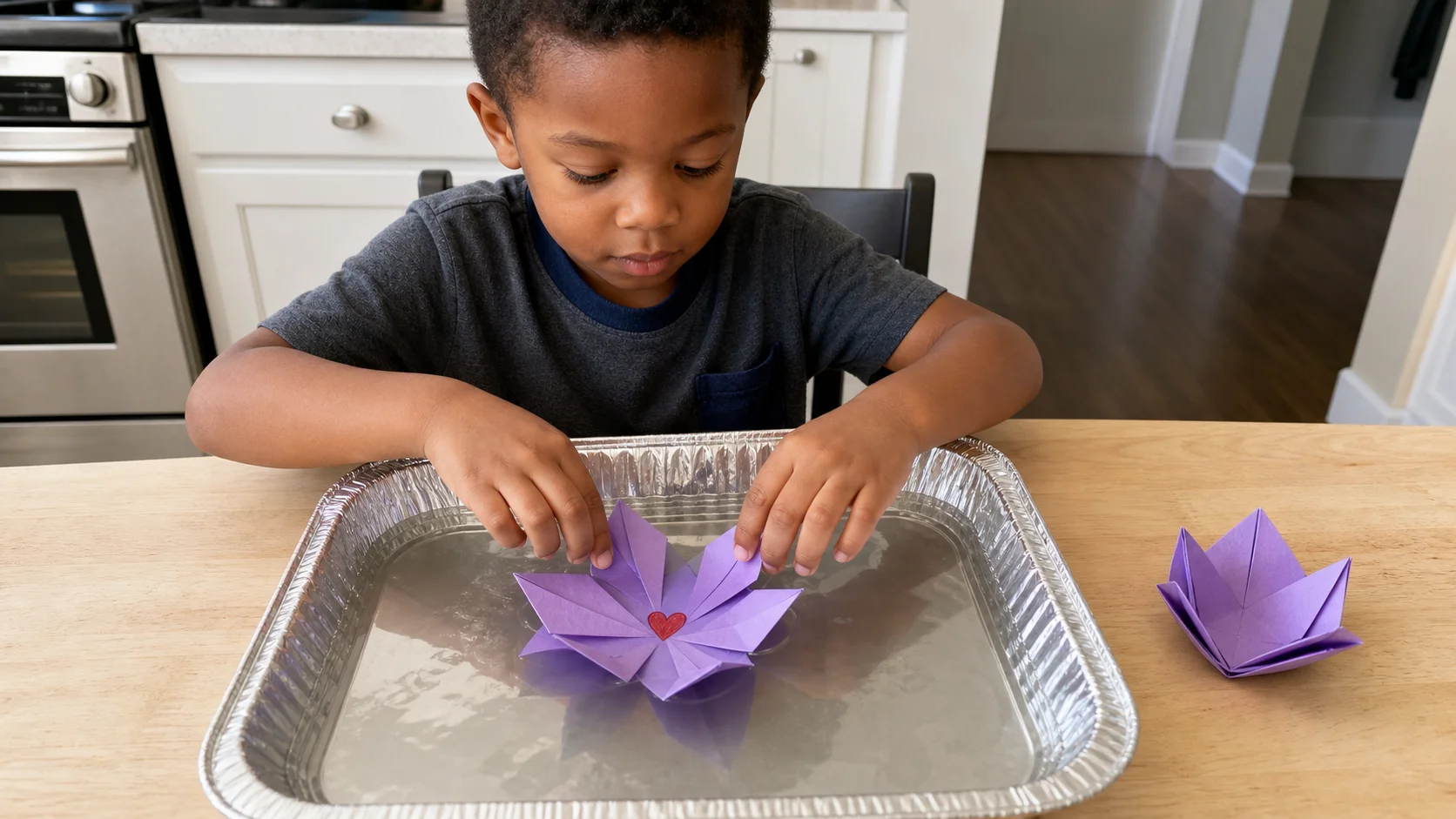
Preschool child placing a folded paper flower onto a shallow foil pan of water while a grown-up sits nearby.
Fine motorTwo Hand CoordinationIndoor

Paper Water Lily Bloom.

A folded paper flower opens on the water and gives your child a quick, satisfying fine motor reveal.

Play time
5-10+ min
Age
3-5 years
Energy
Low
Mess
Low
Effort
Medium
Where
Indoor
Start here

The recipe.

Medium parent effort
5 things

What you need

  • 1 foil pan
  • water
  • 1 sheet of construction paper
  • 1 marker
  • scissors for adult prep
5 min minimum

Setup

Then start the loop
Step 01
On a flat indoor table or floor spot, set the foil pan down and fill it with about 1 inch of water.
Step 02
Beside the pan on a dry surface, draw 2 paper flowers with pointed petals, add a small heart to the center of each, and cut them out before your child starts.
Step 03
Next to the pan, place both flowers flat and dry, keeping the second flower far enough back that splashes will not reach it before its turn.
Step 04
Out of reach, move the scissors away, sit beside your child, and keep one hand ready to steady the pan for the first turn if needed.
`Fold in. Soft on top.`
The loop

How play unfolds.

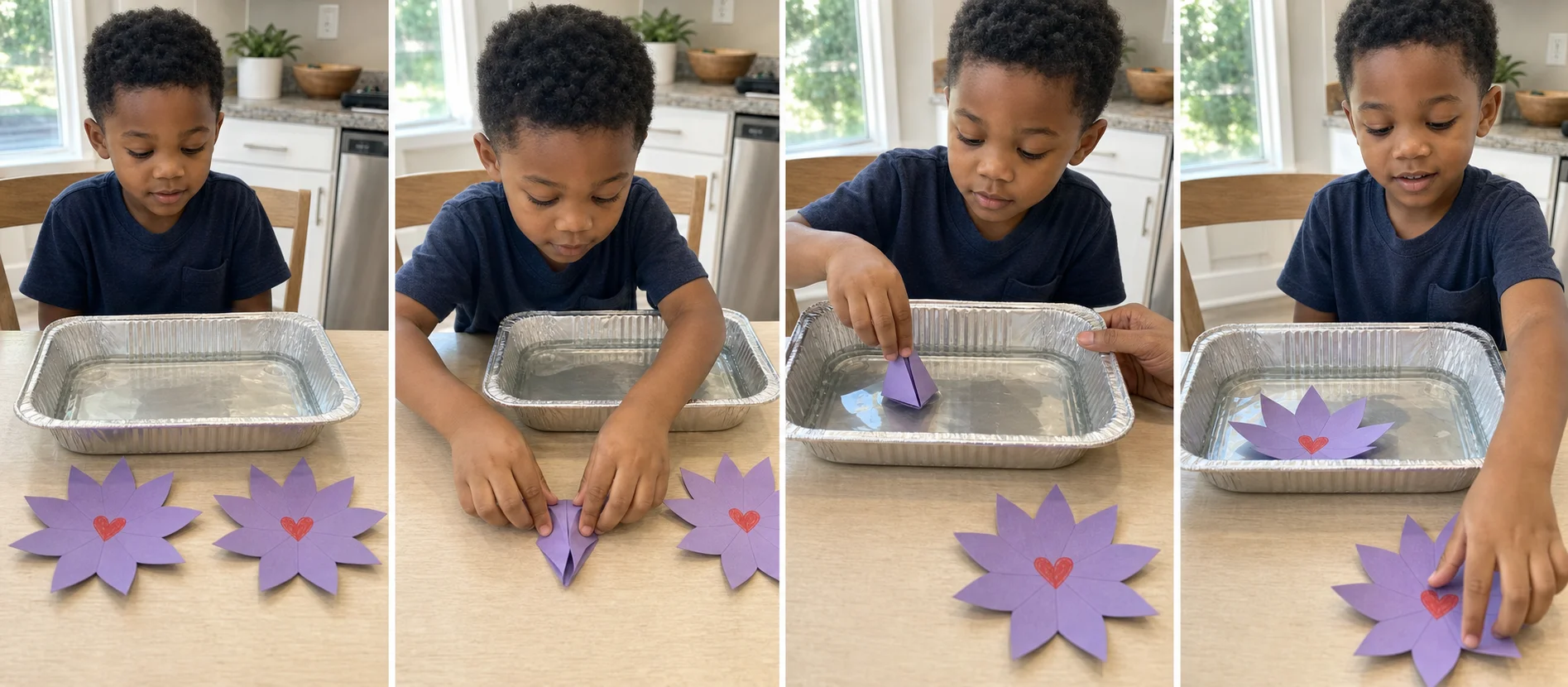
Sequence showing a child folding paper petals inward, setting the flower on water, and watching it open to reveal a heart.
  1. 01
    Hand your child 1 dry flower and say, `Fold it closed.`
  2. 02
    Let your child fold the petals in and lay the flower flat on the water.
  3. 03
    Watch the petals open and reveal the heart.
  4. 04
    Try the second dry flower and repeat, then stop after both blooms or sooner if your child is done.

Safety Check

  • Stay close throughout the activity because water play still needs adult supervision.
  • Keep the scissors in the adult-only setup portion and smooth any rough paper or foil edges before play starts.
  • Wipe splashes right away so the nearby floor or table edge does not get slippery.
Supporting the play

What to say in the moment

Match what you say to what you see.

Prompt ladder
Level 1 (Start)
`Close it up. Set it on top.`
Level 2 (Keep going)
`Soft hands. Watch it bloom.`
Level 3 (Stretch)
`Can you make this one even gentler?`
Level 4 (Extend)
`Let's do one quick bloom, then one slow bloom.`
If your child seems...
What you'd see
Focused
What to do
Say
`You are making it bloom with soft hands.`
Add
`Ask one quick prompt like, "Where is the heart?"`
Extend
`Move straight to the second flower while your child still wants another reveal.`

Make it easier

Younger end
  • -Pinch a small starter crease into each petal before handing the flower to your child.
  • -Turn the pan so your child can place the flower from the closest edge instead of reaching across the middle.
  • -Keep the second flower out of sight until the first bloom is finished so there is only one choice to manage.

Make it harder

Older end
  • +Ask your child to close every petal neatly before the flower touches the water.
  • +Try the second flower with your child placing it nearer the middle of the pan without splashing.
  • +Do 1 turn with only a short `soft on top` reminder and let your child control the rest.

If it's not working

If you see
If child ignores it
Bloom the first flower yourself, say `Watch it open,` and hand your child the second dry flower right away for the next turn.
If you see
If child misuses it
If the flower opens early, gets dunked, or gets too wet to close, refold it once while it is still dry. If it is already soaked or torn, set it aside, wait for still water, and switch to the next dry flower.
If you see
If child gets frustrated
Fold the first 1 or 2 petals together, guide the flower to the water edge, and count 1 opened flower as enough.
Skill spotlight
Two-Hand Coordination

Using both hands together to fold and float the flower

This helps your child use both hands on 1 delicate paper job, change hand pressure without crushing the piece, and finish a short craft sequence with more control.

  • Folding each petal in gives your child a small two-hand paper job that ends with a clear visual payoff.
  • The flower either opens on the water or it does not, so the feedback is immediate without needing a lot of extra talk.
  • Keeping the game to one short fold-place-watch turn at a time makes fine motor practice easier to enter for a child who wants quick results.
Real-world transfer
  • Holding 1 part steady while the other hand adjusts it
  • Setting light or wet items down with more care
  • Handling paper, crayons, and other quiet table materials without crushing or dropping them

Parent questions