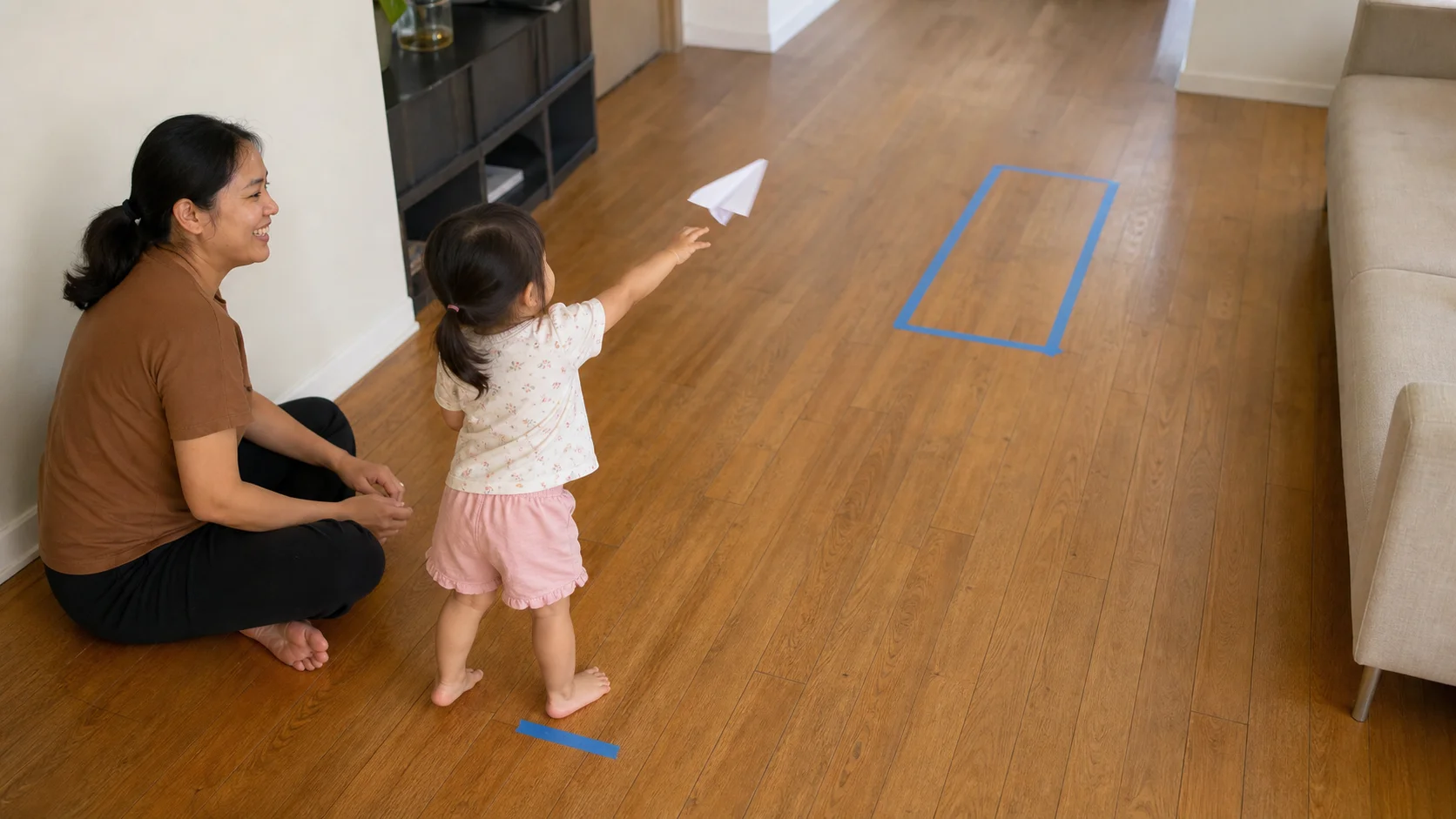
A toddler launching a simple paper plane toward a nearby landing strip while a grown-up sits beside the start spot.
Skill builderRepeat LoopIndoor

Paper Plane Launch.

One paper plane and one short landing strip turn throw-and-chase energy into a repeatable indoor game.

Play time
5+ min
Age
2-3 years
Energy
Medium
Mess
Low
Effort
Medium
Where
Indoor
Start here

The recipe.

Medium parent effort
5 things

What you need

  • 1 sheet of lightweight paper folded into 1 very simple paper airplane
  • 1 landing strip made from painter's tape or 1 sheet of paper
  • 1 open indoor floor space
  • 1 child
  • 1 adult
5 min minimum

Setup

Then start the loop
Step 01
On the floor or at a low-table start spot, place the ready paper airplane directly in front of your child.
Step 02
On the floor a few toddler steps ahead, place the landing strip where a gentle toss can reach it without hard throwing.
Step 03
Between the start spot and the strip, clear the lane so your child can walk out and back without stepping over toys, then stay beside your child ready to smooth the same plane between turns.
Plane ready. Send it.
The loop

How play unfolds.

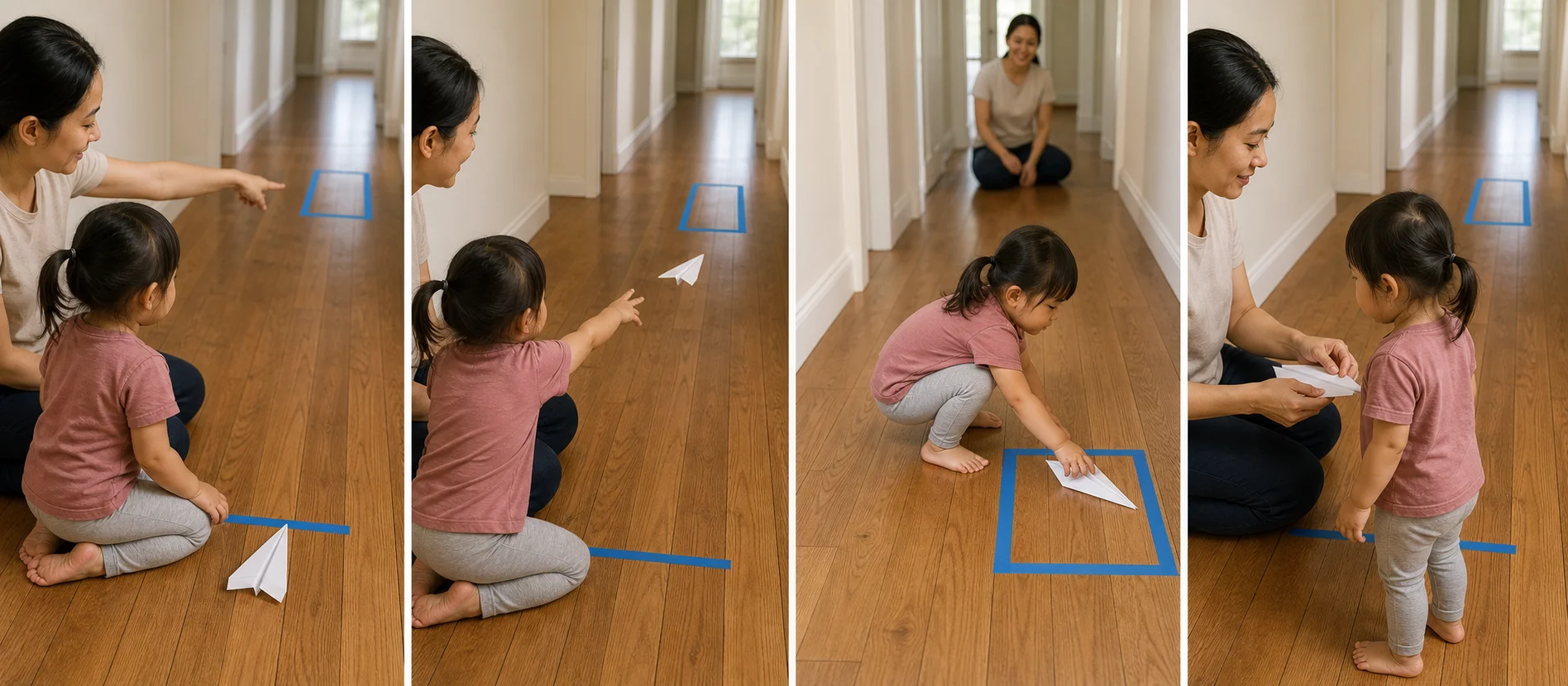
A multi-panel sequence showing a child launching a paper plane, walking to pick it up, bringing it back, and launching again from the same spot.
  1. 01
    Help your child press the plane flat if needed, point it toward the strip, and say, `Send it.`
  2. 02
    Let your child launch the plane, walk to it, and bring it back to the same start spot.
  3. 03
    Smooth the same plane if it bent on landing and hand it back ready for the next turn.
  4. 04
    Repeat for a few calm send-and-return rounds, or stop after one good turn if attention drops.

Safety Check

  • Stay close so the paper airplane does not hit faces or eyes during excited throws.
  • Keep the throwing lane away from stairs, sharp corners, and other people so the pickup turn does not become a running chase.
  • Stop if throws start aiming at people or the return path no longer feels safe.
Supporting the play

What to say in the moment

Match what you say to what you see.

Prompt ladder
Level 1 (Start)
Send the plane.
Level 2 (Keep going)
Bring it back.
Level 3 (Stretch)
Aim for the strip.
Level 4 (Extend)
Choose slow or fast.
If your child seems...
What you'd see
Focused
What to do
Say
Plane ready. Send it.
Add
Name one action only, like throw or back.
Extend
Let your child choose slow or fast for the next toss while keeping the same throw-and-return loop.

Make it easier

Younger end
  • -Keep the plane in the same hand each turn so the grip never changes.
  • -Place the landing strip at the closest end of the setup range so the throw stays tiny.
  • -Let the turn count if the plane lands anywhere in the clear lane, not only on the strip.

Make it harder

Older end
  • +Ask your child to point the plane nose at the strip before each throw.
  • +Pause one beat at the start spot before the toss so the same sequence resets each round.
  • +Try for 2 throws in a row that land on or near the strip.

If it's not working

If you see
If child ignores it
Do one very short toss yourself, walk out together to get it, and offer one shared turn back at the start spot.
If you see
If child misuses it
If the plane gets crushed, whipped at people, or carried away, take over the reset and only hand it back when the lane is clear for one gentle toss.
If you see
If child gets frustrated
Shorten the distance, count a tiny forward toss as a full turn, and end after one successful send-and-return.
Skill spotlight
Launch And Return Loop

Repeating a short launch-and-return routine, Holding onto one simple movement sequence

This helps a child hold onto a short movement plan, remember that the turn is not over after the throw, and carry the action through the return.

  • Launching, walking back, and starting again helps your child finish a short routine instead of stopping after the first throw.
  • Using the same strip and start spot each round makes the next step easier to picture.
  • Smoothing the same plane and trying again gives your child a simple reason to notice what changed on the next send.
Real-world transfer
  • Carrying out short go-get-it-and-bring-it-back routines
  • Sticking with a simple movement plan instead of stopping after the first action
  • Trying another turn after a short miss or bent flight

Parent questions