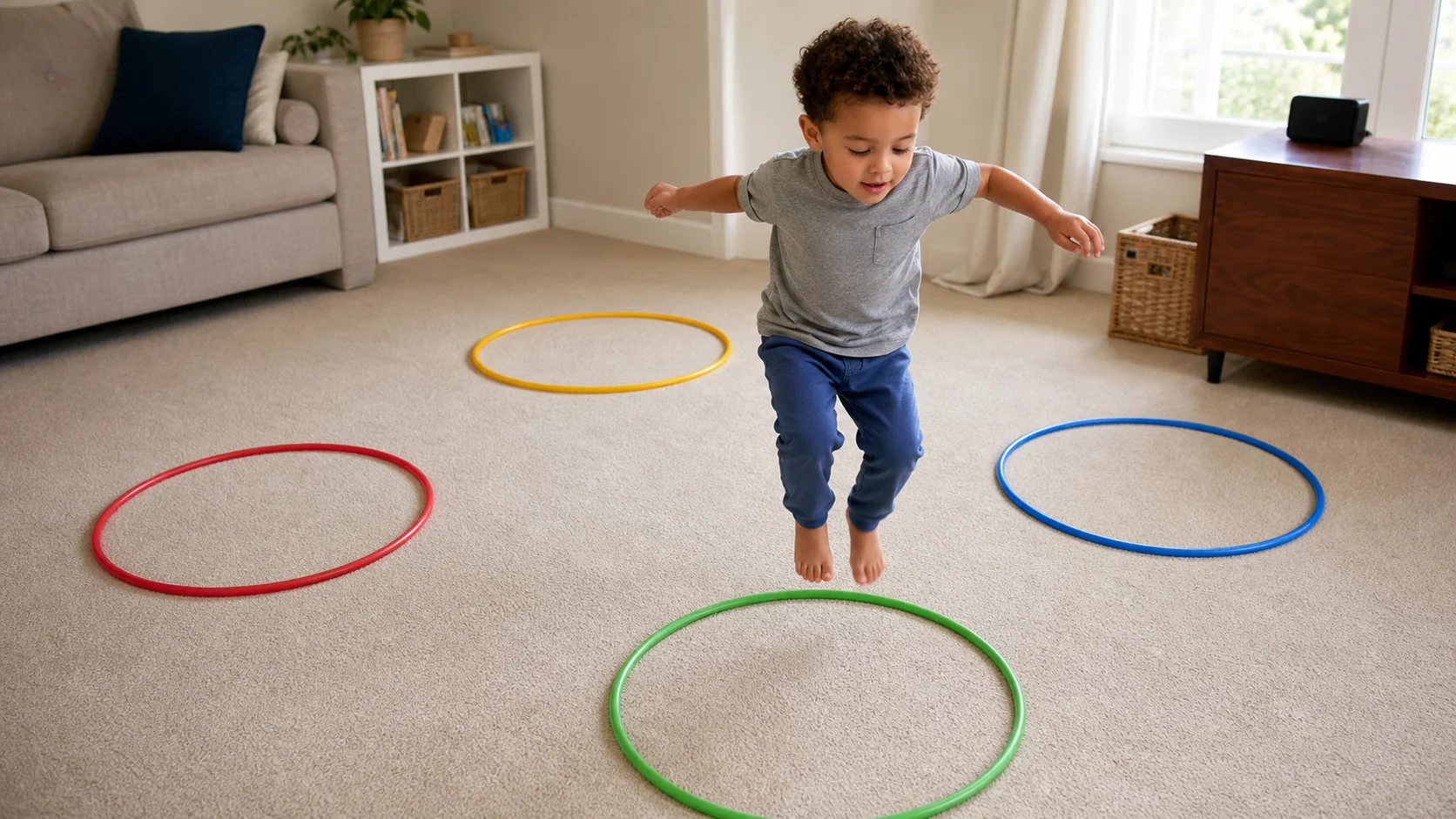
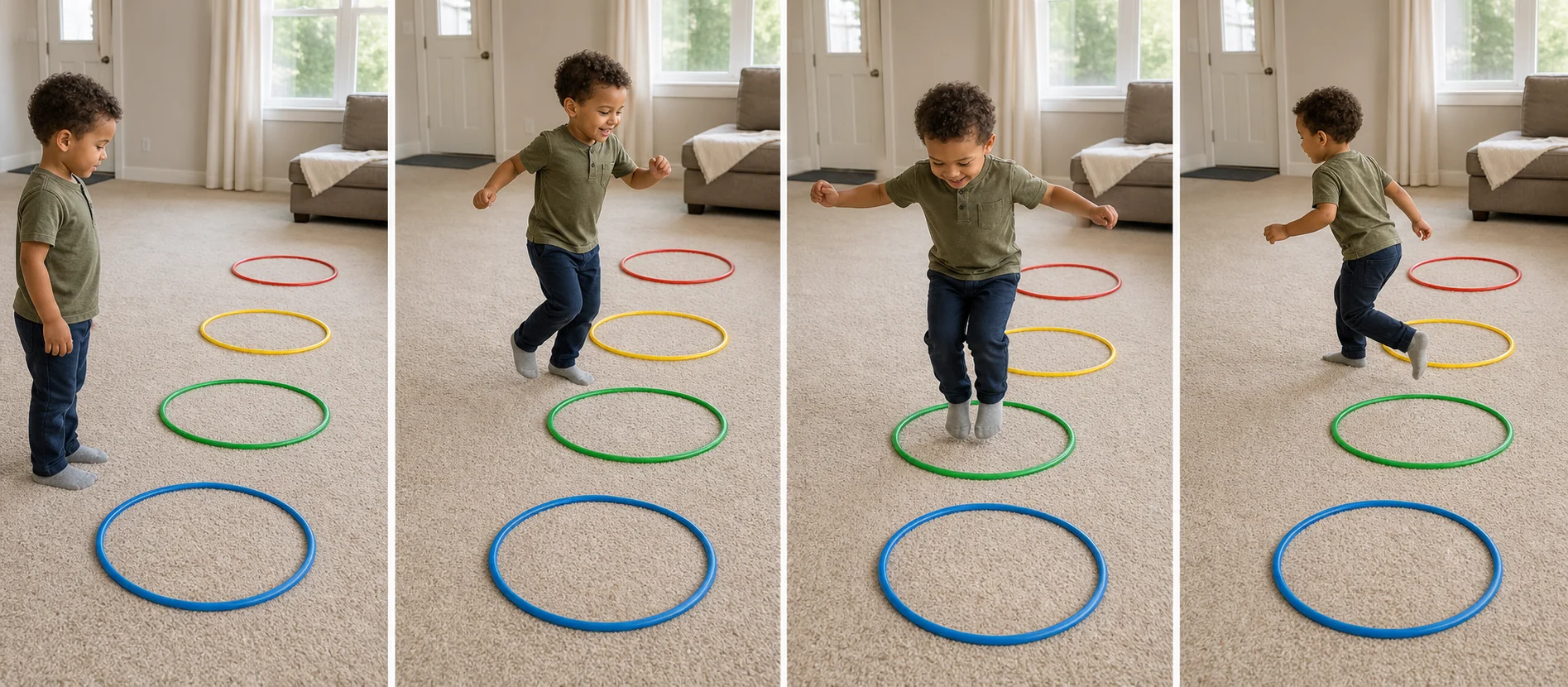
A toddler dancing between floor islands made from hoops or blankets, then hopping onto one when the music stops.
Fine motorStop And StartIndoor Or Outdoor

Musical Islands.

A low-prep stop-and-go game where your child dances between floor islands and hops onto one each time the music stops.

Play time
10-15+ min
Age
2-4 years
Energy
High
Mess
Low
Effort
Low
Where
Indoor Or Outdoor
Start here

The recipe.

Low parent effort
2 things

What you need

  • music
  • at least 1 play hoop, carpet square, or baby blanket per child
10 min minimum

Setup

Then start the loop
Step 01
On the floor or ground in a wide open space, put one hoop, carpet square, or baby blanket per child.
Step 02
On the floor or ground, spread the islands far enough apart that your child can move between them without stepping on one by accident.
Step 03
Around the play space, clear hard obstacles and keep the music control within easy reach.
"Dance around."
The loop

How play unfolds.

A child dancing through open space, stopping on the music cue, and hopping onto a nearby floor island before the next round starts.
  1. 01
    Start the music and say, "Dance around the islands."
  2. 02
    Stop the music and let your child hop onto a nearby island.
  3. 03
    Start the music again so your child leaves the island and keeps moving for the next round.

Safety Check

  • Keep enough room between the islands so children do not bump into each other on the stop cue.
  • Use a surface where hoops, carpet squares, or blankets will not slide or bunch underfoot.
  • Move the game away from hard obstacles so a quick stop or hop does not turn into a fall.
Supporting the play

What to say in the moment

Match what you say to what you see.

Prompt ladder
Level 1 (Start)
"Music on. Dance around the islands."
Level 2 (Keep going)
"Keep moving. Stop and hop."
Level 3 (Stretch)
"Try a new island this time."
Level 4 (Extend)
"Can you freeze, then hop?"
If your child seems...
What you'd see
Focused
What to do
Say
"You heard it stop."
Add
Name one move, such as march or spin.
Extend
Ask for a different island on the next round.

Make it easier

Younger end
  • -Use fewer islands in the space so the target feels obvious.
  • -Keep the music slow enough that your child can notice the stop cue.
  • -Start each round with your child already near an island.

Make it harder

Older end
  • +Let the music play longer before the stop cue.
  • +Encourage your child to reach a different island each round.
  • +Add one still freeze before the hop.

If it's not working

If you see
If child ignores it
Join the dance, keep the round short, and stop the music fast so your child can copy you.
If you see
If child misuses it
Pause the music, get everyone off the islands, and restart with "Music on means dance."
If you see
If child gets frustrated
Let your child walk to the nearest island instead of hopping, and stop the music when your child is already close to one.
Skill spotlight
Stop And Start

Stopping and starting the body on a signal, Landing on a clear target with control

This helps with active games, group movement, and everyday moments when a child has to pause their body, steady themselves, and start again.

  • The stop cue gives your child a clear reason to pause and restart their body.
  • Hopping to an island adds balance, timing, and a visible target.
  • Repeating the same loop gives active listening a lot of practice without extra explanation.
Real-world transfer
  • Stop-and-go games
  • Movement in group play or music time
  • Pausing the body and starting again during everyday transitions