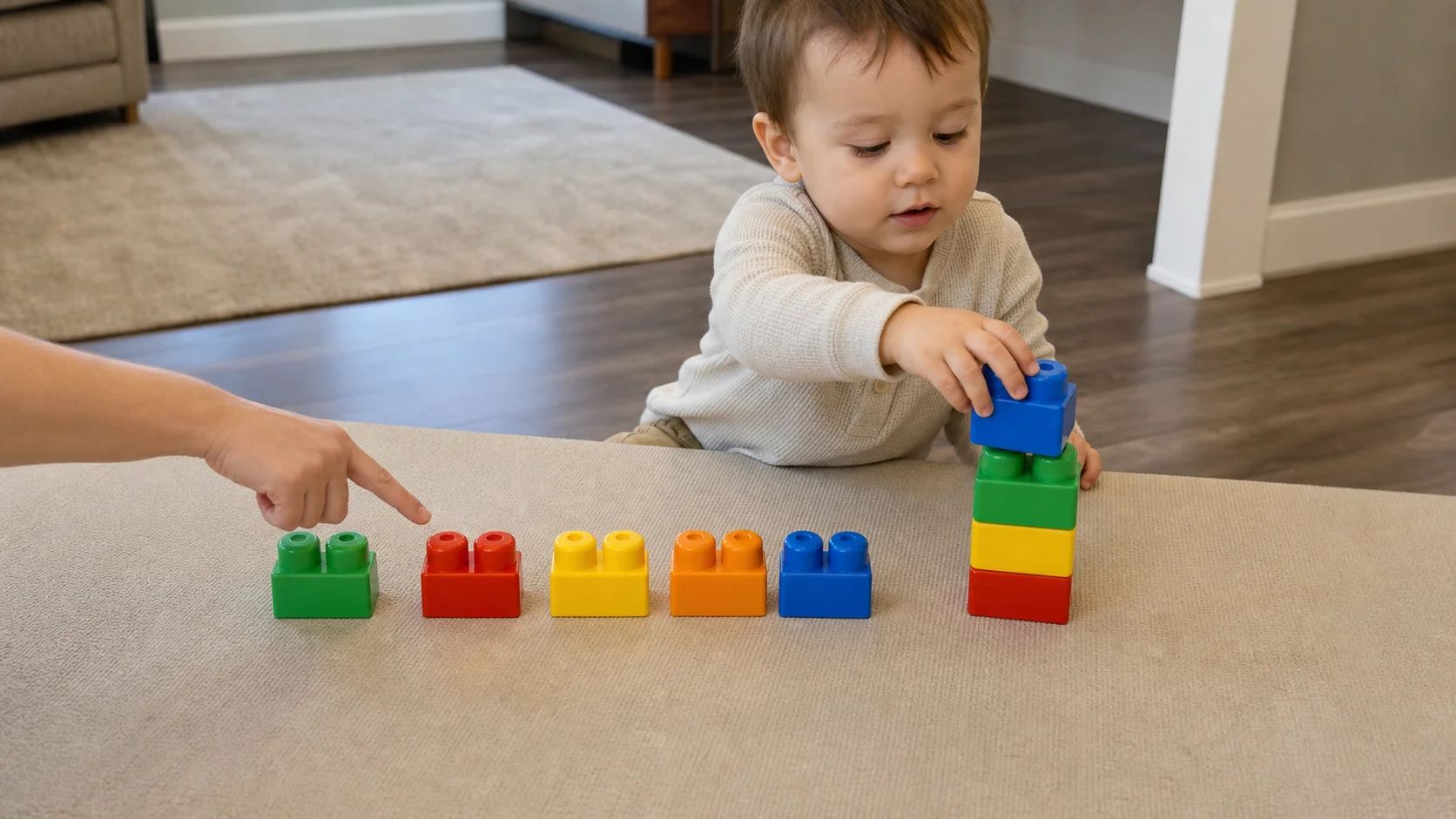
A toddler placing a large Mega Block onto a short tower beside a neat row of blocks on a low table while a grown-up points to the next block.
Fine motorAutism supportPlace With ControlIndoor

Mega Block Strip Stack.

A short left-to-right row of Mega Blocks gives your child one simple job: stack the next block onto the tower.

Play time
5-10+ min
Age
1-3 years
Energy
Low
Mess
No
Effort
Low
Where
Indoor
Start here

The recipe.

Low parent effort
2 things

What you need

  • A few Mega Blocks
  • 1 flat floor or table surface
5 min minimum

Setup

Then start the loop
Step 01
On the floor or at a low table, put a few Mega Blocks in a short row from left to right where your child can see each one clearly.
Step 02
Beside that row, leave one empty tower spot where the next block can always go.
Step 03
Sit close enough to point to the next block and steady the tower if it tips.
"Stack it."
The loop

How play unfolds.

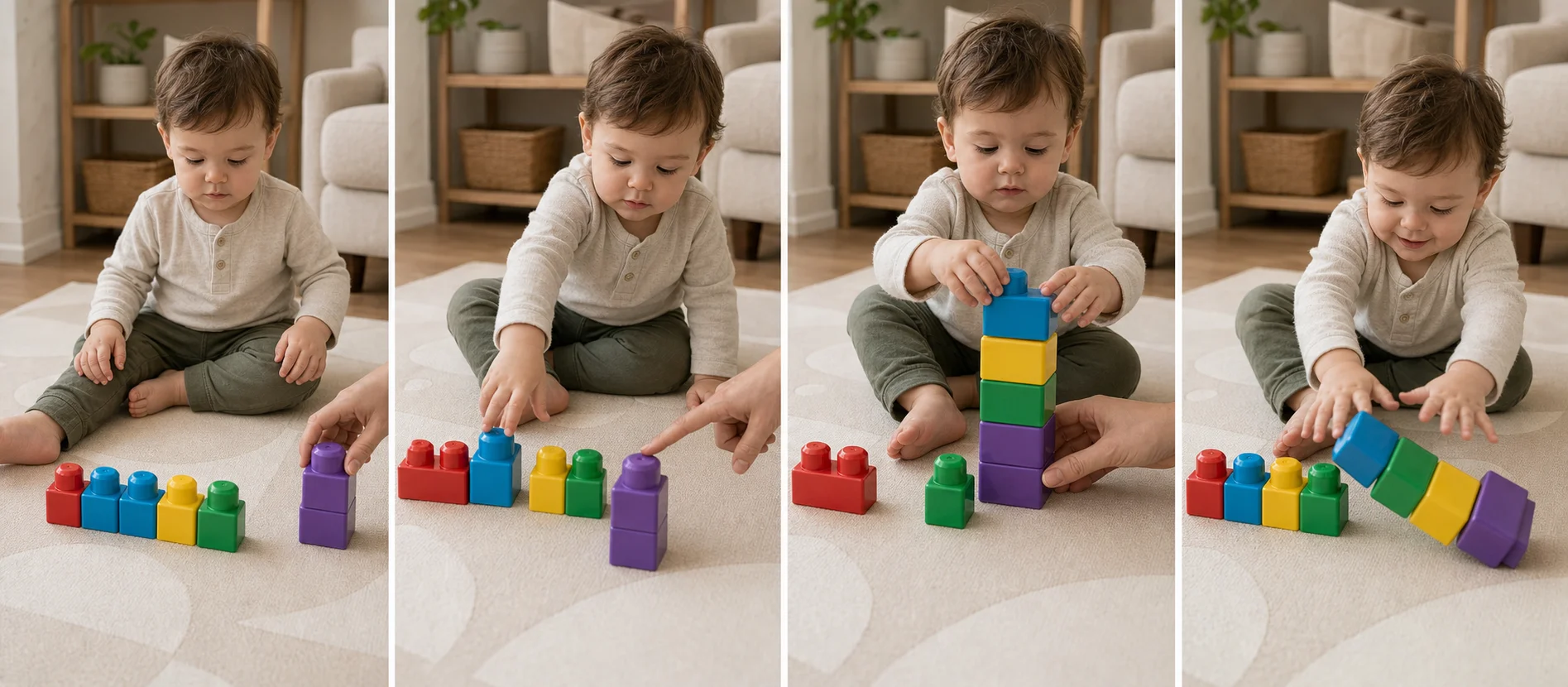
Four panels showing a grown-up setting out a short row of Mega Blocks, modeling the first stack, a child adding the next block to the tower, and the child knocking down the finished tower.
  1. 01
    Stack the first Mega Block yourself and say, "Blocks stack. Your turn."
  2. 02
    Let your child pick up the next block in the row and place it on the tower.
  3. 03
    Point to the next block and repeat from left to right.
  4. 04
    When the row is finished, knock the tower down together or rebuild the short row for one more round.

Safety Check

  • Stay close if your child throws blocks or knocks the tower toward another person.
  • Use large toddler-safe blocks that fit your child's mouthing safety needs.
  • Stop and simplify if the activity turns into throwing instead of stacking.
Supporting the play

What to say in the moment

Match what you say to what you see.

Prompt ladder
Level 1 (Start)
"Put it on."
Level 2 (Keep going)
"Next block."
Level 3 (Stretch)
"Can it go higher?"
Level 4 (Extend)
"Finish the whole row."
If your child seems...
What you'd see
Focused
What to do
Say
"You found the next block."
Add
Pause before pointing so your child gets a chance to scan the row first.
Extend
Let your child knock the tower down after the last block.

Make it easier

Younger end
  • -Use only 2 or 3 blocks in the row.
  • -Keep the tower very short.
  • -Point to the next block right away every turn.

Make it harder

Older end
  • +Wait before pointing to the next block.
  • +Let your child place the first base block.
  • +Finish the whole short row before the crash.

If it's not working

If you see
If child ignores it
Build the first 2 blocks quickly, tap the next block, and say, "This one goes on."
If you see
If child misuses it
Keep only 2 or 3 blocks in the row and point to 1 next block at a time.
If you see
If child gets frustrated
Hold the tower base, shorten the row, and count one placed block as a full success.
Skill spotlight
Careful Placement

Careful block placement in a simple sequence

This helps a child slow the hand before release, line one object up over another, and stay with a short repeatable work pattern.

  • Early. Your child may place one block, knock the tower, and need you to point to the next block.
  • Later. Your child looks for the next block, places it with less wobble, and keeps the tower going through the full short row.
  • Middle. Your child starts stacking several blocks in order and slows down before release.
Real-world transfer
  • Placing objects carefully instead of dropping them fast
  • Staying with a short start-to-finish play routine
  • Lining up toys and simple materials with more control