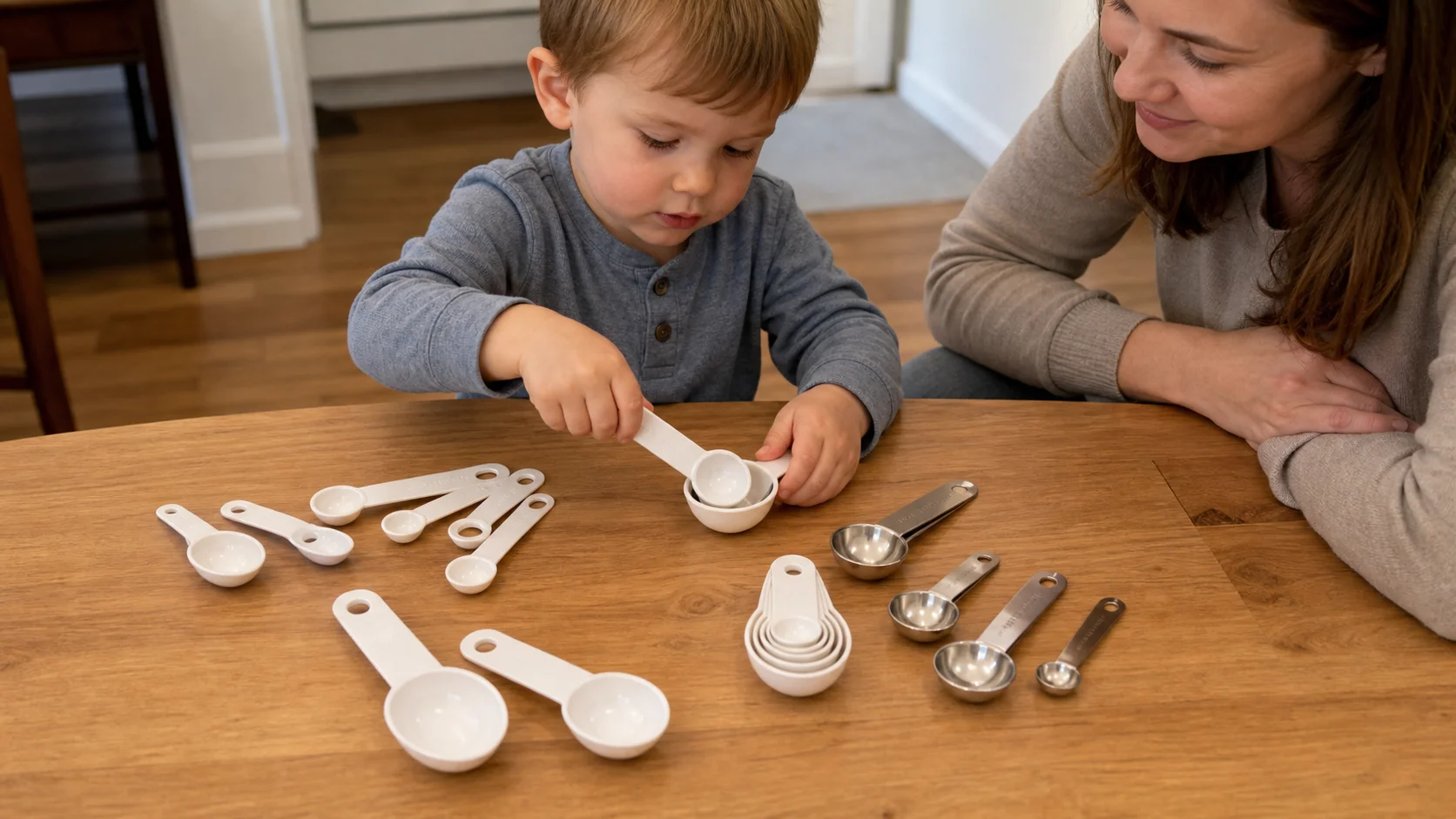
Toddler matching measuring spoons and nesting them into one stack on a low table.
ThinkingFit InsideIndoor

Measuring Spoon Nesting.

Mix two measuring spoon sets and let your child match shapes and build quick nesting stacks.

Play time
5-10+ min
Age
2-3 years
Energy
Low
Mess
Low
Effort
Low
Where
Indoor
Start here

The recipe.

Low parent effort
2 things

What you need

  • 2 complete measuring spoon sets with different shapes
  • 1 low table or clear floor spot
5 min minimum

Setup

Then start the loop
Step 01
On a low table or clear floor spot in front of your child, spread both measuring spoon sets into one loose mixed group so every spoon stays visible.
Step 02
At the front edge of that space, pull the 2 biggest matching spoons a little closer as an easy starting pair and leave room behind them for finished stacks.
Step 03
Beside your child, sit close enough to show 1 quick fit and keep the rest of the spoons within easy reach.
"Same shape. Try it."
The loop

How play unfolds.

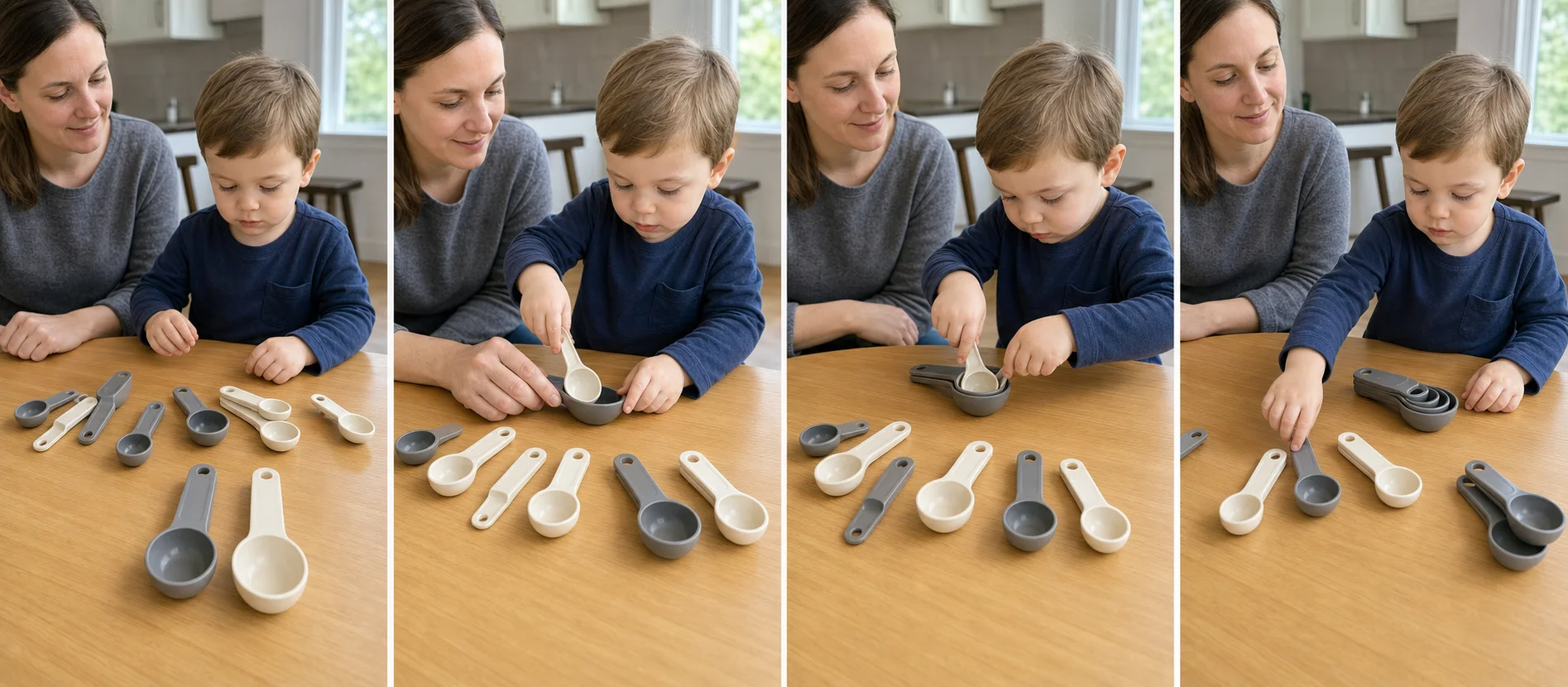
Multi-panel sequence showing a child choosing a measuring spoon, finding the same shape, fitting it inside, and finishing the stack.
  1. 01
    Show one easy fit and say, `Find the same shape.`
  2. 02
    Let your child choose a spoon, find its match, and fit one inside the other.
  3. 03
    If it catches, let your child turn the spoon or switch the order and try again.
  4. 04
    Keep building that stack from biggest to smallest, then start the next shape or pull one apart for another round.

Safety Check

  • Stay beside your child the whole time because loose kitchen tools still need close supervision at this age.
Supporting the play

What to say in the moment

Match what you say to what you see.

Prompt ladder
Level 1 (Start)
"Find the same shape."
Level 2 (Keep going)
"Try it in."
Level 3 (Stretch)
"Turn it and try again."
Level 4 (Extend)
"Finish this stack."
If your child seems...
What you'd see
Focused
What to do
Say
"You found the matching shape."
Add
Ask one quick prompt like, "Big or small?"
Extend
Let your child leave the finished stack beside them and move straight into the second shape set.

Make it easier

Younger end
  • -Keep the current stack at the front and place only 2 possible next spoons beside it so your child scans a smaller choice set.
  • -Turn the larger spoon so its open bowl faces your child before each new fit.
  • -Leave each finished stack on the table instead of pulling it apart for another round.

Make it harder

Older end
  • +Pause after a mismatch and wait to see whether your child turns the spoon without a hint.
  • +Let your child pick the next matching spoon from the full mixed group before you move anything closer.
  • +After one stack is finished, start the second stack without another adult demo fit.

If it's not working

If you see
If child ignores it
Build the first 2-spoon match yourself, slide it to your child, and ask for just 1 more spoon that fits the same shape.
If you see
If child misuses it
If your child starts banging, throwing, or scattering the spoons, put out only 1 shape set and say, "These stay on the table. Let's find the one that matches."
If you see
If child gets frustrated
Pull out the biggest spoon and the next matching size, offer a "this way or turn it?" choice, and stop after 1 finished stack instead of pushing for both.
Skill spotlight
Fit Inside

Fitting 1 spoon inside another by noticing shape and space

This helps your child line up small objects, change hand position when something catches, and notice when one object fits inside another during play and daily routines.

  • Matching by shape gives your child one clear choice instead of a big mixed guess.
  • Nesting from biggest to smallest repeats the same fit-inside move with small hand adjustments.
  • A spoon that catches does not end the turn. It gives your child a simple problem to solve and retry.
Real-world transfer
  • Fitting toys, lids, and small objects into the right spaces
  • Stacking and nesting kitchen or play items with more control

Parent questions