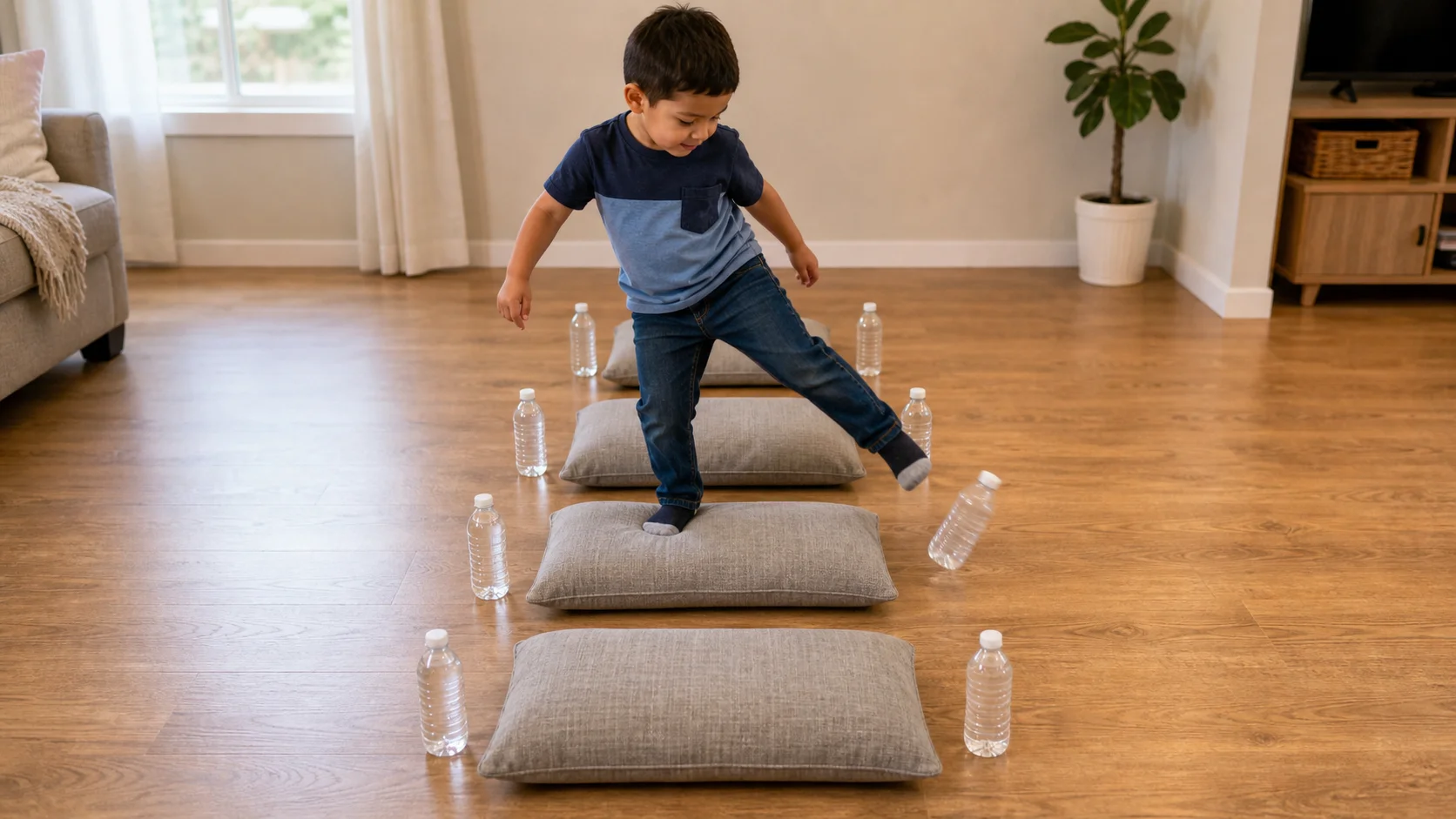
Preschool child landing on a pillow and kicking a light target beside a jump path.
Gross motorNavigate PathIndoor Or Outdoor

Jump-and-Kick Path.

Build a short jump path with pillows and light targets so your child can land, kick right, kick left, and move on.

Play time
5-10+ min
Age
3-5 years
Energy
High
Mess
Low
Effort
Medium
Where
Indoor Or Outdoor
Start here

The recipe.

Medium parent effort
2 things

What you need

  • 3 or more steppingstones or pillows
  • 2 light targets for each stop, such as cardboard blocks, empty water bottles, shoe boxes, paper rolls, paper cups, or plastic containers
5 min minimum

Setup

Then start the loop
Step 01
On the floor or ground in a straight lane, clear enough room for a short jump path so your child can land and kick without bumping into furniture or other obstacles.
Step 02
In that lane, place 3 or more steppingstones or pillows in a line, close enough that your child can jump from one to the next and still land with both feet on each stop.
Step 03
Beside each stop, place 1 light target on the right and 1 on the left, close enough that your child can kick each one after landing without stepping off first.
Step 04
At the first stop, stand your child facing down the path and stay beside the lane so you can cue the order and stand targets back up between rounds if needed.
Step 05
Check that your child can land on each stop and reach both side targets with one simple kick from that spot.
`Right. Left. Jump.`
The loop

How play unfolds.

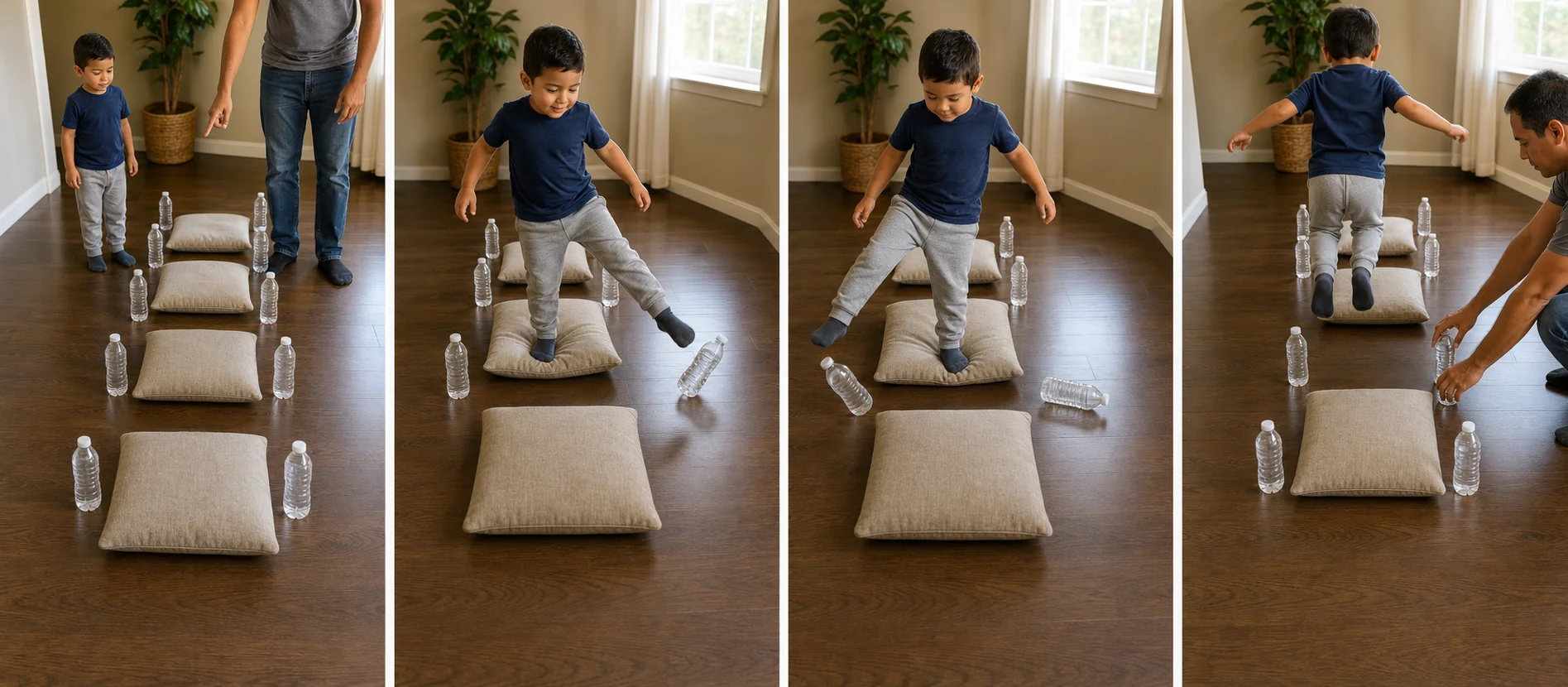
Sequence showing a child landing on a stop, kicking right, kicking left, and jumping to the next pillow.
  1. 01
    Point to the first stop and say, `Right, left, jump.`
  2. 02
    Let your child land on the stop, kick the right target, kick the left target, and jump to the next stop.
  3. 03
    Keep the same right-left-jump pattern going until your child reaches the last stop.
  4. 04
    Stand the targets back up, walk back to the start, and repeat only while your child is landing safely.

Safety Check

  • Stay close during the whole activity because active jumping and kicking still need adult supervision.
  • Keep enough open space around the path to prevent falls or collisions when your child lands and kicks.
  • Use only light targets that tip with a gentle kick, and skip heavy or unstable targets that raise tripping or foot-impact risk.
Supporting the play

What to say in the moment

Match what you say to what you see.

Prompt ladder
Level 1 (Start)
`Kick right. Kick left. Jump ahead.`
Level 2 (Keep going)
`Nice path move. Do the next stop.`
Level 3 (Stretch)
`Can you land still, then kick both sides?`
Level 4 (Extend)
`Let's clear the whole path one more time.`
If your child seems...
What you'd see
Focused
What to do
Say
`You are moving right down the path.`
Add
`Was that the right side or the left side?`
Extend
`Try the next stop with a quiet landing before the kicks.`

Make it harder

Older end
  • +Ask for a steady one-count freeze on each landing before the first kick.
  • +Give one start cue at the first stop, then see how much of the path your child can carry with fewer reminders.
  • +Try two clean passes in a row before cleanup if the first round already looks controlled and easy.

If it's not working

If you see
If child ignores it
Cut the path down to 2 stops, knock down the first target yourself, and invite your child to finish just 1 right-side and 1 left-side kick.
If you see
If child misuses it
If your child runs through the path, throws the targets, or skips the side kicks, rebuild just the first stop and restart with the same `right, left, jump` order before adding the rest back in.
If you see
If child gets frustrated
Move the targets closer, shorten the path to 2 or 3 stops, and help with the jump timing by giving the cue one step at a time instead of rushing the whole path.
Skill spotlight
Navigate Path

Moving through a jump path and clearing both side targets in order

This helps your child stay with a short route, shift weight from one side to the other, and keep a whole-body movement pattern going without rushing past the next job.

  • The right-left-jump pattern gives your child one repeated order to hold while moving.
  • Landing before each kick helps your child practice stopping, balancing, and starting again.
  • Light targets create an obvious payoff without needing a score, timer, or new rules.
Real-world transfer
  • Moving through playground or obstacle paths without losing track of what comes next
  • Kicking or nudging objects on purpose while staying on the feet
  • Stopping, rebalancing, and moving again during active play

Parent questions