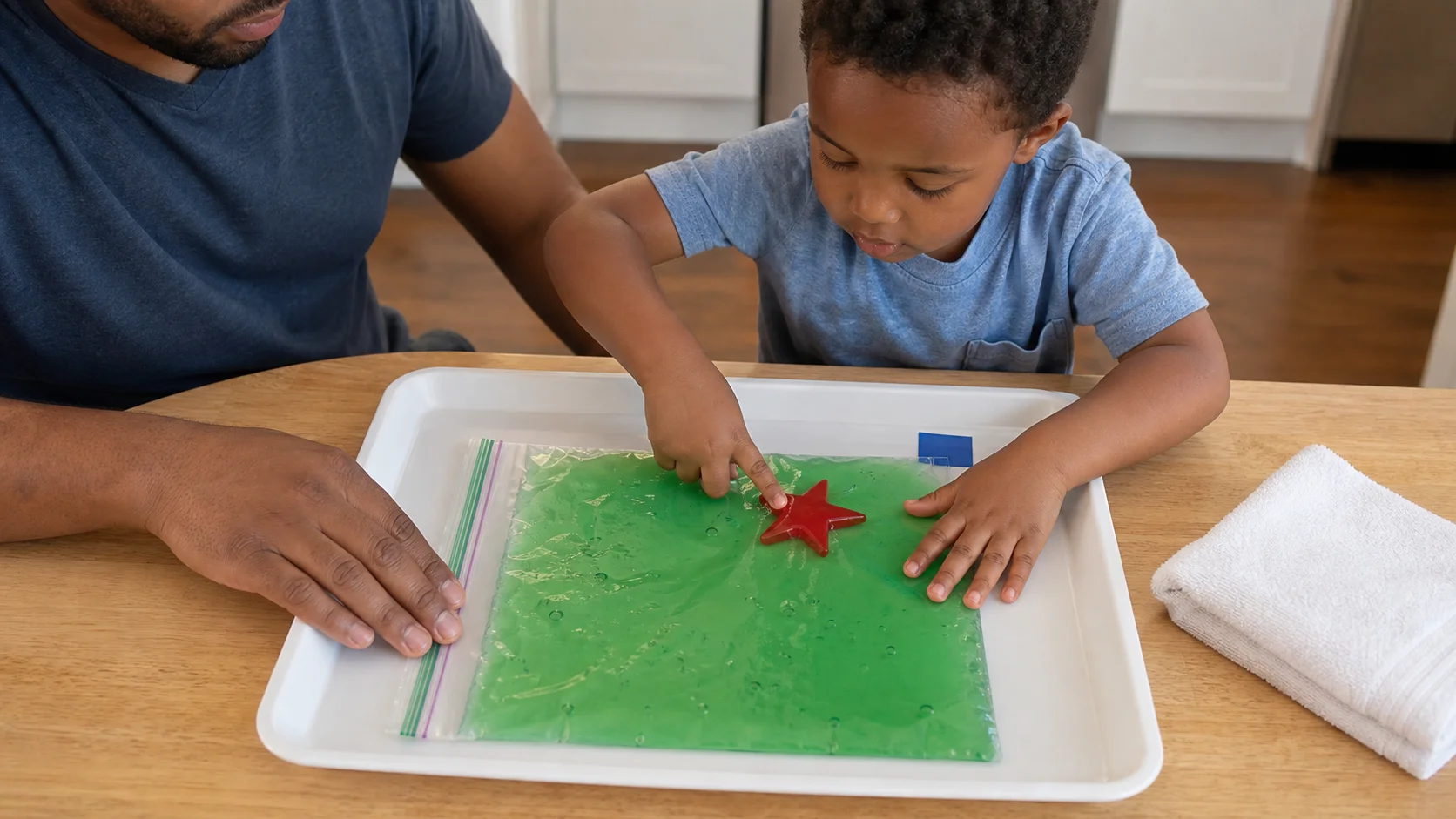
Toddler pressing a sealed clear bag of jelly on a tray to find a large hidden toy.
Fine motorSensory-friendly supportPush Through ResistanceIndoor

Jelly Bag Search.

A sealed jelly bag turns hidden-object play into a contained press, slide, and find game.

Play time
5-10+ min
Age
2-4 years
Energy
Low
Mess
Low
Effort
Medium
Where
Indoor
Start here

The recipe.

Medium parent effort
9 things

What you need

  • 1 clear zip-top or polythene bag
  • 1 serving of set jelly
  • 1 large washable toy, plastic shape, or sealed object
  • 1 tray
  • 1 spoon
  • 1 washable marker or small piece of painter's tape
  • 1 towel or wipe
  • 1 adult
  • 1 child
5 min minimum

Setup

Then start the loop
Step 01
Inside the clear bag, place one large washable toy, plastic shape, or sealed object.
Step 02
Inside the bag, spoon in enough set jelly to cover the object in a thin layer.
Step 03
Over the bag opening, press out extra air, then seal the bag tightly.
Step 04
On the tray, lay the sealed bag flat with the closure turned away from your child.
Step 05
On one outside corner of the bag or tray, make a finish mark with painter's tape or a washable marker.
Step 06
Beside the tray, place the towel or wipe.
Step 07
On a table or floor spot, put the tray where your child can press with both hands while you sit close enough to take the bag away quickly.
Step 08
On the tray, press once around the hidden object. The object should slide a little under the jelly, and no jelly should leak.
"Find the bump."
The loop

How play unfolds.

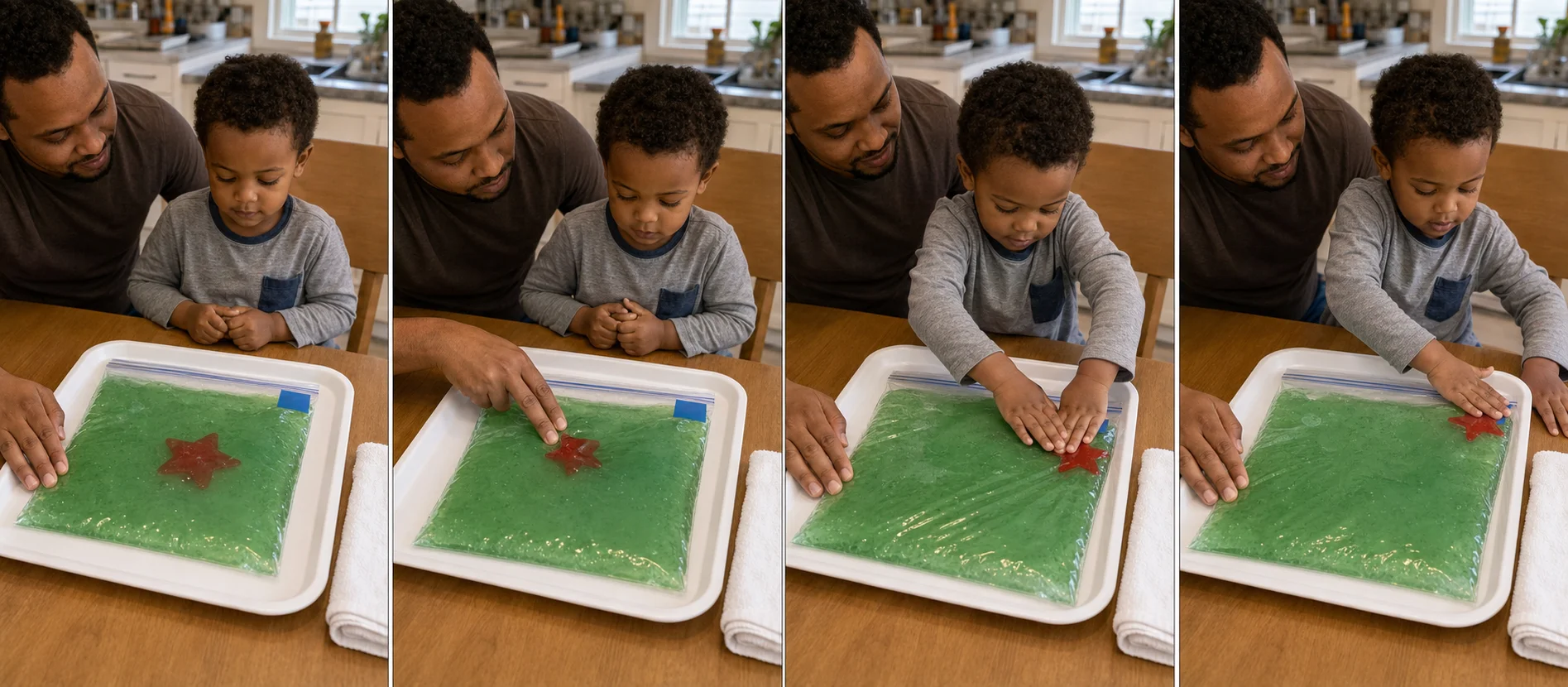
Panels showing a grown-up sealing a jelly bag, a child pressing to find the object, pushing it to a marked corner, and smoothing the bag for another turn.
  1. 01
    Press beside the hidden object so it peeks through the jelly and say, "I found it. Can you push it to the corner?"
  2. 02
    Let your child press around the object until they can see or feel the bump.
  3. 03
    Point to the marked corner and let your child push the jelly beside the object so it slides closer.
  4. 04
    When the object reaches the corner, say, "Found it," and let your child smooth the jelly flat.
  5. 05
    Turn the bag or gently shift the object under the jelly, lay the bag flat again, and search again.

Safety Check

  • Use one large hidden object only. Do not use small objects that could become choking hazards if the bag opens.
  • Keep the jelly sealed inside the bag for the whole activity.
  • Keep the bag flat on the tray, and keep the sealed edge under adult control.
  • Stop if your child lifts, bites, mouths, hard-squeezes, or presses the sealed edge.
  • Stop and throw away the bag if it leaks, tears, looks stretched, or becomes too full for the object to move.
Supporting the play

What to say in the moment

Match what you say to what you see.

Prompt ladder
Level 1 (Start)
Press beside the bump and watch what peeks out.
Level 2 (Keep going)
Push the bump a tiny bit closer to the corner.
Level 3 (Stretch)
Try one slow finger push instead of your whole hand.
Level 4 (Extend)
Hide your eyes while I slide it under the jelly again.
If your child seems...
What you'd see
Focused
What to do
Say
"Keep it flat."
Add
Ask one close-or-far question while the object is already moving.
Extend
Move the object back to the middle for another short search.

Make it easier

Younger end
  • -Start with the hidden object near the middle so every press gives visible feedback.
  • -Count one gentle press as a full turn before asking for any sliding.
  • -Keep your hand lightly on the tray so the bag does not scoot away.

Make it harder

Older end
  • +Begin with the object farther from the marked corner.
  • +Ask for one-finger presses when your child is already calm and accurate.
  • +Let your child predict which side the object will appear on after the reset.

If it's not working

If you see
If child ignores it
Make the object easy to see for the first turn, press beside it yourself, and offer one simple choice: "Press with fingers or whole hand?"
If you see
If child misuses it
Move the bag back to the tray, cover the sealed edge with your hand, and say, "Press flat. No teeth." Stop if the bag goes toward the mouth again.
If you see
If child gets frustrated
Slide the object halfway to the corner, count one final gentle push together, and end after that success.
Skill spotlight
Controlled Pressing

Press with controlled finger pressure.

This helps the child use hand pressure on purpose instead of squeezing as hard as possible. That matters for crayons, utensils, buttons, wipes, and other small daily hand jobs.

  • The sealed bag gives squishy feedback while keeping the jelly contained on the tray.
  • The hidden object gives the pressing a visible purpose: find it, move it, smooth the bag, and search again.
  • Gentle finger and palm presses help your child practice changing pressure without turning the activity into hard squeezing.
Real-world transfer
  • Pressing a crayon or marker without crushing the tip
  • Using a fork, spoon, or button with steadier fingers
  • Wiping, smoothing, and pressing during cleanup
  • Handling squishy or slippery textures with less overwhelm

Parent questions