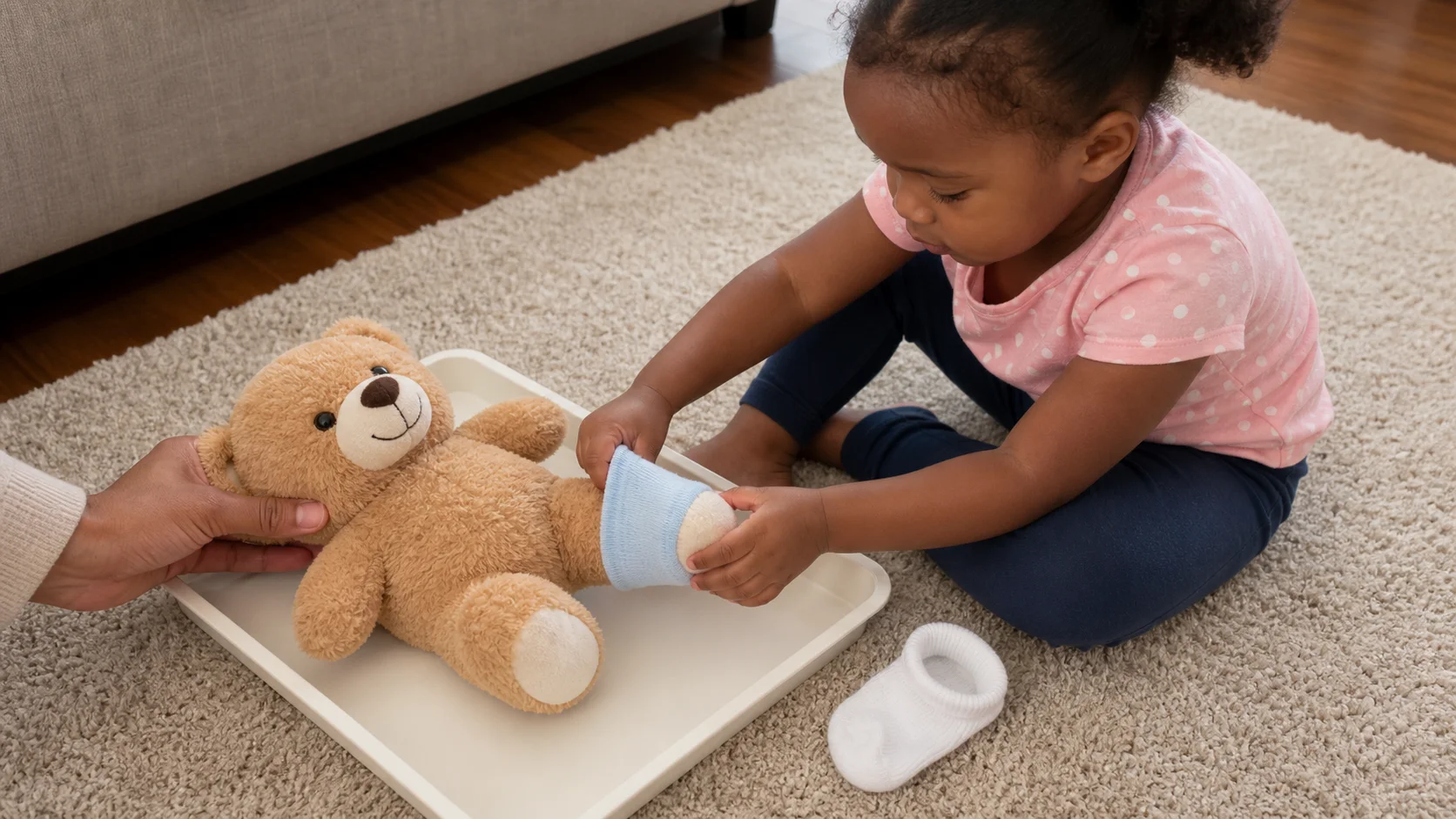
Child sliding a soft sock onto a teddy foot while a grown-up holds the toy steady
Skill builderSensory-friendly supportOT-adjacent supportPull ThroughIndoor

Inside-Out Sock Teddy.

A soft sock and a teddy foot make sock-on, sock-off practice visible, short, and easy to stop.

Play time
3-7+ min
Age
2-4 years
Energy
Low
Mess
No
Effort
Low
Where
Indoor
Start here

The recipe.

Low parent effort
5 things

What you need

  • 1 doll, teddy, stuffed toy, or rolled-sock foot
  • 2 clean soft socks
  • 1 clear table, tray, or floor spot
  • 1 grown-up
  • 1 child
3 min minimum

Setup

Then start the loop
Step 01
On a calm table, tray, or floor spot, clear away extra clothing and noisy distractions.
Step 02
In the middle of the play spot, place the doll, teddy, stuffed toy, or rolled-sock foot so the child can see the foot-shaped end.
Step 03
Beside the toy foot, place the soft socks within reach.
Step 04
Turn one sock inside out and leave the opening facing the child.
Step 05
If you are using a rolled-sock foot, roll one sock into a short soft bundle and use the other sock for the practice turn.
Step 06
Sit beside the child, approach from the front, and keep your hands visible.
"Sock on teddy."
The loop

How play unfolds.

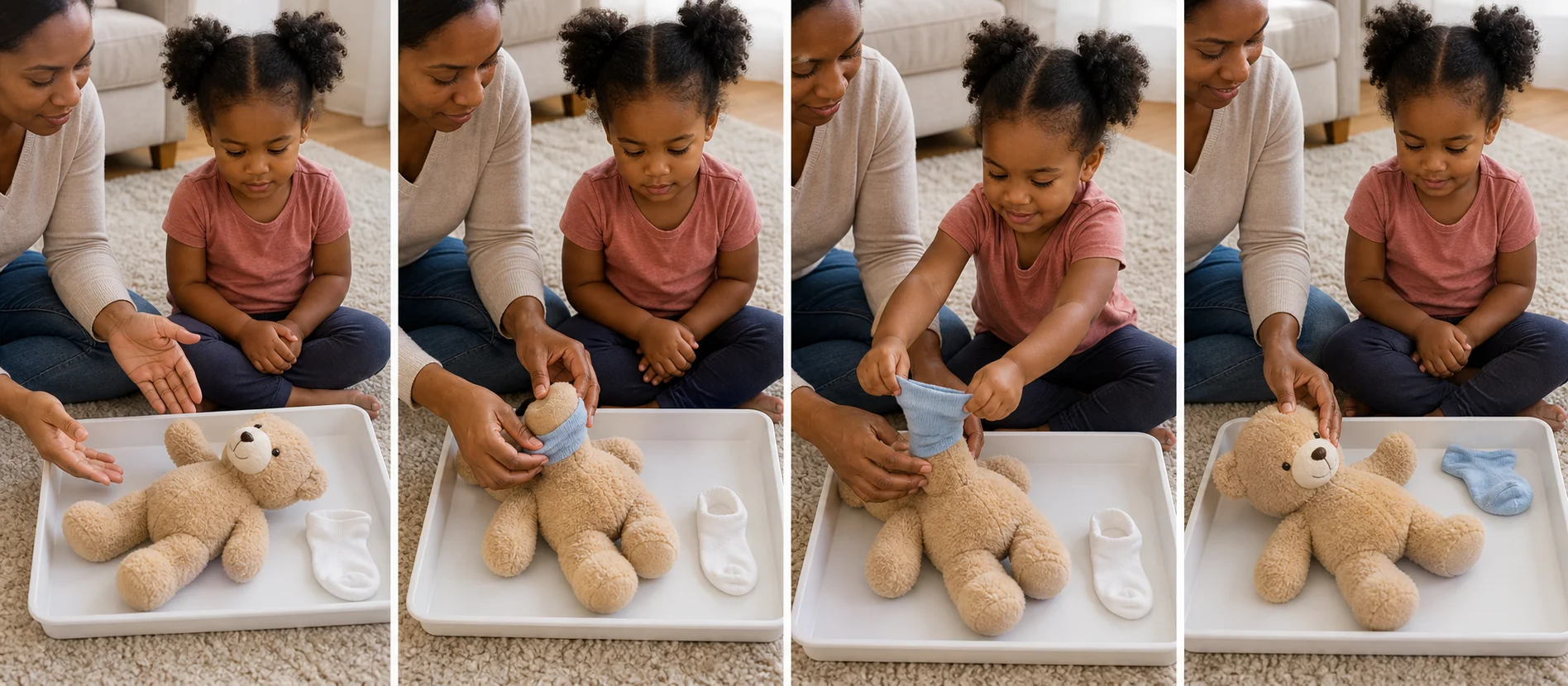
Sequence showing a grown-up modeling sock on teddy, child pulling the sock off, and the sock reset beside the toy
  1. 01
    Slide the sock halfway onto the toy foot, pull it off, and say, "Sock on teddy. Sock off. Your turn."
  2. 02
    Hold the toy steady and let your child touch the sock, find the opening, or watch while you hold it wide.
  3. 03
    Help your child slide the sock onto the toy foot, then let them pull it off and drop it beside the toy.
  4. 04
    Reset the same sock beside the same foot and repeat while the texture still feels okay.

Safety Check

  • Use loose, clean, soft socks that slide without force.
  • Ask before touching the child's hands, and do not help from behind or with surprise touch.
  • Keep the sock on the toy foot unless the child clearly wants to try it on their own body.
  • Stop or switch to watching if the child becomes anxious, distressed, or uncomfortable with the sock texture.
Supporting the play

What to say in the moment

Match what you say to what you see.

Prompt ladder
Level 1 (Start)
Touch the sock, then watch me put it on teddy.
Level 2 (Keep going)
Your turn: sock on, sock off.
Level 3 (Stretch)
Try one tiny pull, then stop.
Level 4 (Extend)
Teddy wears the sock, gives one kick, then sock off.
If your child seems...
What you'd see
Focused
What to do
Say
"Sock on, sock off."
Add
Name one thing only: sock, foot, or teddy.
Extend
Add one gentle teddy kick before the pull-off turn.

Make it easier

Younger end
  • -Brace the toy foot against the table edge or your forearm so it does not slide.
  • -Count a turn when the sock opening touches the toy foot and comes away again.
  • -Turn the sock inside out between rounds so the child only manages on and off.

If it's not working

If you see
If child ignores it
Put the sock on the teddy's foot yourself, make the teddy give a tiny kick, and offer one choice: "Pull off or sock on?"
If you see
If child misuses it
If the sock is thrown or mouthed, pause and say, "Sock is for teddy foot." Put it back beside the toy and model one calm round.
If you see
If child gets frustrated
Hold the sock opening wide, let the child do only the final pull-off, or stop and try again later.
Skill spotlight
Pull-Through Dressing

Sock on and off practice

This gives a child a low-pressure way to practice clothing-like hand motions before using the same kind of pull on their own socks or clothes.

  • The sock-on, sock-off loop gives your child a clear dressing motion to repeat on a toy first.
  • Managing the soft sock uses two hands together: one hand steadies while the other finds, pulls, or releases.
  • The toy target keeps sock texture separate from the child's own body, so a tiny touch or one pull can still count.
Real-world transfer
  • Pulling socks, sleeves, or pant legs during dressing.
  • Tolerating sock texture in a short, controlled way.
  • Helping with a simple dressing routine.

Parent questions