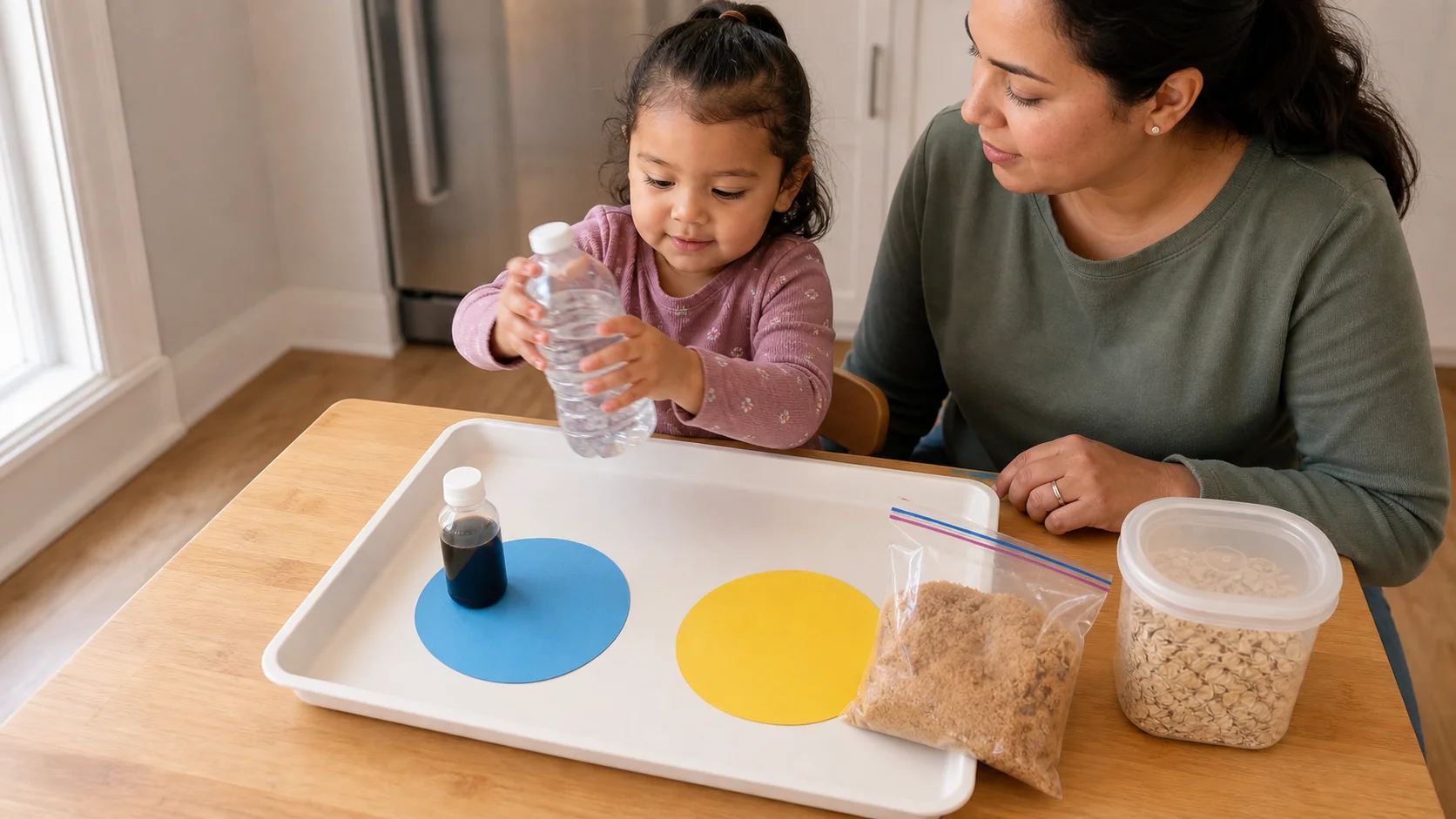
Toddler sorting closed kitchen containers on a tray by shaking and squeezing them
ThinkingSensory-friendly supportOT-adjacent supportBy TypeIndoor

Ingredient Shake Sort.

Shake and squish sealed kitchen items, then sort them by how they move.

Play time
5-10+ min
Age
1-2 years
Energy
Low
Mess
Low
Effort
Low
Where
Indoor
Start here

The recipe.

Low parent effort
6 things

What you need

  • 1 tray, placemat, or shallow box lid
  • 2 small bowls, paper circles, or taped sort spots
  • 2 sealed liquid containers, such as a vanilla bottle, water bottle, or oil bottle
  • 2 sealed crumbly or moldable ingredient bags or containers, such as brown sugar, rice, oats, or flour
  • 1 adult
  • 1 child
5 min minimum

Setup

Then start the loop
Step 01
On a low table or floor, put the tray, placemat, or shallow box lid where your child can reach the middle without leaning.
Step 02
On the tray, place one bowl, paper circle, or taped spot on the left for "shaky liquid."
Step 03
On the tray, place the second bowl, paper circle, or taped spot on the right for "squishy crumbly."
Step 04
In your hands, check all four ingredients. Use only closed, non-glass containers or sturdy bags with tight lids, no loose caps, no leaks, and no allergy-triggering ingredients for your child.
Step 05
At the top of the tray, place the four sealed ingredients in a short row above the two sort spots.
Step 06
Beside your child, sit close enough to hand over one item at a time and take it back quickly if needed.
"Shake, shake."
The loop

How play unfolds.

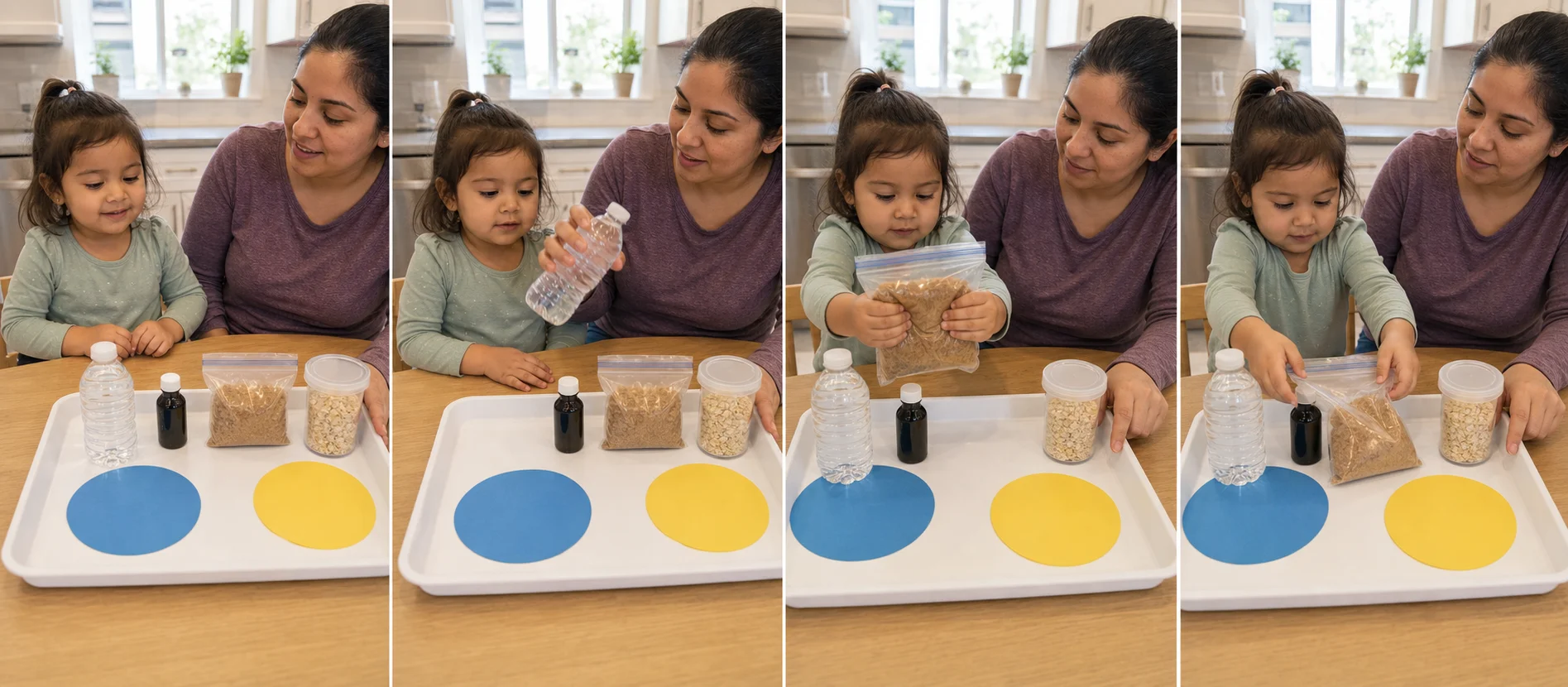
Panels showing a grown-up offering one sealed ingredient, the child testing it, and placing it on a sort spot
  1. 01
    Pick up one sealed item, model a shake or squeeze, and say, "This one is shaky" or "This one is squishy."
  2. 02
    Place it in your child's hands and let them shake, squeeze, tap, or turn it while it stays closed.
  3. 03
    Point to the two sort spots and say, "Shaky liquid or squishy crumbly?"
  4. 04
    Let your child place the item on either spot. Name the group yourself if needed.
  5. 05
    Repeat with the next sealed ingredients, then point to each group and say, "These shook. These squished."

Safety Check

  • Keep every ingredient sealed for the whole activity.
  • Use only containers that are light enough for your child to handle, not glass, and too large to become a choking hazard.
  • Skip loose caps, thin bags that can pop, leaky containers, heavy containers, and any ingredient that worries you for allergies or tasting.
  • Stop if your child tries to open, mouth, throw, crush, or taste an item.
  • Choose another activity if food smells, package sounds, or kitchen items increase distress.
Supporting the play

What to say in the moment

Match what you say to what you see.

Prompt ladder
Level 1 (Start)
Start with the clearest shaker and say, "Shake first."
Level 2 (Keep going)
Slide the next closed item forward and say, "Try this one."
Level 3 (Stretch)
While the item is moving, ask, "Shaky or squishy?"
Level 4 (Extend)
After the sort is full, say, "Pick one to move again."
If your child seems...
What you'd see
Focused
What to do
Say
"You found that one."
Add
Name one property while the item is moving.
Extend
Let your child choose the next item from the row.

Make it easier

Younger end
  • -Start with the two items that feel most different and leave the similar ones for later.
  • -Pull the two sort spots closer to your child's hands.
  • -Use action words like "shake side" and "squeeze side" instead of liquid and crumbly.

Make it harder

Older end
  • +Let your child pick the next closed item before testing it.
  • +Ask your child to test the item two ways, such as shake then squeeze, before choosing.
  • +Sort the same four items again with less pointing from the adult.

If it's not working

If you see
If child ignores it
Start with the loudest or most obvious item, shake it yourself, and offer only one clear place: "Put it here."
If you see
If child misuses it
Hold the item with your child for one turn and say, "Closed stays closed. Shake, then place." If opening, mouthing, or throwing continues, end the round and put the ingredients away.
If you see
If child gets frustrated
Drop the category words and make it a simple in-or-out game. Shake one item, place it in any bowl, and stop after two items.
Skill spotlight
Texture And Movement Groups

Sorting by how something feels or moves

This helps the child use what they feel and hear to make a simple choice. That same skill shows up later in cleanup, kitchen helping, matching games, and describing everyday objects.

  • Testing each package before placing it gives your child a concrete compare-and-sort routine.
  • Closed containers let your child notice sound, weight, and movement without direct food touch.
  • The one-item turn keeps the sequence predictable: test, choose a spot, place it, repeat.
Real-world transfer
  • Sorting toys or cleanup items into groups
  • Noticing food packages, bottles, and bags safely
  • Using words like shake, soft, loud, or quiet
  • Following a simple test-then-place routine

Parent questions