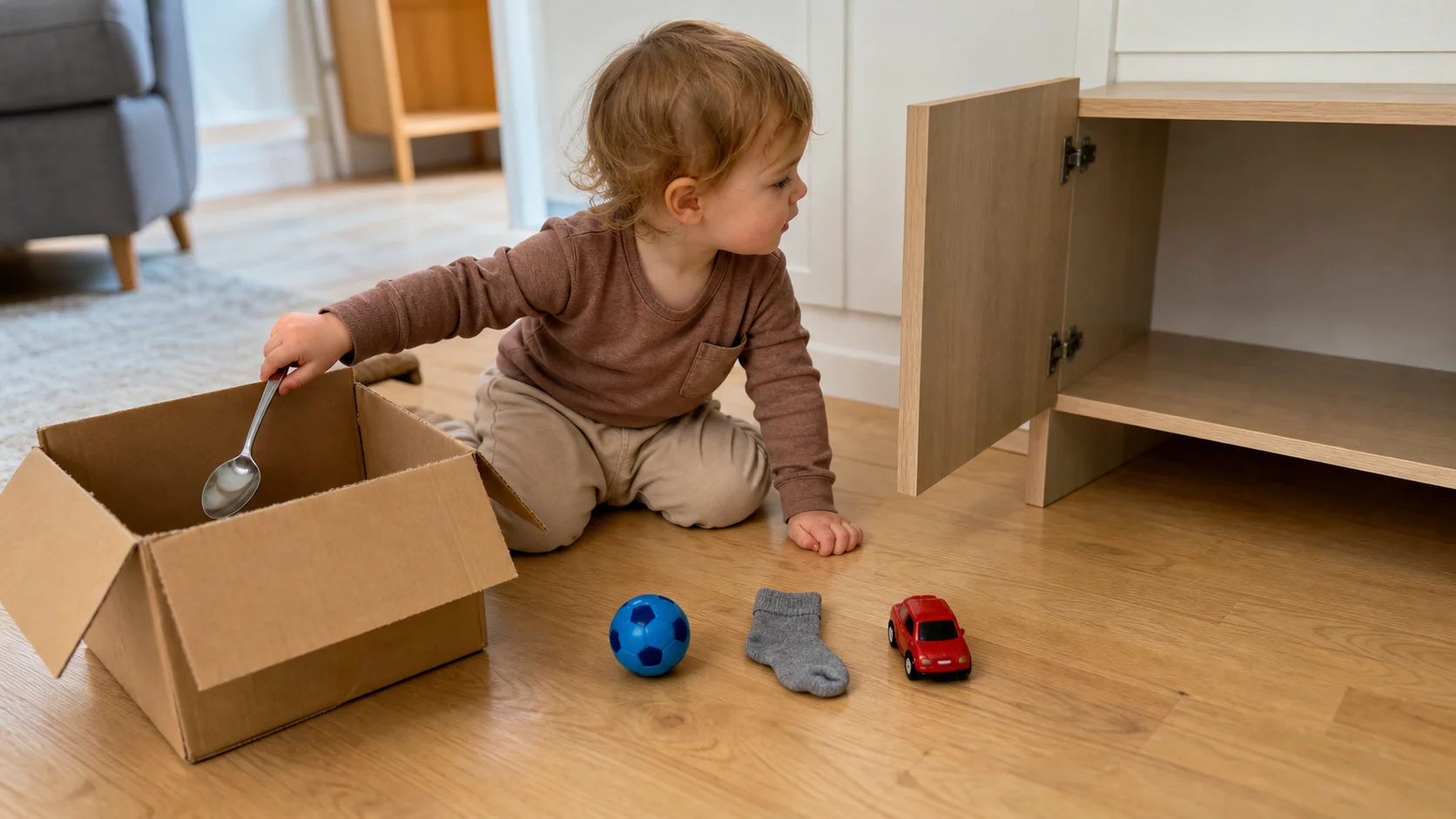
A toddler carries a spoon toward an open box while a grown-up points to another everyday object beside a low cupboard in a simple indoor play space.
LiteracySpeech delay supportFollow One StepIndoor

Hide-and-Place Game.

Say one short hide-and-place cue and let your child move the right object to the right spot.

Play time
5-10+ min
Age
2-3 years
Energy
Low
Mess
No
Effort
Low
Where
Indoor
Start here

The recipe.

Low parent effort
4 things

What you need

  • 4 everyday objects large enough for safe supervised toddler handling
  • 1 box
  • 1 low cupboard or one similar safe hiding spot
  • 1 floor or low table play area near both hiding places
5 min minimum

Setup

Then start the loop
Step 01
On the floor or at a low table, put the box on one side and leave it open.
Step 02
On the other side, open the low cupboard or set up the second safe hiding spot so your child can see both choices at once.
Step 03
In the middle, place 4 everyday objects in a short row where your child can see and reach each one.
Step 04
Point to the box, then point to the cupboard, so your child sees both hiding places before the first turn.
"In the box."
The loop

How play unfolds.

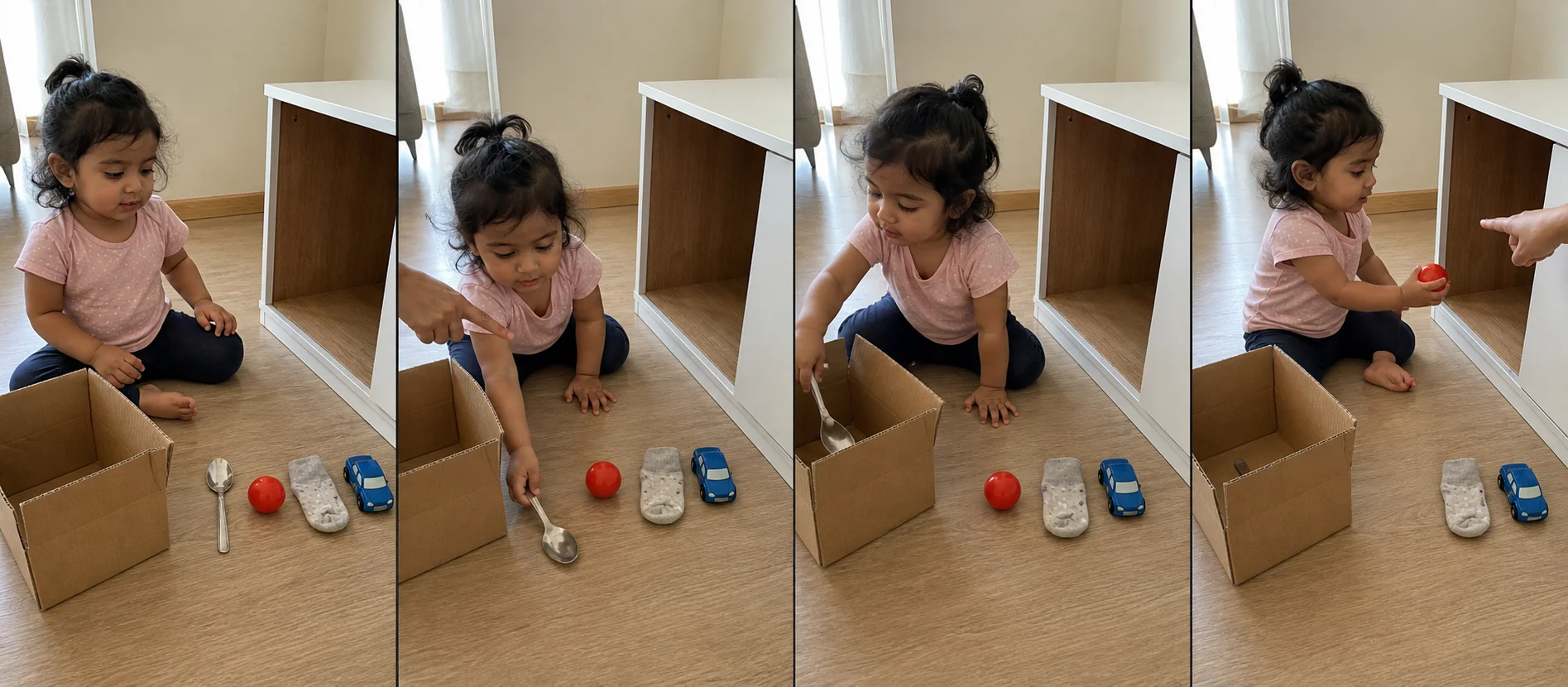
A four-panel sequence shows a row of everyday objects, a grown-up giving a hide-and-place cue, a toddler moving the named object to the box or cupboard, and the next turn starting.
  1. 01
    Model one quick turn and say, "Hide the spoon in the box."
  2. 02
    Give one short object-and-place cue for the next turn.
  3. 03
    Let your child pick up the named object and hide it in the named spot.
  4. 04
    Give the next cue and repeat until all the objects are hidden.

Safety Check

  • Stay close if any chosen object could go in the mouth.
  • Use only low hiding places your child can reach without climbing.
  • Avoid doors or lids that could pinch fingers.
Supporting the play

What to say in the moment

Match what you say to what you see.

Prompt ladder
Level 1 (Start)
Hide the spoon in the box.
Level 2 (Keep going)
Now hide the ball in the cupboard.
Level 3 (Stretch)
Which one goes in the box?
Level 4 (Extend)
You tell me where this one goes.
If your child seems...
What you'd see
Focused
What to do
Say
"You got the right place."
Add
Pause a second before helping so your child can look at both hiding spots.
Extend
Let your child carry the next object from the row without you handing it over.

Make it easier

Younger end
  • -Use only 2 objects.
  • -Start with one hiding place for a couple of turns before switching back to two.
  • -Keep using the same object-and-place phrase for two rounds in a row.

Make it harder

Older end
  • +Leave all 4 objects visible and pause before pointing.
  • +Alternate box and cupboard every turn.
  • +Let your child choose the next object after hearing the place cue.

If it's not working

If you see
If child ignores it
Do one fast model turn, then hand your child the next object and repeat the same cue pattern.
If you see
If child misuses it
Hold up the named object, repeat the short phrase, and guide your child to the correct place with one point.
If you see
If child gets frustrated
Use 2 objects instead of 4 and keep using the same two hiding places for a few easy turns.
Skill spotlight
Follow One Step

Following one short object-and-place direction and acting on it

This helps a child hold a short spoken direction long enough to do something useful with it while also practicing where objects go during everyday put-away routines.

  • The same short cue pattern gives your child repeated practice hearing one direction and doing something useful with it.
  • Picking one object from a small row helps your child connect the spoken object name to something they can see and carry.
  • Switching between the box and cupboard adds a clear place word without adding a lot of extra language.
  • The round stays easy to reset, so you can keep practice short and successful.
Real-world transfer
  • Following short spoken directions during play and routines
  • Putting objects where they belong during simple cleanup or helping jobs
  • Understanding object-and-place phrases in everyday speech
Back to library
Keep playing

Related activities.