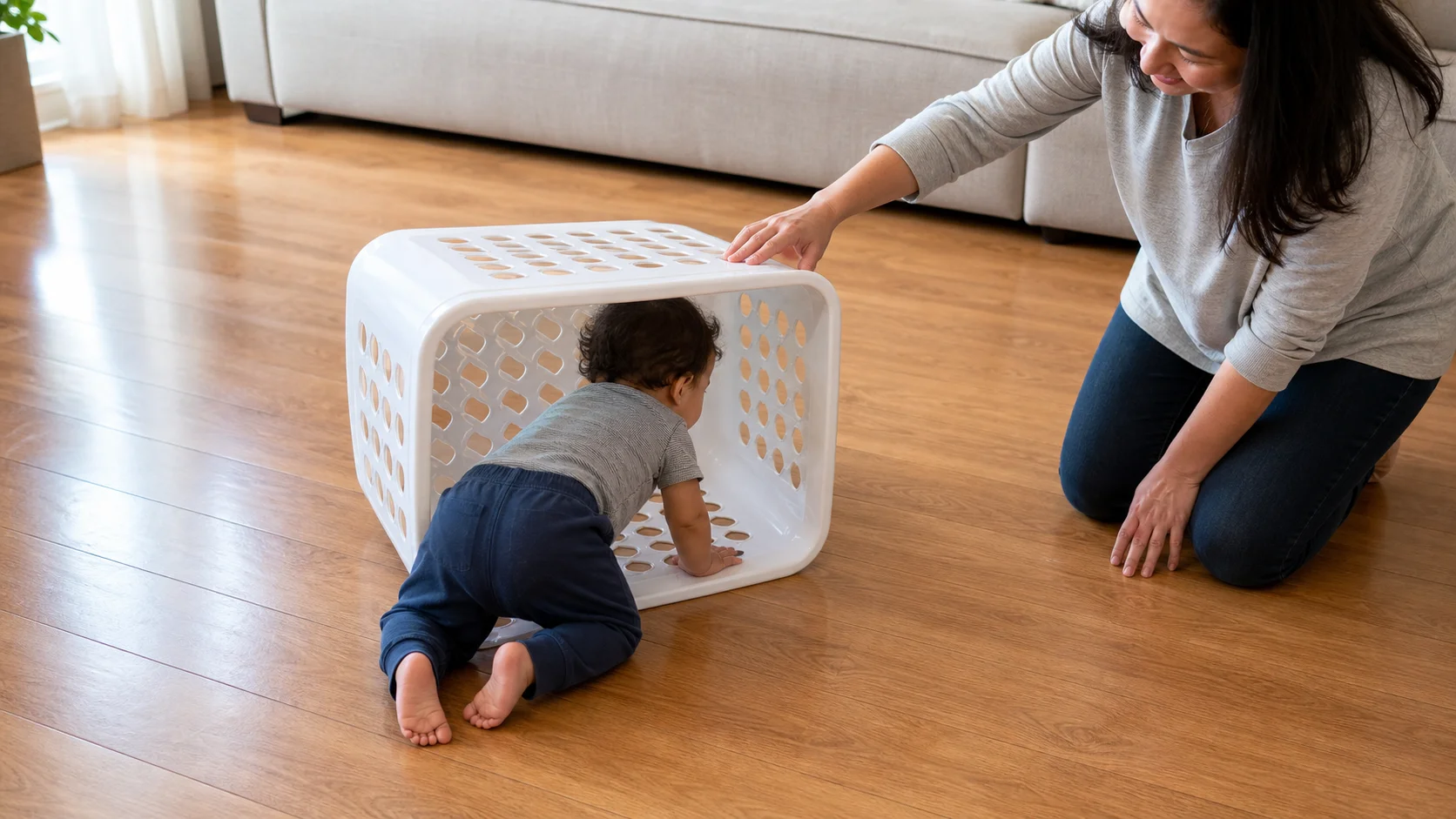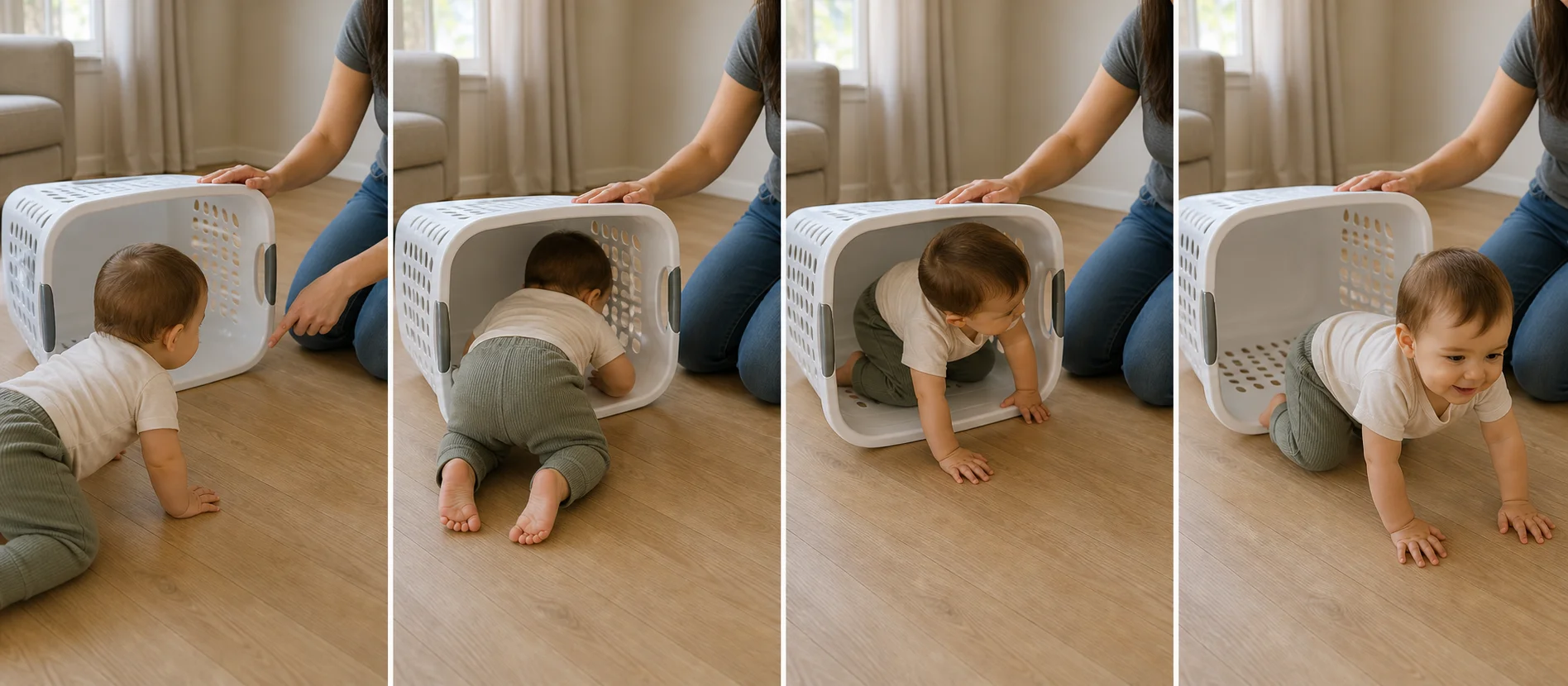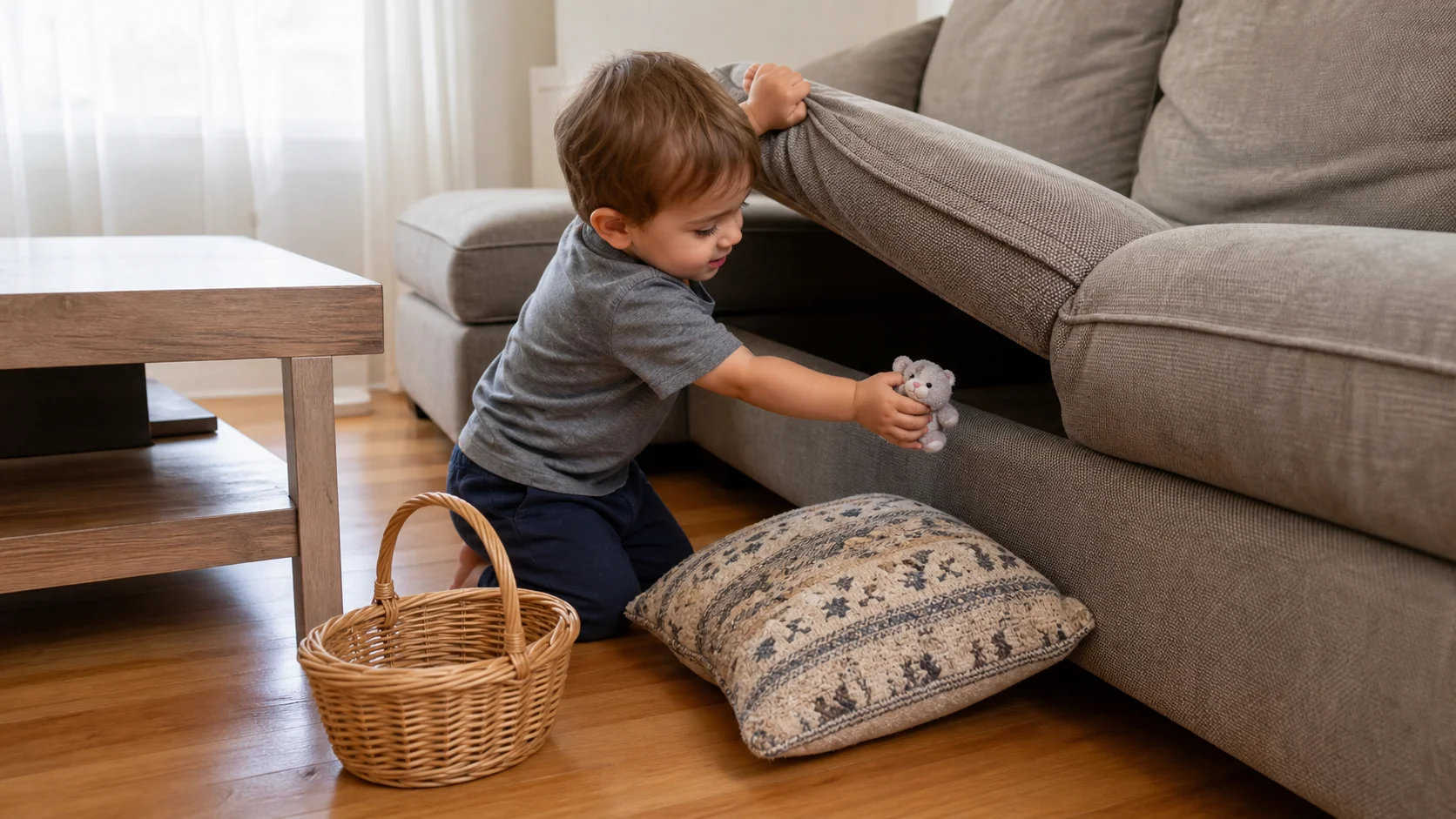
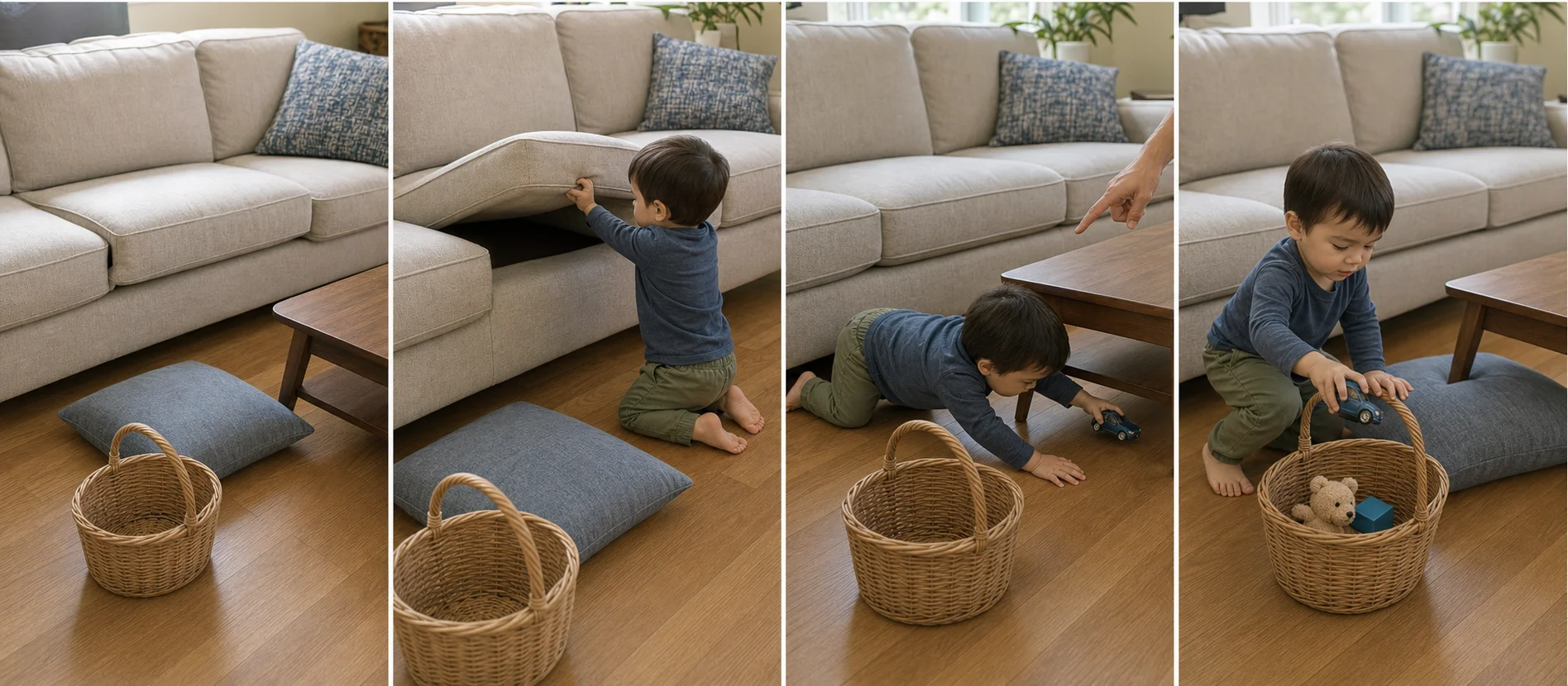
A young child lifts a sofa cushion to find a hidden toy, then carries it back to a basket in a living room.
Fine motorOT-adjacent supportChange Body LevelIndoor

Heavy-Work Scavenger Hunt.

A short indoor scavenger hunt where your child crawls, lifts, finds, and carries hidden items back to one return spot.

Play time
5-10+ min
Age
2-5 years
Energy
Medium
Mess
Low
Effort
Medium
Where
Indoor
Start here

The recipe.

Medium parent effort
4 things

What you need

  • 3 easy-to-grab household items or toys
  • 3 safe hiding spots such as sofa cushions, pillows, or a low table
  • 1 basket, bin, or clear floor return spot
  • 1 open floor area
5 min minimum

Setup

Then start the loop
Step 01
Put 1 basket, bin, or clear floor return spot near where your child will start.
Step 02
In the same room, hide 3 easy-to-grab items at 3 safe heavy-work spots, such as under 1 sofa cushion, under 1 pillow, and under 1 low table edge.
Step 03
Leave enough open floor around each hiding spot so your child can crawl under or lift without bumping into furniture.
"Go find."
The loop

How play unfolds.

A multi-panel sequence showing a child searching one room, crawling under or lifting a safe obstacle to find an item, and carrying it back to a basket.
  1. 01
    Point to the room and say, "Find one and bring it back."
  2. 02
    Let your child check 1 hiding spot, crawl under or lift the safe object, and grab the hidden item.
  3. 03
    Have your child carry the item back to the basket or return spot.
  4. 04
    Cue the next search with one short phrase and repeat until all the hidden items are found.

Safety Check

  • Use only stable furniture and lightweight objects your child can move safely.
  • Stay close if your child is crawling under tables or lifting cushions near hard edges.
  • Stop if the hunt turns into climbing unstable furniture, rough pulling, or fast uncontrolled running.
Supporting the play

What to say in the moment

Match what you say to what you see.

Prompt ladder
Level 1 (Start)
"Find one."
Level 2 (Keep going)
"Bring it back."
Level 3 (Stretch)
"Now check the next spot."
Level 4 (Extend)
"Can you finish the whole hunt?"
If your child seems...
What you'd see
Focused
What to do
Say
"You got it."
Add
Pause at the basket so your child drops the item in before the next search.
Extend
Wait one beat before pointing so your child scans for the next spot.

Make it easier

Younger end
  • -Keep all hiding spots in the same half of the room.
  • -Let part of each hidden item stay visible.
  • -Put the basket very close to the start spot.

Make it harder

Older end
  • +Wait before pointing to the next hiding spot.
  • +Spread the 3 hiding spots a little farther apart in the same room.
  • +Ask your child to bring back all 3 items before stopping.

If it's not working

If you see
If child ignores it
Walk together to the easiest hiding spot and let your child pull out 1 partly visible item.
If you see
If child misuses it
Slow the pace, return to 1 safe hiding spot, and say, "Lift, find, bring back."
If you see
If child gets frustrated
Use only 2 hiding spots and make the next item partly visible.
Skill spotlight
Change Body Level

Changing body level to get under or around a hiding spot with control

This helps a child move up and down with more control, manage body position around household obstacles, and finish a short physical job from search to return.

  • The hunt gives your child a clear movement loop: search, get low, grab, carry back, repeat.
  • Crawling under or lifting something safe adds the heavy-work part without changing the simple game.
  • One basket and a small set of hiding spots make the job easy to follow with very little language.
  • Each return gives your child a clean finish before the next round starts.
Real-world transfer
  • Moving under, around, and back out from everyday play spaces with more control.
  • Handling simple household jobs that involve lifting light objects and bringing something back.
Back to library
Keep playing

Related activities.