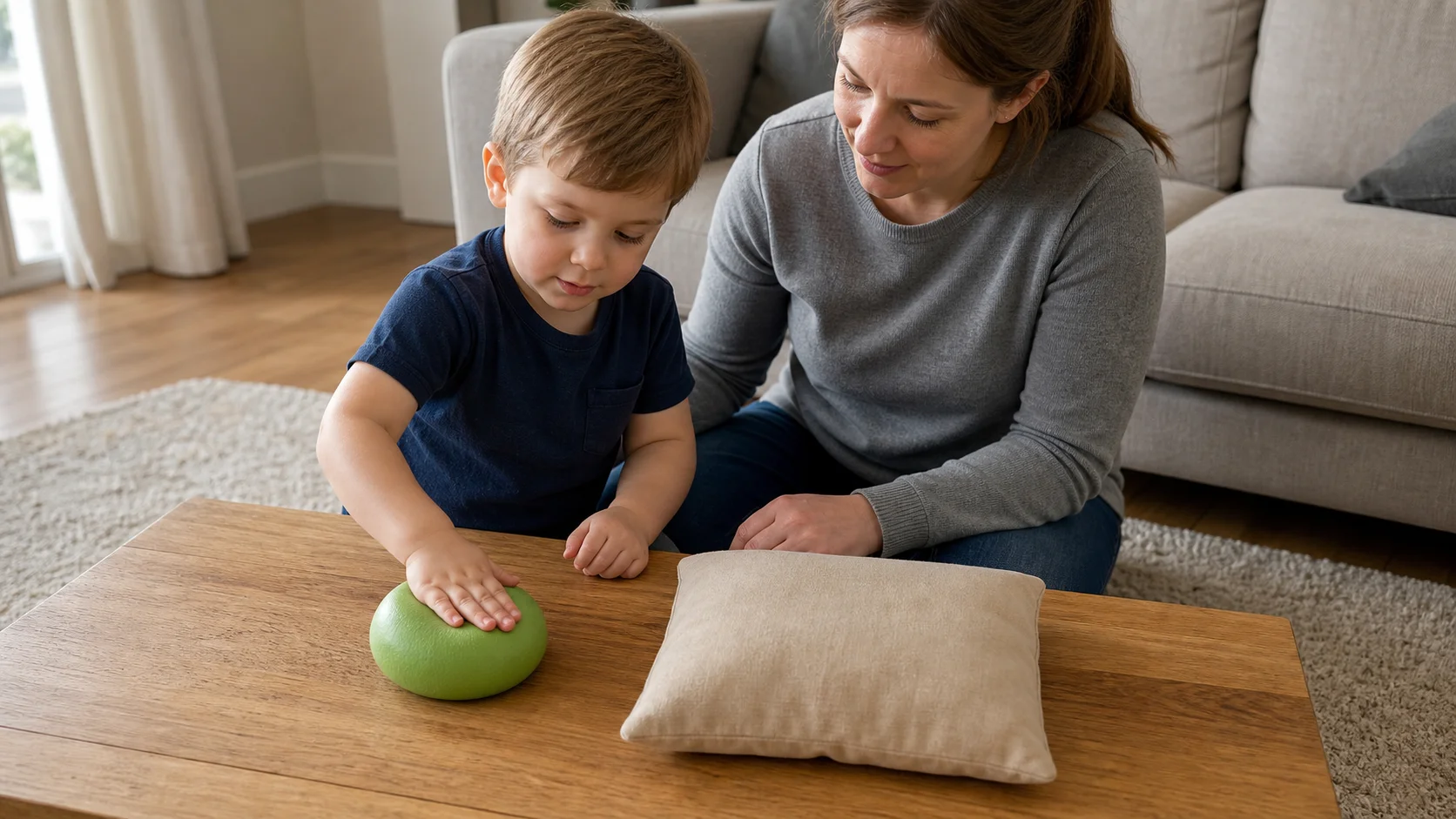
Toddler pressing a soft ball and pillow on a low table while a grown-up models light and firm hands.
Fine motorSensory-friendly supportOT-adjacent supportPush Through Resistance`Indoor

Heavy-Light Toy Press.

Press a soft toy lightly, press it a little firmer, and notice how much the toy changes.

Play time
5-10+ min
Age
2-4 years
Energy
Low
Mess
No
Effort
Low
Where
Indoor
Start here

The recipe.

Low parent effort
5 things

What you need

  • 1 soft ball or stress ball
  • 1 small pillow, cushion, or soft squashable toy
  • 1 flat floor spot or low table
  • 1 adult
  • 1 child
5 min minimum

Setup

Then start the loop
Step 01
On the floor or a low table, clear enough space for both toys to be pressed without falling, rolling into furniture, or bumping anything breakable.
Step 02
In your hands, check the soft ball or stress ball and the pillow or cushion. Use only toys that are intact, too large to fit in the mouth, not leaky, and soft enough to press without hurting hands.
Step 03
On one side of the play spot, place the soft ball or stress ball.
Step 04
Beside it, place the pillow, cushion, or second soft toy with a small gap between the two toys.
Step 05
Beside your child, sit close enough to model one light press and one firmer press on the same toy.
"Tiny press first."
The loop

How play unfolds.

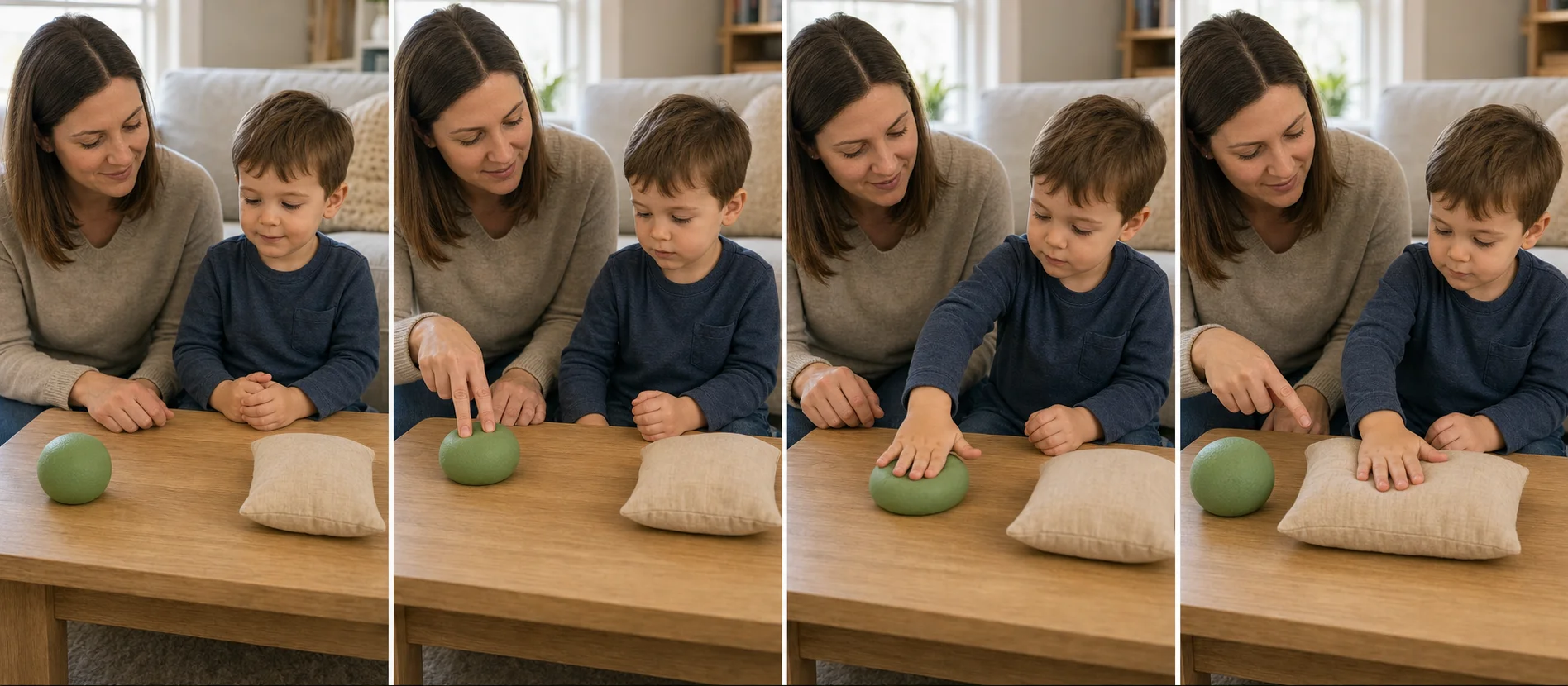
Sequence showing a light press, a firm press, a toy change, and a calm reset with soft toys.
  1. 01
    Press one toy with two fingers so it barely moves and say, "Light press."
  2. 02
    Press the same toy with a flat hand just firmly enough to squash or move it a little. Say, "Firm press. This one moved more."
  3. 03
    Let your child try a light press and a firmer press on the same toy.
  4. 04
    Switch to the second soft toy and repeat the light, firm, compare loop.
  5. 05
    Let the toy return to its normal shape, slide it back if needed, and offer, "Ball or pillow next?"

Safety Check

  • Use only intact, toddler-safe soft toys. Skip any toy that can pop, leak, shed pieces, or become a choking hazard.
  • Keep "firm" as a safe press on a toy, not hitting, punching, jumping, or pressing on a person.
  • Move to the floor if a toy rolls or slides on the table.
  • Stop or switch to the pillow if your child throws, bites, mouths, tries to break a toy, or becomes too activated by the pressure game.
Supporting the play

What to say in the moment

Match what you say to what you see.

Prompt ladder
Level 1 (Start)
Press once so the toy barely changes.
Level 2 (Keep going)
Make the same toy change a little more.
Level 3 (Stretch)
Choose ball or pillow for the next safe press.
Level 4 (Extend)
Try two calm presses on your favorite toy.
If your child seems...
What you'd see
Focused
What to do
Say
"You found the toy change."
Add
Offer one more turn on the same toy.
Extend
Ask once, "Small change or big change?"

Make it easier

Younger end
  • -Use one toy for the whole game so your child only has to change pressure.
  • -Let your child copy your hand motion in the air before touching the toy.
  • -Count any safe press as a turn, even if the pressure difference is small.

Make it harder

Older end
  • +Ask your child to make the toy change just a little, not all the way flat.
  • +Invite your child to repeat the same pressure on the second toy.
  • +Have your child show you which press was lighter after the round.

If it's not working

If you see
If child ignores it
Do the whole light-then-firm comparison yourself once, make the toy change obvious, and ask, "Which one should I press next?" Watching or choosing counts as a start.
If you see
If child misuses it
If the child throws, bites, mouths, or tries to break the toy, calmly remove that toy and say, "Pressing game is for hands." Offer the pillow for one safe press or stop.
If you see
If child gets frustrated
Make the goal smaller. Ask for one light finger touch and one firm pillow press, then finish with "You made it change."
Skill spotlight
Pressure Control

Hand pressure control

This helps your child notice how much force their hands are using, so play, drawing, squeezing, and helping routines can be gentler or stronger when needed.

  • The same toy gives quick feedback: a tiny press barely moves it, while a firmer press changes it more.
  • The repeated light, firm, compare loop lets your child practice changing hand pressure without a long explanation.
  • Switching between two soft toys keeps the game predictable while still giving your child a small choice.
Real-world transfer
  • Squeezing playdough or stress balls safely
  • Pressing crayons or markers with less force
  • Handling toys without breaking them
  • Using gentler hands with people and pets

Parent questions