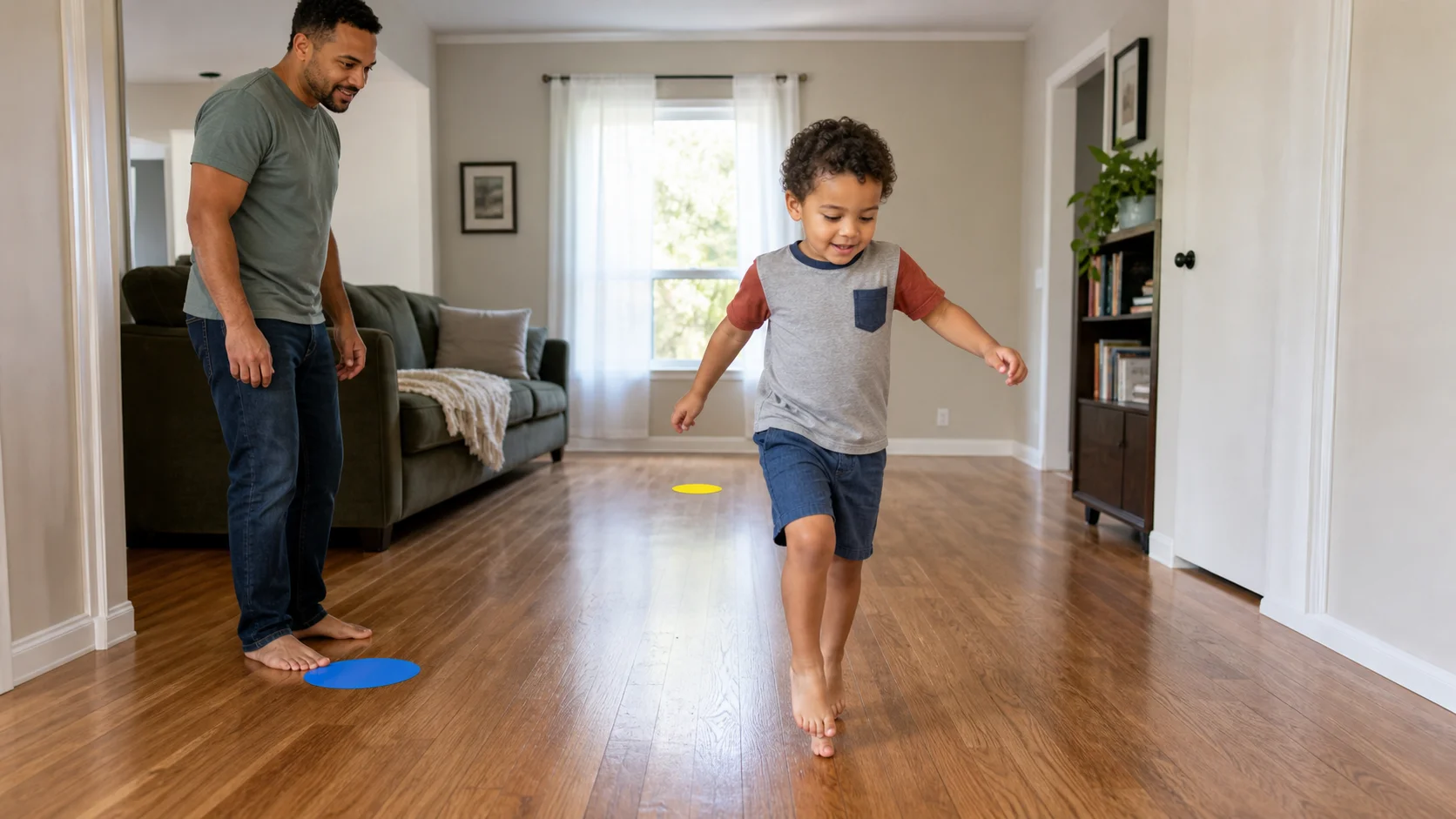
A toddler stomps down a short indoor lane toward a floor marker while a grown-up waits nearby for the turn back.
Gross motorNavigate PathIndoor Open Room

Heavy-Light Feet Run.

One short lane lets your child stomp out, turn, and come back with quieter lighter feet.

Play time
1-5+ min
Age
2-4 years
Energy
Medium
Mess
Low
Effort
Low
Where
Indoor Open Room
Start here

The recipe.

Low parent effort
4 things

What you need

  • 2 floor markers or tape spots
  • 1 clear indoor lane
  • 1 adult
  • 1 child
1 min minimum

Setup

Then start the loop
Step 01
On the floor, clear one short straight lane across the room with no slippery spots or obstacles.
Step 02
On the two ends of that lane, place 1 floor marker at the start and 1 marker at the turn-around end, or use the two ends of the room as those points.
Step 03
On the start marker, stand your child facing the far end.
Step 04
Beside the lane, stay close enough to model one quick heavy-feet trip out and one light-feet trip back before your child's first round.
"Heavy out."
The loop

How play unfolds.

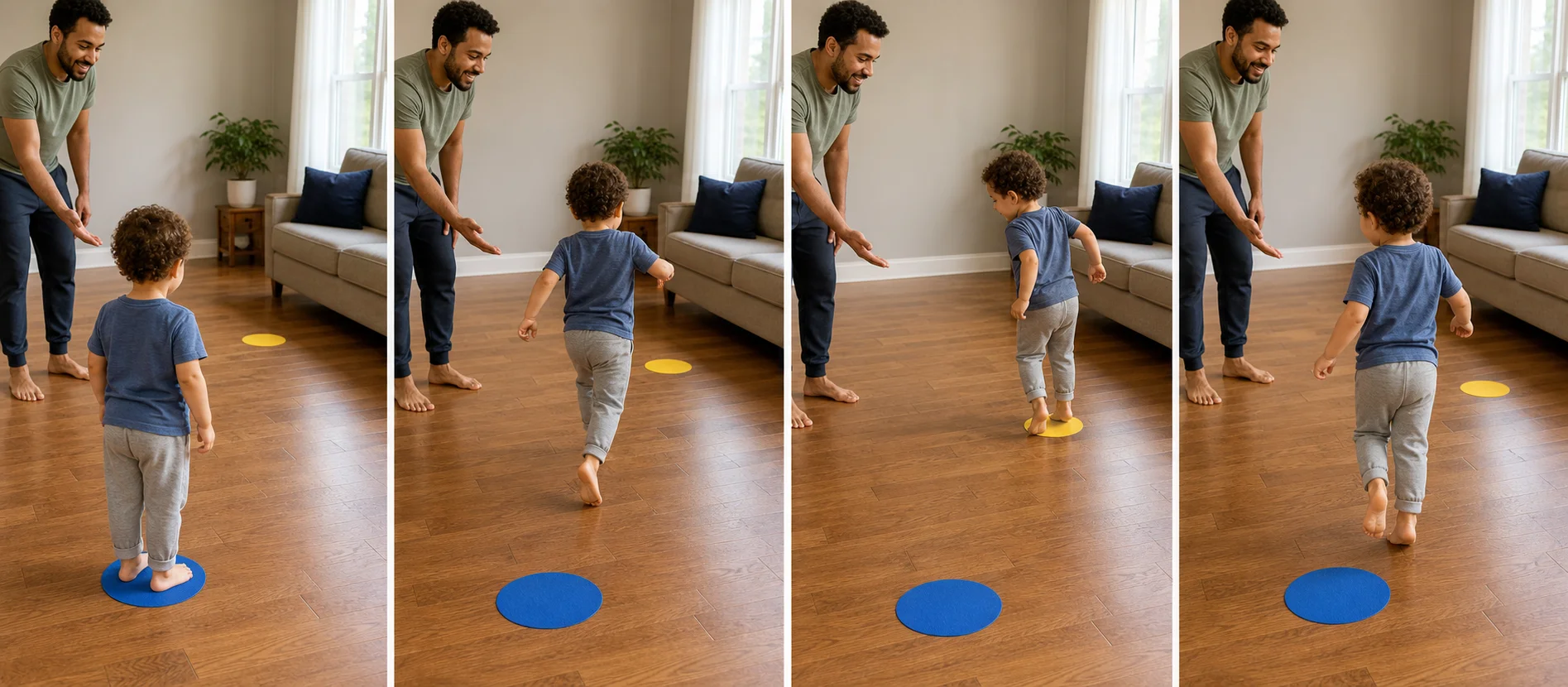
Four panels show a toddler stomping to a far marker, turning around, coming back with quieter lighter feet, and resetting for the next round.
  1. 01
    Model one quick round and say, "Heavy feet out. Light feet back."
  2. 02
    Let your child stomp to the far marker or wall.
  3. 03
    At the turn, have your child come back with quieter lighter feet, either on tiptoes or with soft walking steps.
  4. 04
    Pause at the start, name the next round, and repeat for a few short turns.

Safety Check

  • Keep the lane clear and dry because your child is running, turning, and trying quieter toe or light-foot steps.
  • Stay close enough to help at the turn if your child rushes, stumbles, or loses balance on the quiet return.
  • Skip crowded spaces or hard-edge pathways where a fast turn or fall would be riskier.
Supporting the play

What to say in the moment

Match what you say to what you see.

Prompt ladder
Level 1 (Start)
"Heavy feet to the end. Light quiet feet back."
Level 2 (Keep going)
"Boom to the marker. Sneak back to me."
Level 3 (Stretch)
"Big stomps out. Tiny toes back."
Level 4 (Extend)
"Switch at the turn without my reminder."
If your child seems...
What you'd see
Focused
What to do
Say
"Heavy out, quiet back."
Add
Ask one quick prompt like, "Heavy or light?"
Extend
Let the child tap the far marker and switch directions right away.

Make it easier

Younger end
  • -Start with heavy walking out and light walking back before you ask for a full run.
  • -Pause both feet on the far marker before the child turns so the switch feels more obvious.
  • -Stay close enough to mirror the foot change beside the child for the whole return.

Make it harder

Older end
  • +Ask the child to keep the light-feet return on tiptoes for the whole lane.
  • +See if the child can make the heavy trip louder and the light trip quieter in the same round.
  • +Ask for two clean out-and-back rounds in a row without stopping between them.

If it's not working

If you see
If child ignores it
Race beside your child for one round and exaggerate the stomps first so the contrast feels playful right away.
If you see
If child misuses it
Shorten the lane and give one cue at a time: "Heavy feet to the end," then "Light feet back."
If you see
If child gets frustrated
Drop the tiptoe demand and ask for quiet walking feet back to the start, then stop after one successful out-and-back.
Skill spotlight
Navigate Path

Following a short path while switching foot control

This helps your child move through a short route, change how hard the feet hit, and stay steadier while turning and coming back under more control.

  • The heavy-to-light switch helps your child feel the difference between bigger stomps and softer steps on the same lane.
  • Repeating the same out-and-back route gives turning, stopping, and returning one simple pattern to practice.
  • The quiet return adds a small dose of control after the louder trip out.
Real-world transfer
  • Moving through rooms or hallways without crashing through the turn
  • Slowing the body down after a fast burst of movement
  • Changing how hard the feet land during games and daily movement