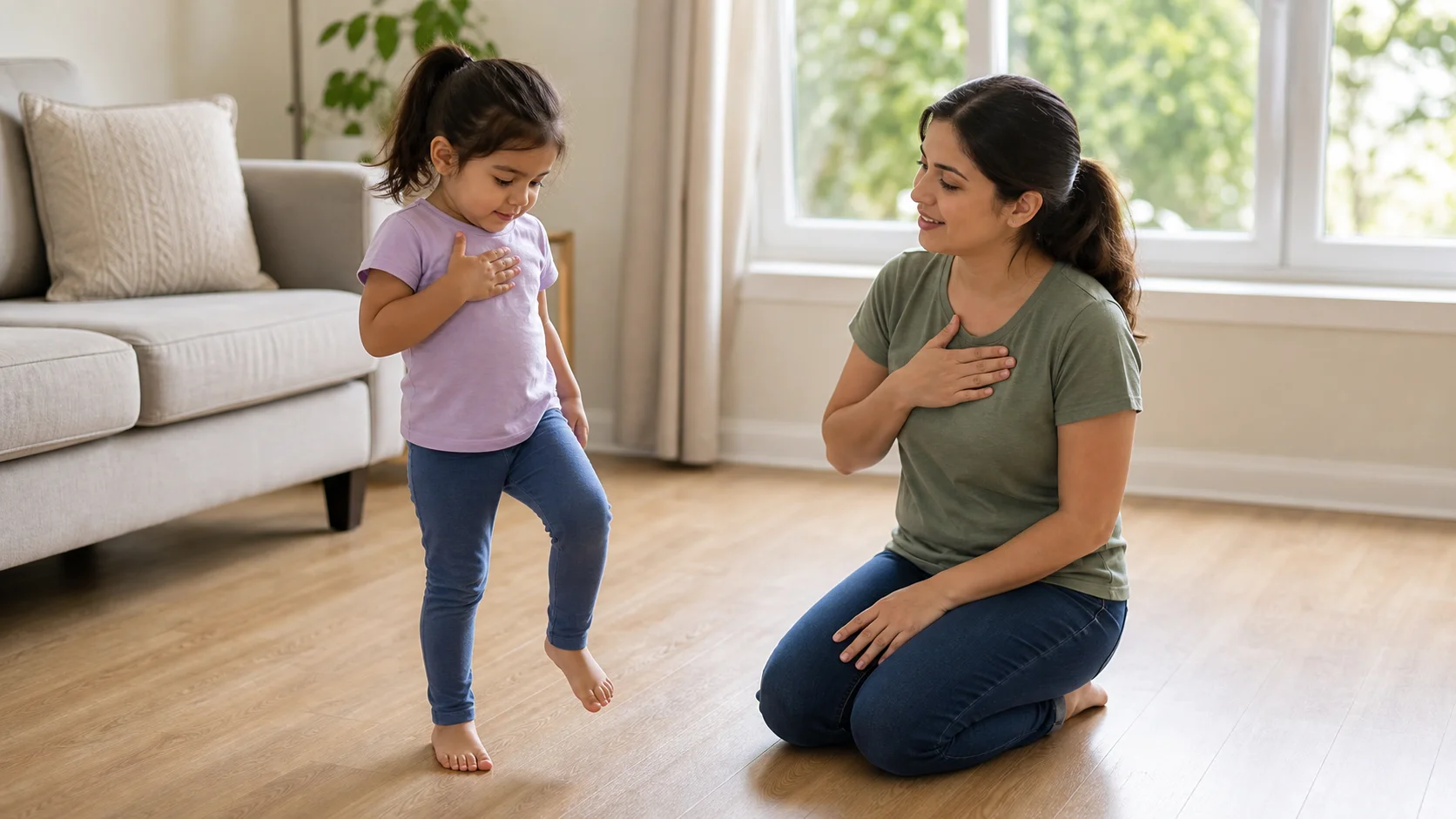
Child standing on a clear indoor floor with one hand on chest while a grown-up models a gentle heartbeat check nearby
ThinkingSensory-friendly supportTest And CompareIndoor

Heartbeat Hide-and-Seek.

A short move-freeze loop helps your child notice thump-thump, compare fast or slow, and reset before another round.

Play time
5-10+ min
Age
2-4 years
Energy
Medium
Mess
No
Effort
Low
Where
Indoor
Start here

The recipe.

Low parent effort
3 things

What you need

  • 1 clear floor space
  • 1 adult
  • 1 child
5 min minimum

Setup

Then start the loop
Step 01
On the floor, clear a small movement spot where your child can jump or march without bumping furniture, toys, rugs, cords, or pets.
Step 02
Beside your child, stand or kneel close enough to model the freeze and heartbeat check right away.
Step 03
Place your hand on your own chest and say, "I feel thump-thump."
Step 04
Invite your child to try chest or wrist, or just watch you, without forcing touch.
Step 05
Before the first round, say, "We move, then we stop."
"March, freeze, feel."
The loop

How play unfolds.

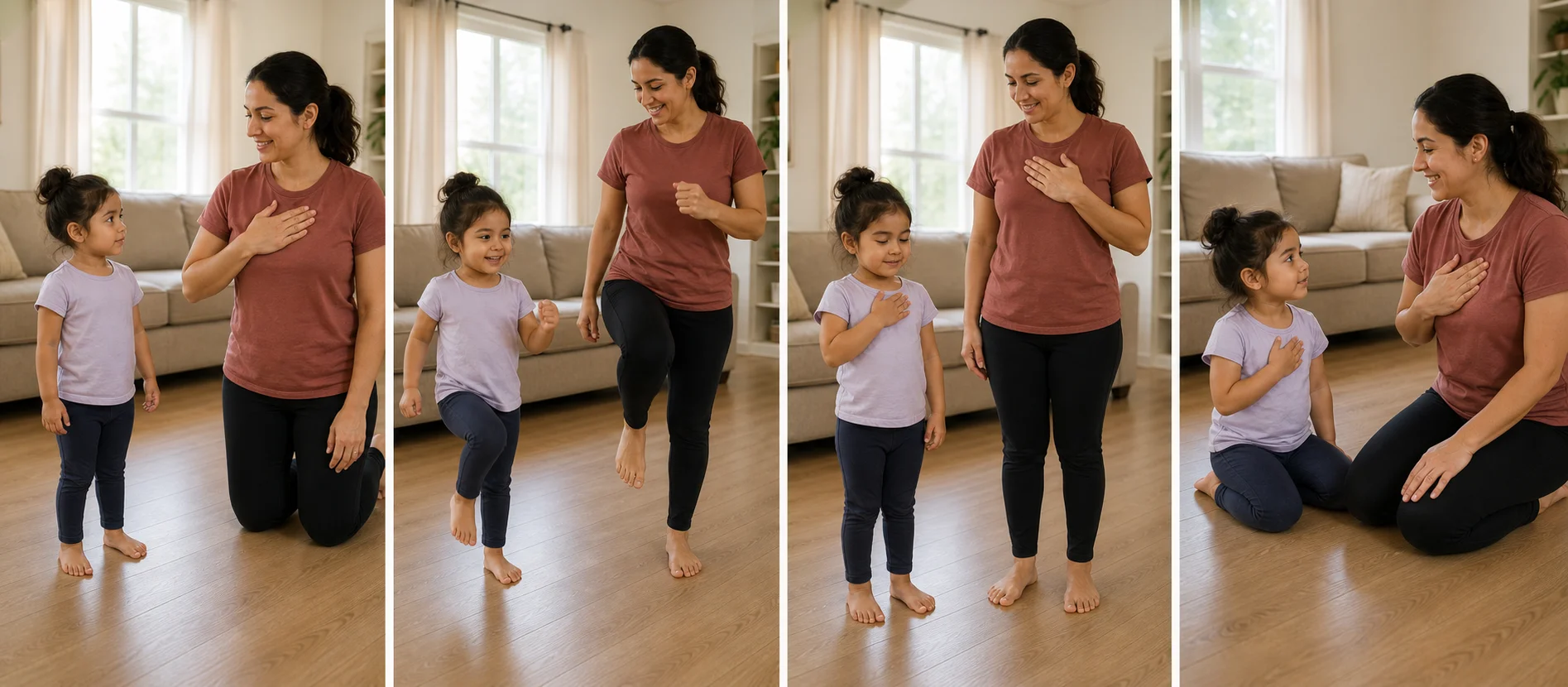
Sequence showing a grown-up model marching, child freezing after movement, hand-on-chest heartbeat check, and quiet rest before another round
  1. 01
    March beside your child, freeze, put one hand on your chest, and say, "Move, stop, find your heartbeat."
  2. 02
    Let your child do one short burst: a few jumps or several in-place marches.
  3. 03
    Say, "Freeze," and stop your own body so your child can copy the stillness.
  4. 04
    Let your child touch chest or wrist, watch your model, or copy your "thump-thump."
  5. 05
    Ask, "Rabbit fast or turtle slow?" Count any notice as the round, rest until breathing looks calmer, then try again.

Safety Check

  • Use a clear, non-slippery floor.
  • Use marches instead of jumps if the floor is slippery, your child is barefoot on a smooth surface, or jumping makes the activity too wild.
  • Keep touch gentle and child-led. Let your child watch your heartbeat check if they do not want chest or wrist touch.
  • Stop for dizziness, pain, hard breathing that does not settle, distress, falling, or any medical concern about exertion or heart rate.
Supporting the play

What to say in the moment

Match what you say to what you see.

Prompt ladder
Level 1 (Start)
Move your body, freeze, and feel for thump-thump.
Level 2 (Keep going)
Try one more round and see if your heart changed.
Level 3 (Stretch)
Make this round tiny, then check again.
Level 4 (Extend)
You call move and freeze for me.
If your child seems...
What you'd see
Focused
What to do
Say
"You found a body clue."
Add
Let your child choose jumps, marches, or tiny steps for the next burst.
Extend
Let your child call the freeze for one parent turn.

Make it easier

Younger end
  • -Let your child answer by pointing to rabbit or turtle instead of saying a word.
  • -Count three pretend beats aloud while your child's hand rests on chest.
  • -Use same or different if fast and slow are too hard.

Make it harder

Older end
  • +Ask your child to guess fast or slow before the movement starts.
  • +Compare a big round with a tiny round.
  • +Wait quietly until your child decides the heartbeat is slower.

If it's not working

If you see
If child ignores it
Do the whole round yourself once with big contrast: march, freeze, hand on chest, "My heart is rabbit fast."
If you see
If child misuses it
If your child runs away, crashes, pushes hard on the chest, or grabs roughly, pause and restart with slow marches only.
If you see
If child gets frustrated
Drop the fast-or-slow answer and say, "Just feel. Thump-thump means you found it." End after one successful touch, copy, or look.
Skill spotlight
Test And Compare

Noticing heartbeat changes, Comparing fast and slow body signals

This helps a child notice a body signal after active play and use a simple word, point, or gesture to show whether their body feels busy or settling.

  • The move-freeze pattern gives your child a clear way to connect active play with a body signal.
  • The heartbeat check turns a hidden feeling into something your child can touch, point to, copy, or name.
  • The fast-or-slow choice keeps the comparison simple enough for a short toddler round.
Real-world transfer
  • Noticing when running, jumping, or climbing made the body feel busy.
  • Taking a pause after active play before switching tasks.
  • Using a simple body word or gesture before frustration builds.
  • Understanding that the body can move from fast back toward calm.

Parent questions