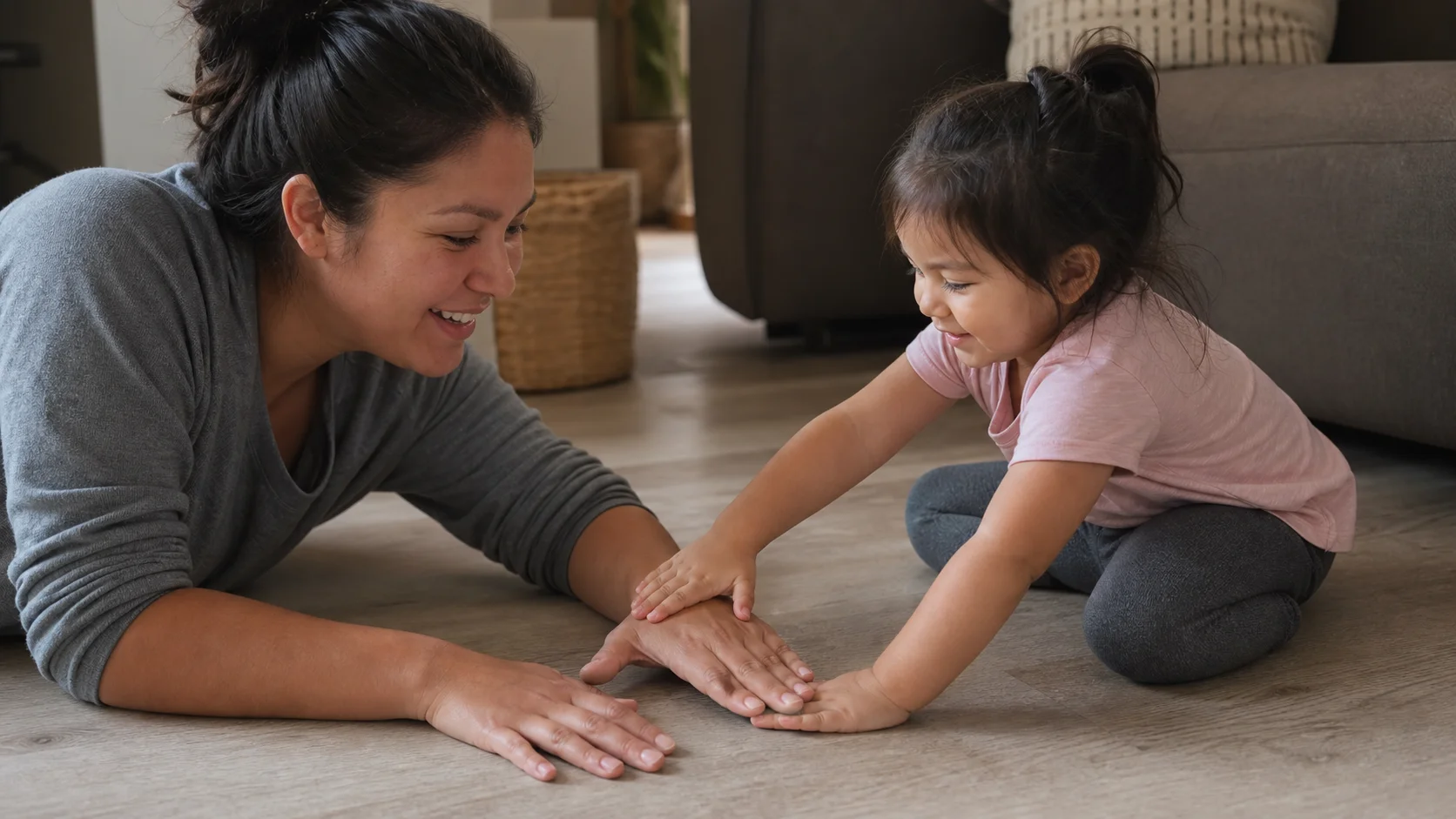
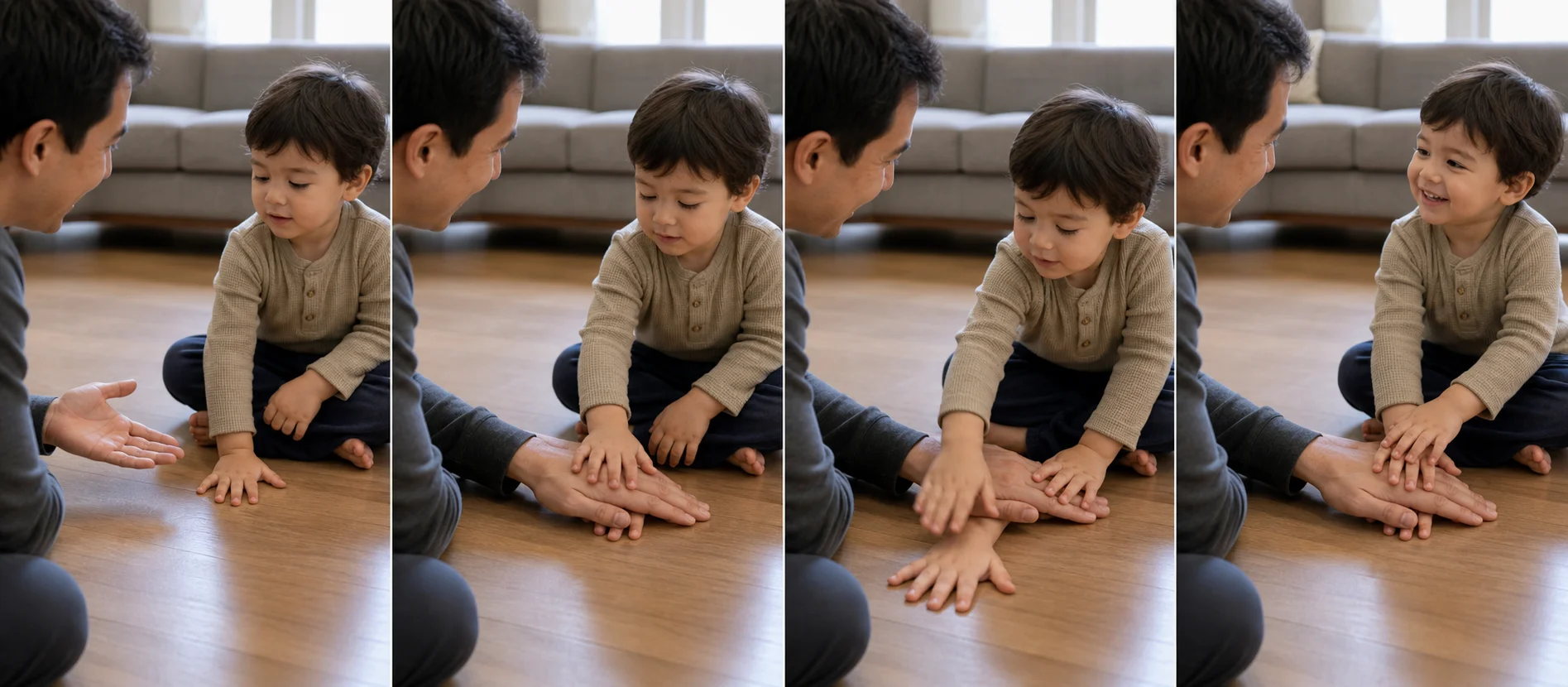
A grown-up and toddler sit facing each other and stack their hands on the floor before the child slides the bottom hand out.
Fine motorSensory-friendly supportTwo Hand CoordinationIndoor

Hand Tower Pull-Out.

Stack hands, slide one out, and rebuild for a tiny no-prep game that is easy to start and easy to stop.

Play time
5+ min
Age
1-4 years
Energy
Low
Mess
No
Effort
Low
Where
Indoor
Start here

The recipe.

Low parent effort
3 things

What you need

  • 1 child
  • 1 grown-up
  • 1 flat floor space or low table
5 min minimum

Setup

Then start the loop
Step 01
Sit facing your child on the floor or at a low table.
Step 02
Clear one flat spot between you.
Step 03
Ask your child to place one hand flat in the middle of that spot.
Step 04
Put your hand on top of your child's hand.
Step 05
Help your child place the other hand on top so the stack is ready.
"Stack hands."
The loop

How play unfolds.

A multi-panel sequence shows a grown-up and child sitting together, building a short hand stack, sliding the bottom hand out, and rebuilding the tower for another turn.
  1. 01
    Build the hand stack and say, "Stack hands."
  2. 02
    Show whose hand is on the bottom, then let your child slide it out in one quick gentle move.
  3. 03
    Rebuild the stack and repeat until your child is done.

Safety Check

  • Stop if your child dislikes the hand contact or starts pulling fingers instead of sliding a flat hand out.
  • Keep the movement quick but gentle so the stack does not twist fingers.
Supporting the play

What to say in the moment

Match what you say to what you see.

Prompt ladder
Level 1 (Start)
"Hands on."
Level 2 (Keep going)
"Pull it out."
Level 3 (Stretch)
"Whose hand now?"
Level 4 (Extend)
"Build it again."
If your child seems...
What you'd see
Focused
What to do
Say
"You pulled it out."
Add
Name whose hand is on the bottom after the stack is built.
Extend
Let your child choose whether your hand or their hand starts on the bottom next.

Make it easier

Younger end
  • -Use a two-hand stack instead of three hands.
  • -Always let your child pull the grown-up hand first.
  • -Stop after one or two successful turns.

Make it harder

Older end
  • +Pause before the pull so your child has to wait for the right moment.
  • +Switch which hand starts on the bottom.
  • +Let your child rebuild the stack with less help.

If it's not working

If you see
If child ignores it
Do one or two quick grown-up turns first, then invite your child to add one hand to the stack.
If you see
If child misuses it
Switch to a two-hand stack and model a gentle slide instead of a yank.
If you see
If child gets frustrated
Let your child pull out the grown-up hand first and stop after one easy success.
Skill spotlight
Two-Hand Coordination

using both hands together in a short shared movement sequence

This helps a child coordinate both hands in one short sequence, switch between helper-hand and moving-hand roles, and stay with a simple shared action long enough to repeat it.

  • Repeating the stack-and-slide pattern gives your child practice using both hands in one shared job.
  • The predictable contact and fast reset can make touch feel easier to try than a bigger sensory activity.
  • The short loop gives your child a clear beginning, action, and finish without needing much language.
Real-world transfer
  • Using one hand to help the other during dressing and simple tool use
  • Keeping both hands involved in short tabletop jobs
  • Waiting, moving, and resetting in a familiar routine
Back to library
Keep playing

Related activities.