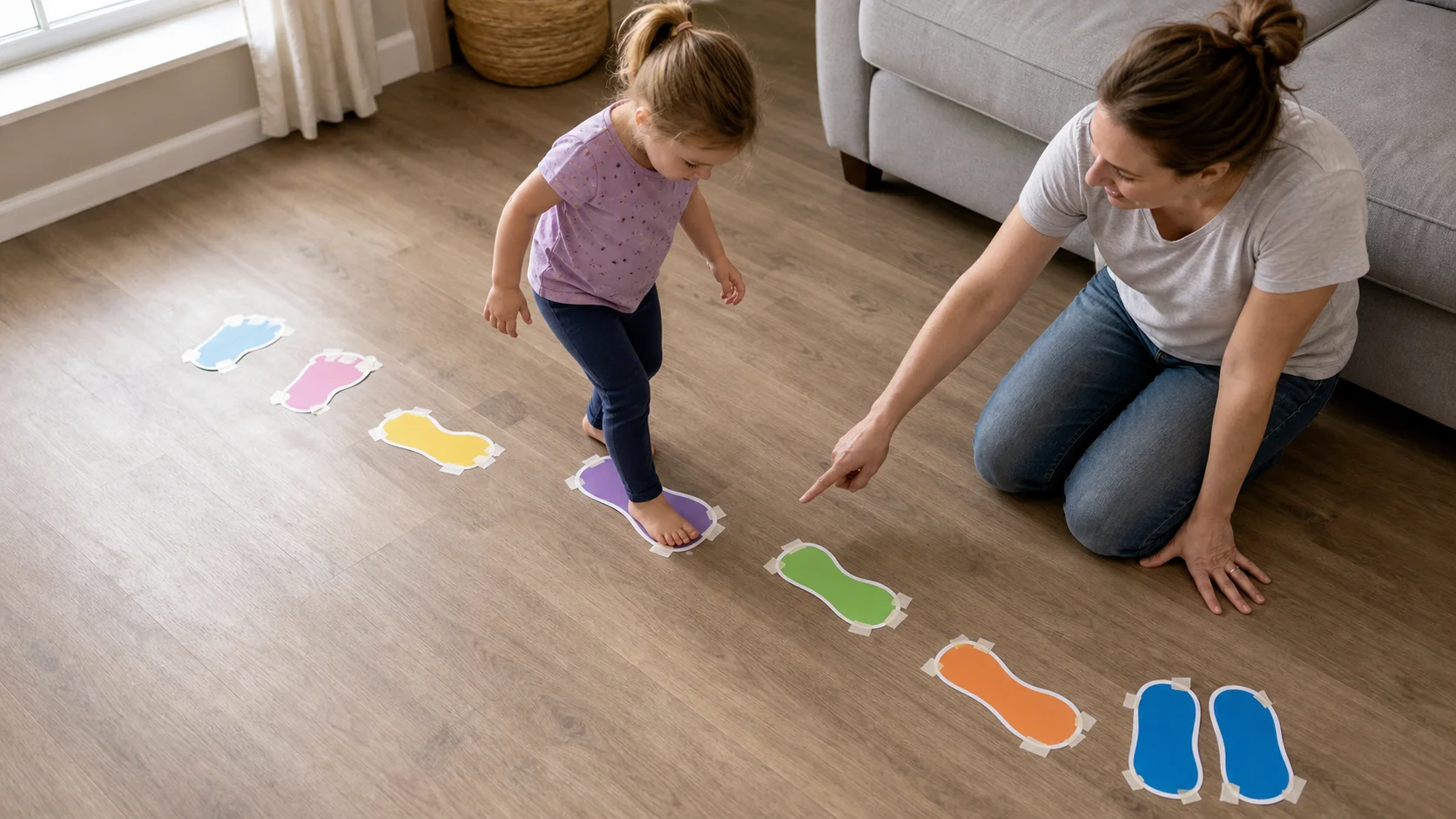
Child stepping onto taped paper footprint markers on a clear indoor floor with a caregiver nearby.
Gross motorOT-adjacent supportNavigate PathIndoor

Footprint Step Path.

A short floor-marker path helps your child step, stop, and finish with a jump or careful two-foot stand.

Play time
3-5+ min
Age
2-4 years
Energy
Medium
Mess
No
Effort
Low
Where
Indoor
Start here

The recipe.

Low parent effort
6 things

What you need

  • 6 to 8 paper foot shapes or floor dots
  • 2 paper foot shapes or floor dots for the finish
  • Low-tack tape if using paper markers
  • 1 clear flat floor lane
  • 1 adult
  • 1 child
3 min minimum

Setup

Then start the loop
Step 01
On a clear flat floor lane about 5 to 8 feet long, remove loose rugs and keep the path away from stairs, furniture corners, and shiny floors.
Step 02
On the floor, place 6 to 8 paper foot shapes or floor dots in a straight or gently curving path.
Step 03
On the path, space each marker about 1 child step from the next marker.
Step 04
At the end of the path, place 2 finish markers side by side so your child can land or stand with both feet together.
Step 05
On every paper marker, press low-tack tape over the edges so the paper stays flat.
Step 06
Beside the path, stand close enough to steady a wobbly step and point to the first marker.
"Find the first foot."
The loop

How play unfolds.

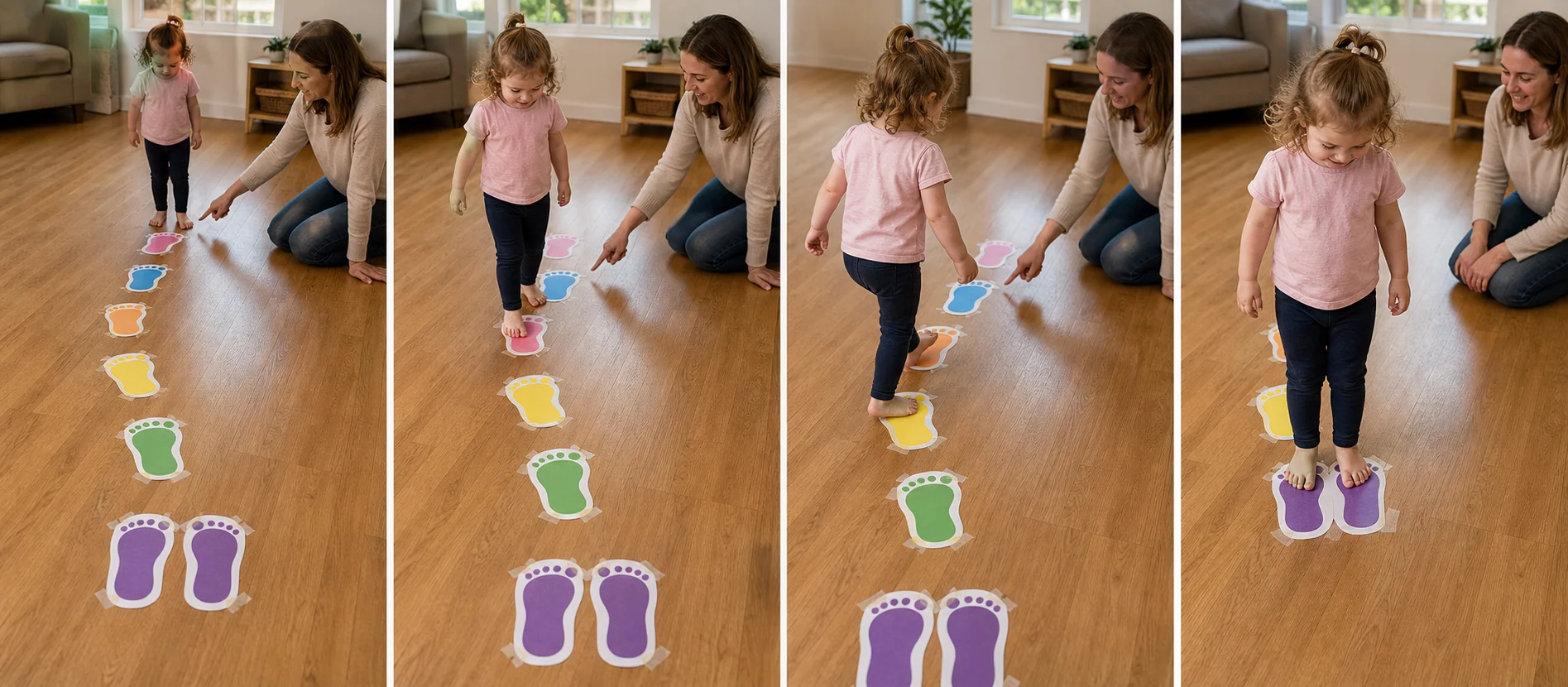
Panels showing the setup of floor markers, the child following each marker, and the two-foot finish.
  1. 01
    Point to the first marker and say, "Find the first foot. Follow the feet to the finish."
  2. 02
    Point to the next marker only after your child's foot lands, then keep going one marker at a time.
  3. 03
    At the finish pair, say, "Two feet," and let your child jump or stand on both markers.
  4. 04
    Move a few middle markers to make a new short path, then repeat if your child wants another round.

Safety Check

  • Use taped-flat paper markers or non-slip floor dots only.
  • Avoid stairs, hard corners, loose rugs, shiny floors, and any lane where your child has to run, leap, or lunge.
  • Stay within reach for balance support.
  • Skip the jump when your child is wobbly, tired, rushing, or unsure. Use a careful two-foot stand on the finish instead.
  • Stop or rebuild shorter if your child trips, skids, peels up markers, or loses control.
Supporting the play

What to say in the moment

Match what you say to what you see.

Prompt ladder
Level 1 (Start)
Point to the first marker and invite one step.
Level 2 (Keep going)
Point to the next marker only after your child's foot lands.
Level 3 (Stretch)
Add one slow stop on a middle marker before the next step.
Level 4 (Extend)
Let your child choose which middle marker moves before the next round.
If your child seems...
What you'd see
Focused
What to do
Say
"Next foot."
Add
"Show me the finish."
Extend
Move one middle marker and walk the changed path.

Make it easier

Younger end
  • -Hold one hand for the first half of the path.
  • -Walk the same marker pattern twice before changing it.
  • -Stand beside the next marker so your child can copy your direction.

Make it harder

Older end
  • +Add one gentle turn in the marker path.
  • +Pause on one middle marker for one slow count.
  • +Let your child move one middle marker and then follow the new path.

If it's not working

If you see
If child ignores it
Walk the first two markers yourself slowly, then invite one step only: "Can your foot find this one?"
If you see
If child misuses it
If your child runs, skids, peels up markers, or kicks them, pause the round, flatten the path, and restart with only 3 markers.
If you see
If child gets frustrated
Offer the finish without the whole path: "Two feet on the finish." Count that as the round and stop or rebuild shorter.
Skill spotlight
Path Navigation

Following a short movement path

This helps a child control where their body goes, place each step, stop before moving again, and handle simple movement routes in daily play and transitions.

  • Following one visible marker at a time helps your child practice stopping, looking, and stepping before rushing.
  • The two-foot finish gives the round a clear body-control goal without needing speed.
  • Moving a few middle markers keeps the rules familiar while giving your child a new path to scan.
Real-world transfer
  • Walking through a room without bumping into things.
  • Following a simple path at the playground, park, or library.
  • Stopping before the next step in a line or transition.
  • Using two feet together for small jumps during play.

Parent questions