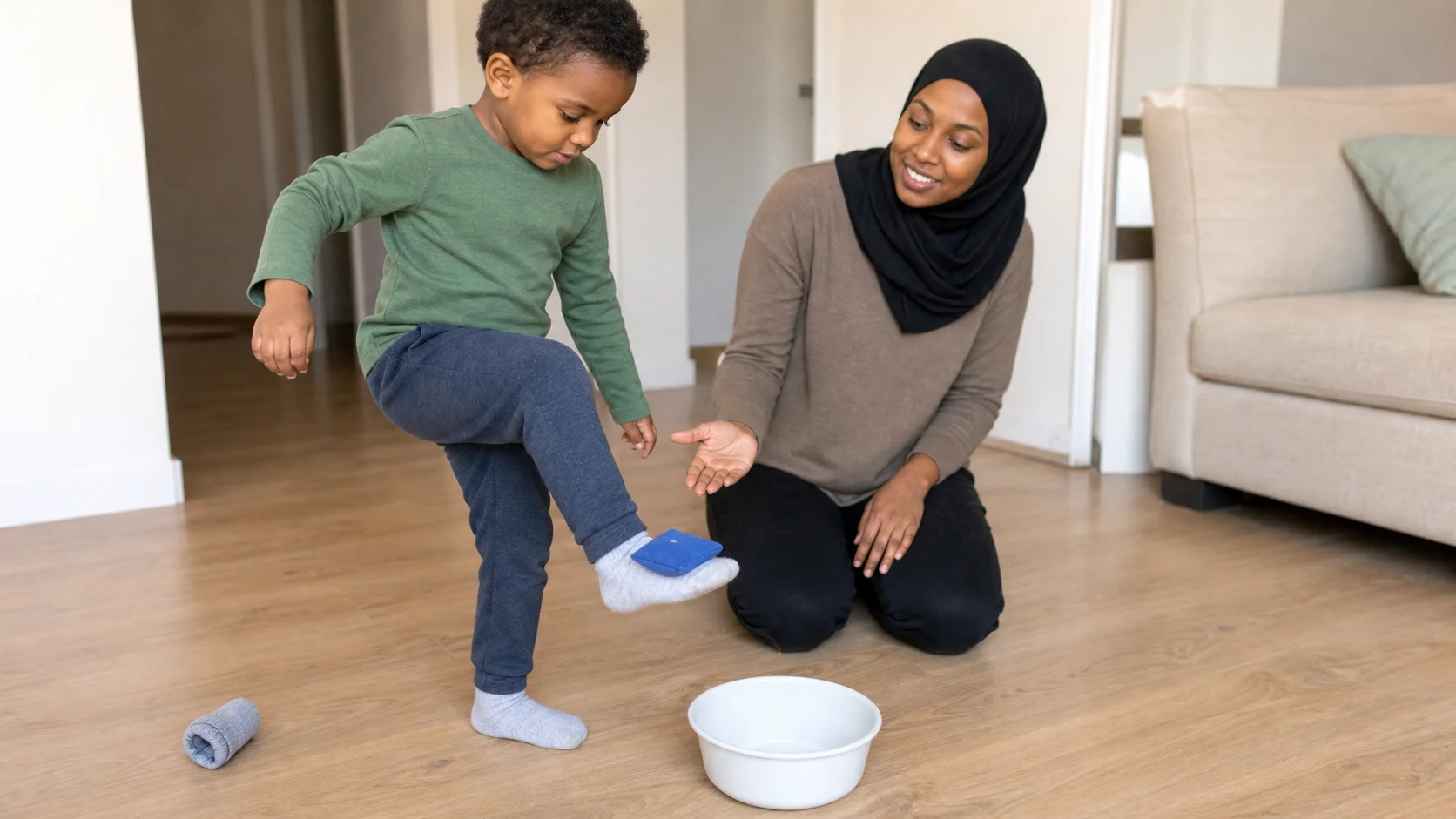
Child slowly lifting one foot with a soft beanbag toward a close bucket target while a grown-up stays nearby
Fine motorOT-adjacent supportStop And StartIndoor

Foot Beanbag Lift.

A soft beanbag on one foot turns slow lifting, aiming, and dropping into a quick balance game.

Play time
3-5+ min
Age
3-4 years
Energy
Low
Mess
No
Effort
Low
Where
Indoor
Start here

The recipe.

Low parent effort
5 things

What you need

  • 1 beanbag or rolled sock
  • 1 small bucket or bowl
  • 1 clear indoor floor spot
  • 1 adult
  • 1 child
3 min minimum

Setup

Then start the loop
Step 01
On a flat indoor floor, clear a spot where your child can stand without toys, furniture, or the bucket underfoot.
Step 02
On the floor close in front of your child's foot, place the bucket or bowl. You can also hold your open hand low and close as the target.
Step 03
Beside your child, stand or kneel within arm's reach.
Step 04
On top of one foot, rest the beanbag or rolled sock. It should sit there while the toes stay relaxed. If it slides off right away, flatten or loosen the sock and try again.
"Beanbag foot."
The loop

How play unfolds.

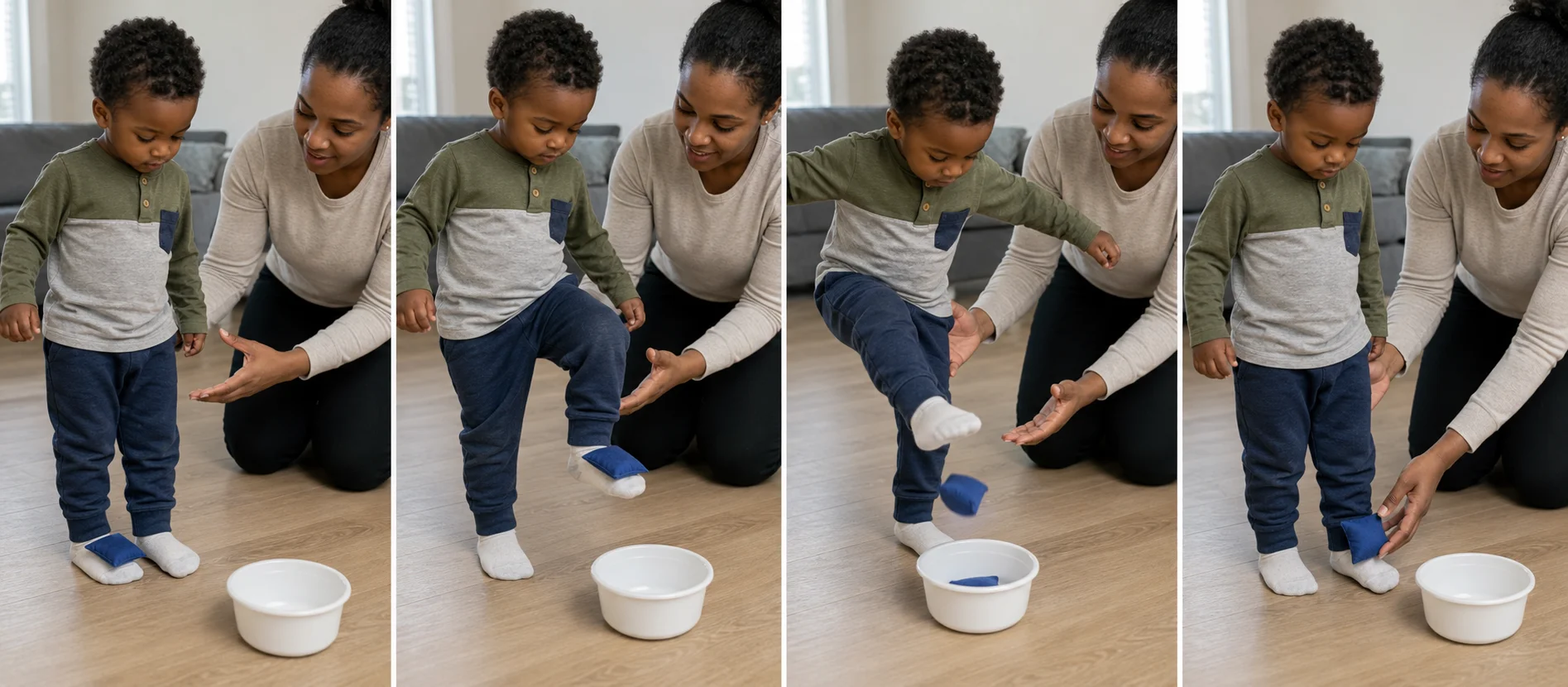
Sequence showing beanbag placed on foot, child lifting slowly, beanbag dropping into a close target, and child resetting for another turn
  1. 01
    Put the beanbag or rolled sock on one foot and say, "Beanbag on foot. Lift slow. Drop it in."
  2. 02
    Your child lifts that foot slowly while the other foot stays planted.
  3. 03
    Your child aims over the bucket or your open hand and lets the beanbag drop without kicking it.
  4. 04
    Reset the beanbag and try another careful lift.

Safety Check

  • Use a clear, flat, non-slippery floor.
  • Stay close enough to steady your child if they wobble.
  • Keep the target close and low so your child does not need to twist, hop, or lunge.
  • Use only a soft beanbag or rolled sock. Avoid hard, heavy, or slippery objects.
  • Stop if your child loses balance repeatedly, kicks or throws the beanbag, shows pain, or looks tired.
Supporting the play

What to say in the moment

Match what you say to what you see.

Prompt ladder
Level 1 (Start)
Put the beanbag on one foot and lift it just a little.
Level 2 (Keep going)
Lift slowly and let it drop into the target.
Level 3 (Stretch)
Try the other foot for the next slow lift.
Level 4 (Extend)
Hold the foot still for one count before dropping it in.
If your child seems...
What you'd see
Focused
What to do
Say
"Slow body, steady foot."
Add
Name the foot or target after the beanbag lands.
Extend
Switch feet after two successful lifts.

Make it easier

Younger end
  • -Place the target on your child's stronger side so the raised foot travels less.
  • -Let your child rest the raised heel lightly against the standing leg before lifting away.
  • -Count an adult catch as a successful target hit.

Make it harder

Older end
  • +Ask for one quiet pause with the foot lifted before the drop.
  • +Move from your hand to the bucket after two steady turns.
  • +Alternate left foot and right foot while keeping the same close target.

If it's not working

If you see
If child ignores it
Do one adult demo, then offer your open hand instead of the bucket and say, "Give it to my hand."
If you see
If child misuses it
If your child kicks or throws the beanbag, pause, put it back on the foot, and say, "Slow lift, no kick." If kicking continues, do one lift without the beanbag and stop.
If you see
If child gets frustrated
Move the target closer, offer one steadying hand, or count a tiny foot lift as the win for that turn.
Skill spotlight
Stop And Start

Steady one-foot balance

This helps a child feel where their body is, control a slow leg movement, and stay steady during everyday actions like stepping, dressing, and climbing.

  • The slow foot lift gives your child practice shifting weight without rushing.
  • The close target gives the movement a clear finish, so a drop becomes part of the game instead of a failure.
  • The soft beanbag or rolled sock keeps the body-awareness practice contained, quiet, and easy to reset.
Real-world transfer
  • Standing steady while putting on pants or shoes.
  • Stepping over small toys without rushing.
  • Climbing stairs or playground steps with better body control.
  • Recovering balance after a small wobble.

Parent questions