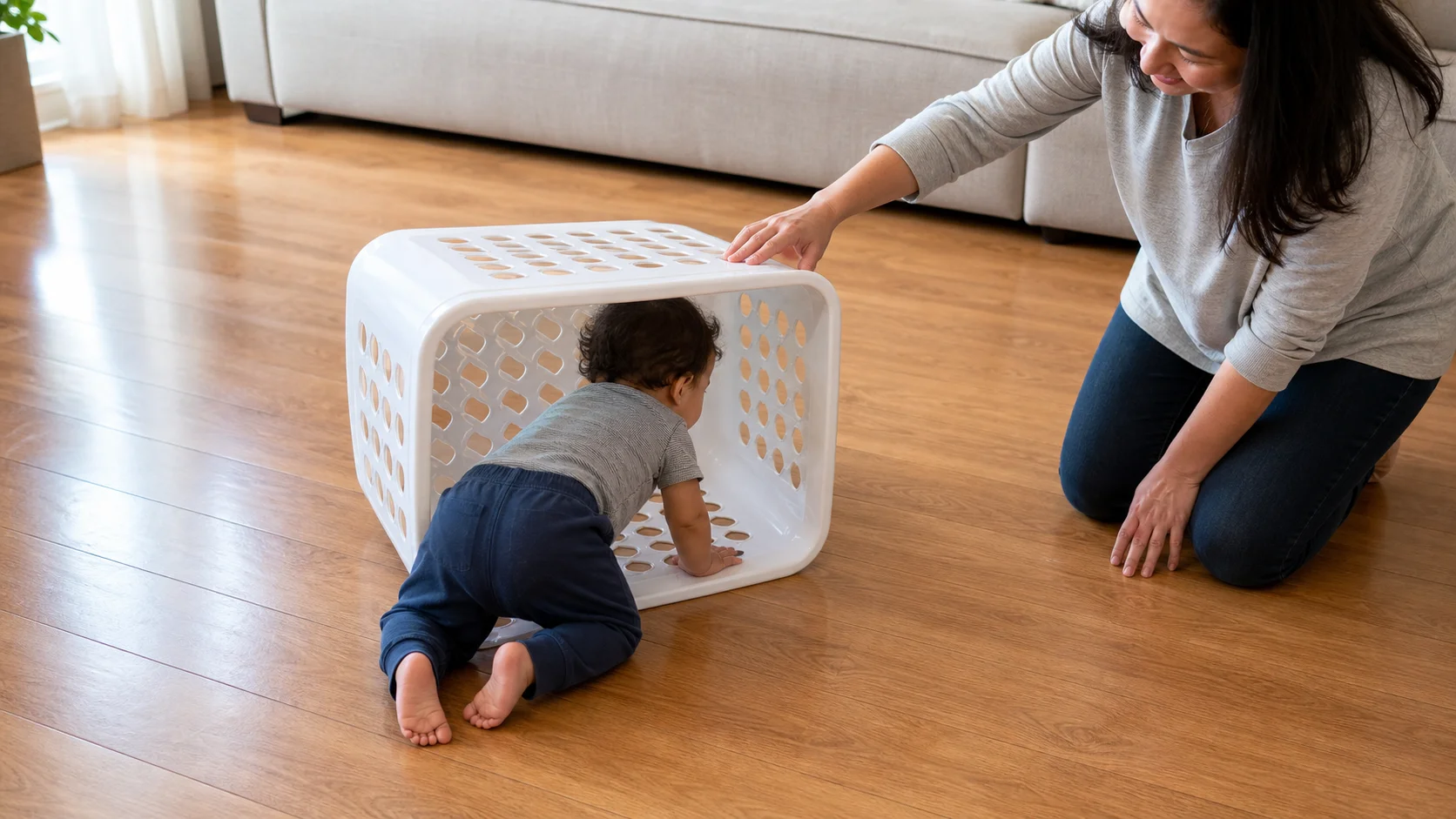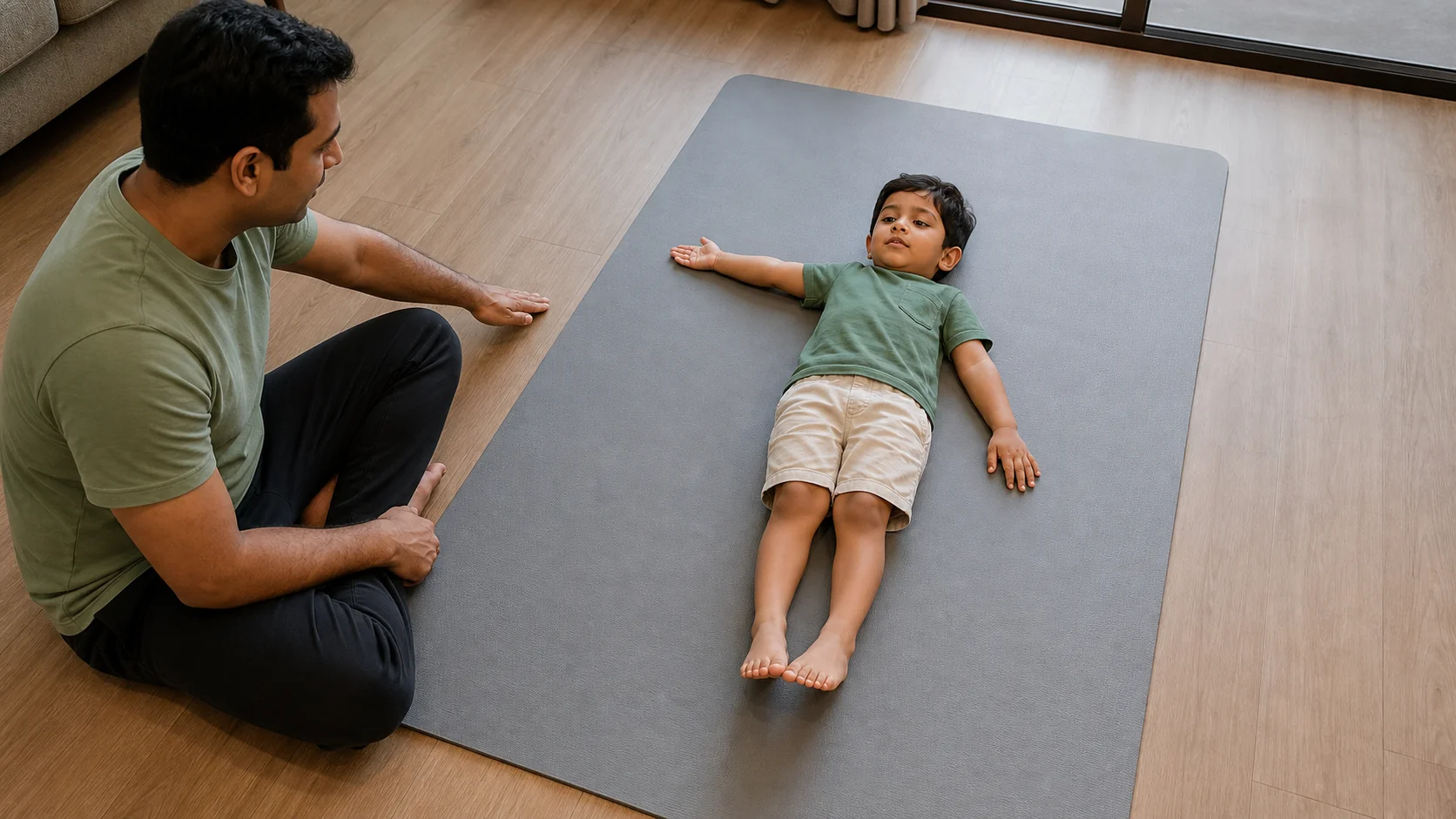
Child lying on a play mat sliding one arm outward for a floor snow angel while a grown-up models nearby.
Fine motorStop And StartOpen Floor Space

Floor Snow Angels.

Give one body cue, let your child slide that limb out and back, and reset for the next snow angel turn.

Play time
4-6+ min
Age
3 years
Energy
Medium
Mess
Low
Effort
Low
Where
Open Floor Space
Start here

The recipe.

Low parent effort
3 things

What you need

  • 1 clear floor spot or play mat large enough for full-body lying
  • 1 child
  • 1 adult
4 min minimum

Setup

Then start the loop
Step 01
On the floor or on a play mat, clear one open spot where your child can stretch both arms and both legs outward without touching furniture.
Step 02
In the middle of that open spot, help your child lie on their back with arms near the sides and legs straight.
Step 03
Beside your child on the floor, kneel, sit, or lie where you can model one move and give one short cue at a time.
Out and in.
The loop

How play unfolds.

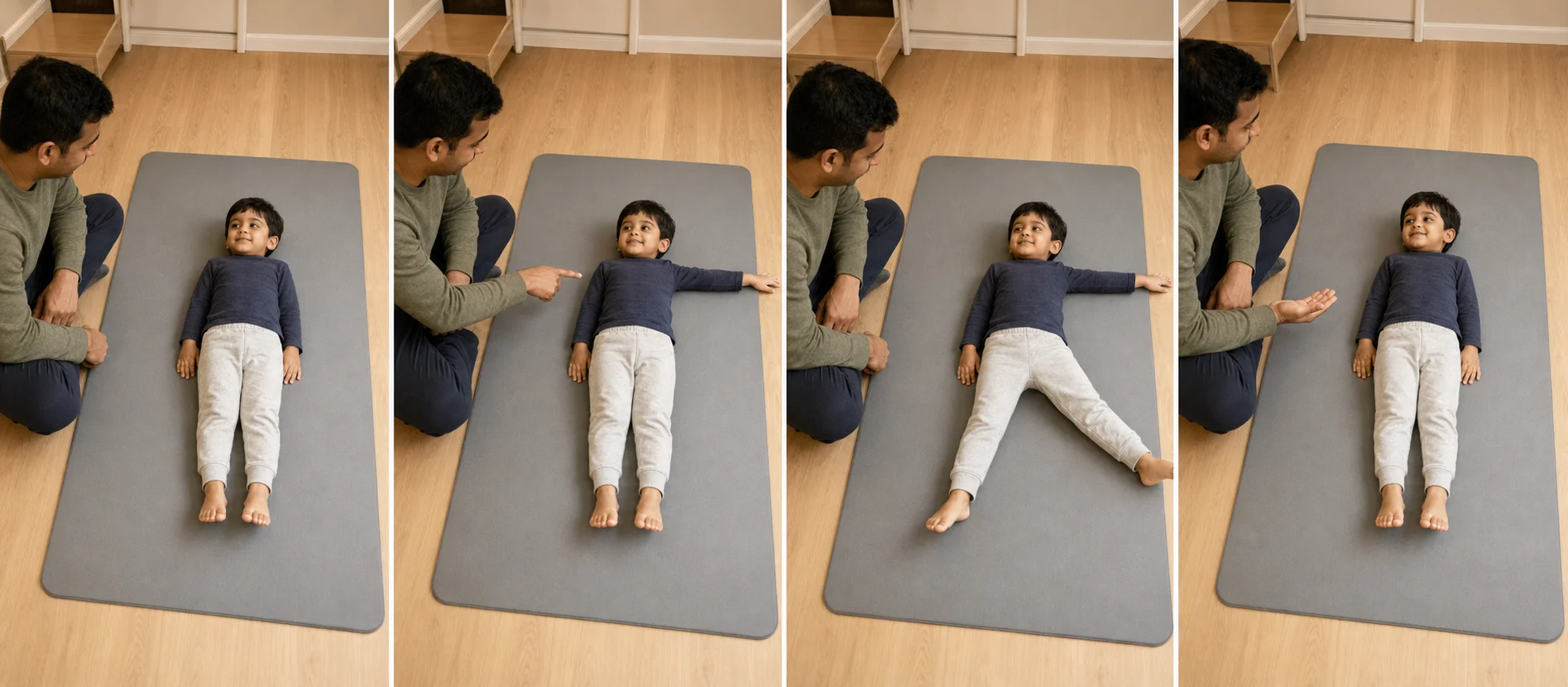
Multi-panel sequence showing a grown-up giving one limb cue, the child sliding out and in, trying a paired move, and resetting.
  1. 01
    Start with one short cue for one arm or one leg, such as `Move your left arm.`
  2. 02
    Let your child slide the named limb out to the side and back to the middle while keeping it on the floor.
  3. 03
    Repeat single-limb turns until a few feel smooth, then try one paired cue, such as `Move your left arm and your right leg.`
  4. 04
    Reset to the middle after each turn and stop after a short calm round, or sooner if your child is done.

Safety Check

  • Use a non-slip floor or mat with clear space around hands and feet so wide arm-and-leg slides do not bump furniture, toys, or other children.
  • Stop if your child seems uncomfortable lying on their back or cannot keep the movement on the floor without sliding into obstacles.
Supporting the play

What to say in the moment

Match what you say to what you see.

Prompt ladder
Level 1 (Start)
Move your left arm out and back.
Level 2 (Keep going)
Now your right arm gets a turn.
Level 3 (Stretch)
Can your left arm and right leg move together?
Level 4 (Extend)
Let's do one slow snow-angel turn.
If your child seems...
What you'd see
Focused
What to do
Say
Nice. Same smooth slide.
Add
Ask one body-part prompt like `Arm or leg?`
Extend
Give one extra paired move before stopping.

Make it easier

Younger end
  • -Keep the whole round to arm cues only before bringing in legs another day.
  • -Accept small slides instead of full wide openings as long as the limb goes out and comes back.
  • -Stay on the same side for two turns in a row so the cue pattern feels predictable.

Make it harder

Older end
  • +Fade your model and use the verbal cue only after a few easy turns.
  • +Repeat the same paired move twice and see if both rounds stay evenly paced.
  • +Alternate one regular-speed turn and one slow-motion turn while the limbs still match.

If it's not working

If you see
If child ignores it
Do 1 turn beside your child with the same one-limb cue, help with 1 copy if needed, and praise the return to the middle.
If you see
If child misuses it
If your child lifts a limb off the floor, moves the wrong limb, or mismatches the speed, pause, reset the body to the start position, point to the named limb, and repeat the simpler cue.
If you see
If child gets frustrated
Go back to the easiest one-limb cue for 1 quick success, or stop as soon as your child seems uncomfortable on their back.
Skill spotlight
Start And Stop On Cue

Starting and stopping named limb movements on cue

This helps a child notice one body part, start and stop that movement on cue, and keep simple body-control games more organized.

  • Each cue asks your child to listen before moving one body part.
  • The out-and-back slide gives start, stop, and reset a visible shape.
  • Paired limb turns add a small timing challenge only after single-limb turns feel steady.
Real-world transfer
  • Following simple movement games like follow the leader.
  • Moving one body part on request during dressing, cleanup, or therapy-style play.
  • Keeping both sides of the body more organized during floor games and action songs.

Parent questions