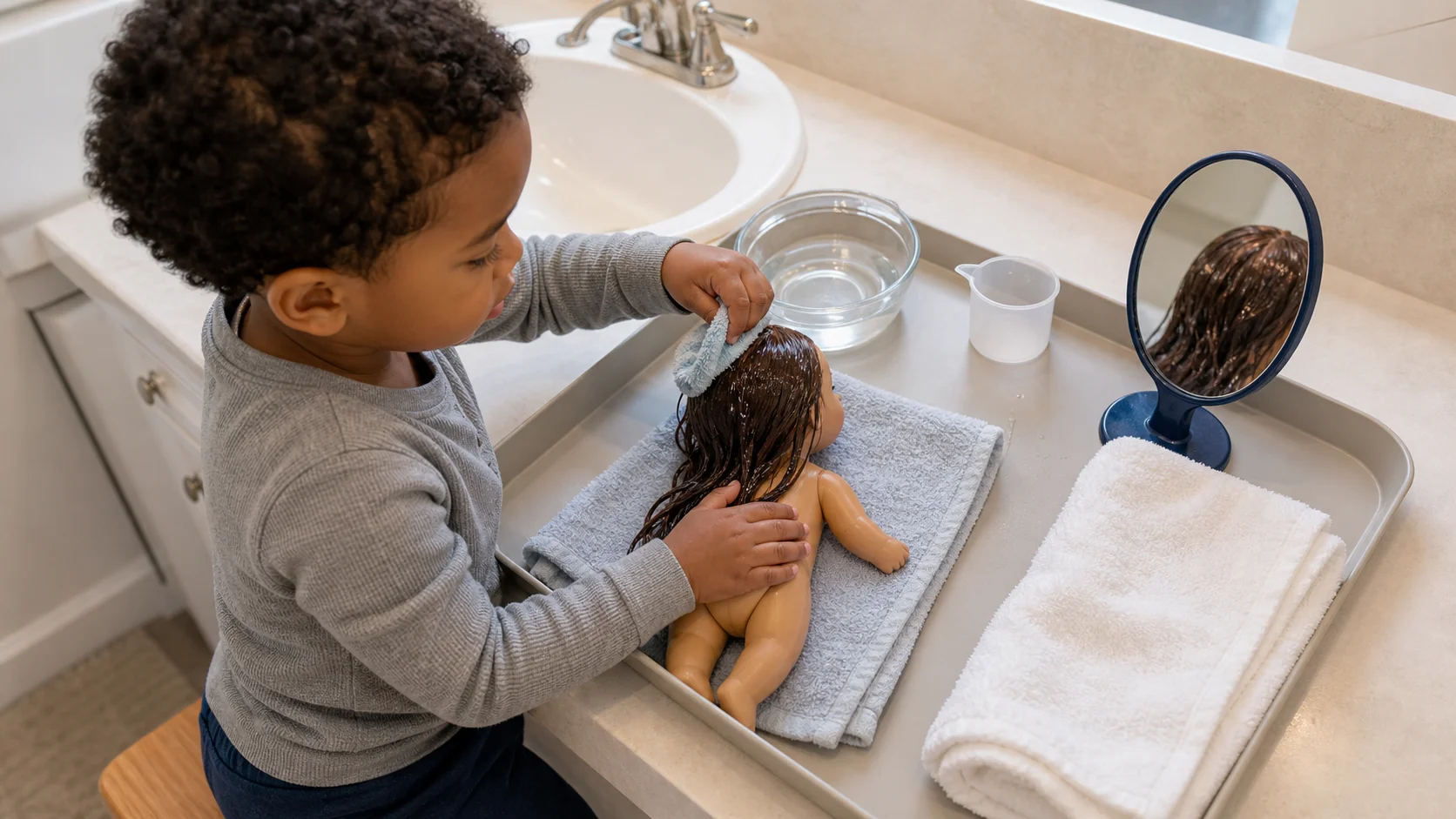
Toddler rinsing a washable doll's hair with a small cloth on a towel beside a mirror.
Skill builderSensory-friendly supportFinish And ResetIndoor

Doll Hair Rinse Choice.

Practice one tiny doll hair rinse with a choice, mirror check, towel pat, and clear all-done ending.

Play time
3-7+ min
Age
2-4 years
Energy
Low
Mess
Low
Effort
Low
Where
Indoor
Start here

The recipe.

Low parent effort
7 things

What you need

  • 1 washable doll or toy animal with hair or a washable head
  • 1 small cup or 1 damp washcloth
  • 1 small bowl with shallow water or 1 reachable sink area
  • 1 hand mirror or wall mirror
  • 1 small towel
  • 1 adult
  • 1 child
3 min minimum

Setup

Then start the loop
Step 01
On a floor towel, stable tray, or sink-side surface where drips can be contained, place the small bowl with shallow water, or set up at a reachable sink with the water off between turns.
Step 02
On the same towel or surface in front of your child, place the doll or toy animal with the hair or head easy to reach.
Step 03
Beside the water but slightly back from the edge, place the cup, damp washcloth, or both rinse tools where your child can reach one without leaning over the bowl.
Step 04
Beside the doll, open the drying towel so it is ready after one rinse.
Step 05
In front of or beside the station, set the mirror so your child can see the doll's head during or right after the rinse.
Step 06
Beside your child, sit close enough to steady or remove the water with one hand.
"Doll gets a tiny rinse."
The loop

How play unfolds.

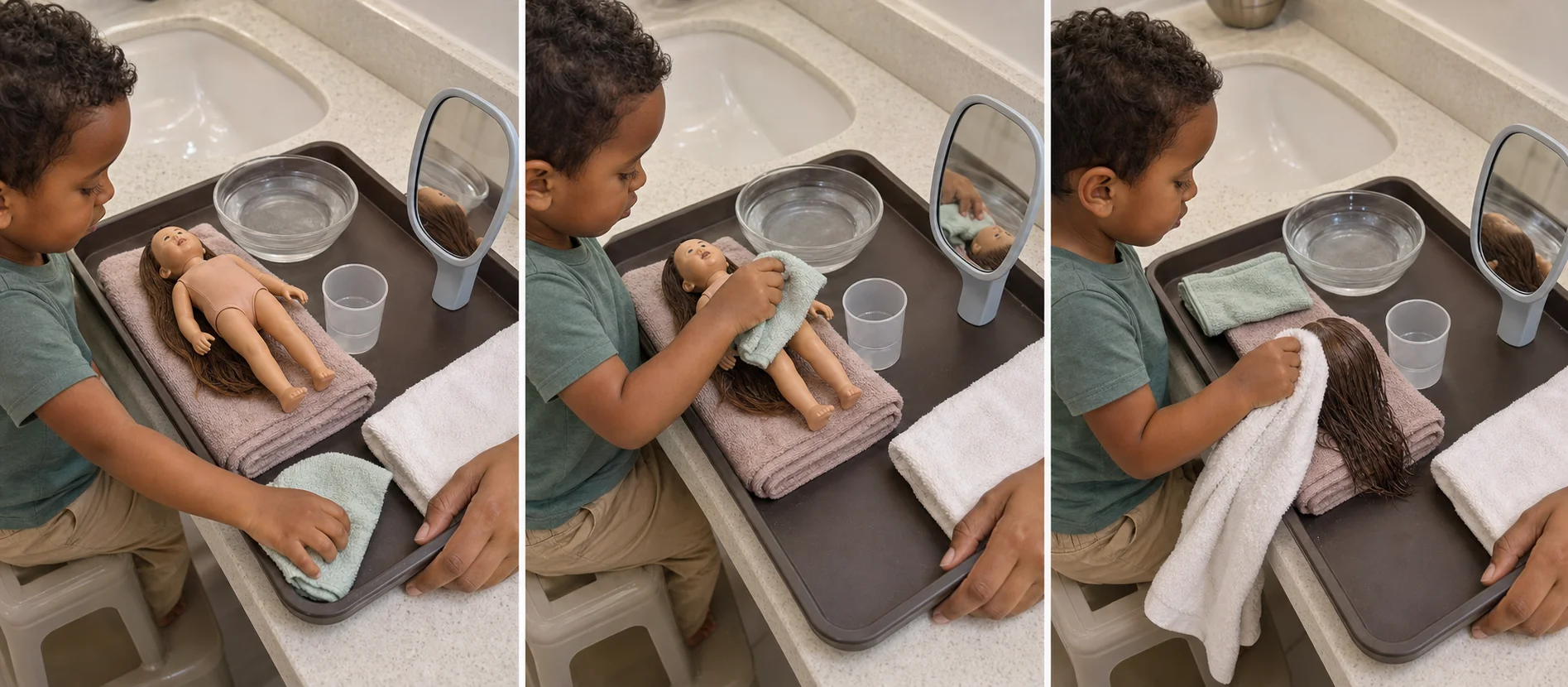
Three-panel sequence showing a child choosing a rinse tool, wetting the doll's hair, then patting it dry.
  1. 01
    Touch the doll's hair or head and say, "Doll's hair needs a tiny rinse. Cup or washcloth?"
  2. 02
    Let your child choose a rinse tool, then help them put a small amount of water on the doll's hair or head.
  3. 03
    Show the mirror and say, "Look, doll's hair is wet."
  4. 04
    Have your child pat the doll's hair or head with the towel.
  5. 05
    Ask, "All done or one more tiny rinse?" Reset the tool and repeat only if your child wants another turn and the station stays calm.

Safety Check

  • Keep water shallow and adult-controlled enough to prevent spills, slipping, or pouring onto your child's own head.
  • Use only a washable doll or toy animal.
  • Keep the bowl, mirror, and towel station stable before each turn.
  • Keep breakable mirrors out of toddler reach.
  • Keep the routine on the doll unless your child independently asks for a separate real-bath step.
  • Stop or switch to a dry pretend-care activity if water play feels too much that day.
Supporting the play

What to say in the moment

Match what you say to what you see.

Prompt ladder
Level 1 (Start)
Let doll choose a tiny rinse and you help.
Level 2 (Keep going)
Do one rinse, one mirror look, and one towel pat.
Level 3 (Stretch)
Ask doll if the next rinse should be cup or washcloth.
Level 4 (Extend)
Make doll teach you the same rinse routine.
If your child seems...
What you'd see
Focused
What to do
Say
"You chose the tool."
Add
"What is wet?"
Extend
"Let doll decide one more rinse or all done."

Make it harder

Older end
  • +Have your child keep the doll's face dry while rinsing the hair.
  • +Let your child reset the tool and towel before the next round.
  • +Add one extra tiny rinse only if the station stays calm.

If it's not working

If you see
If child ignores it
Make the doll ask for help and model one tiny adult rinse, mirror look, and towel pat before offering the tool again.
If you see
If child misuses it
Move the bowl farther back, switch to a damp washcloth, and say, "Water stays on doll. You can pat or stop."
If you see
If child gets frustrated
Drop the choice and make it a one-step job. Your child can pat the doll dry or hold the mirror while you rinse.
Skill spotlight
Finish And Reset

Finishing a small care routine

This helps the child practice ending a small self-care routine instead of getting stuck in the water step.

  • The choose, rinse, mirror, and pat loop gives your child a small care routine with a clear start and finish.
  • The doll-first water step lets your child practice the idea of hair rinsing without water on their own head.
  • The "one more" or "all done" choice keeps the water play connected to a visible ending.
Real-world transfer
  • Getting ready for hair washing.
  • Wiping and drying after small spills.
  • Ending a water routine calmly.
  • Using a simple choice during care tasks.

Parent questions