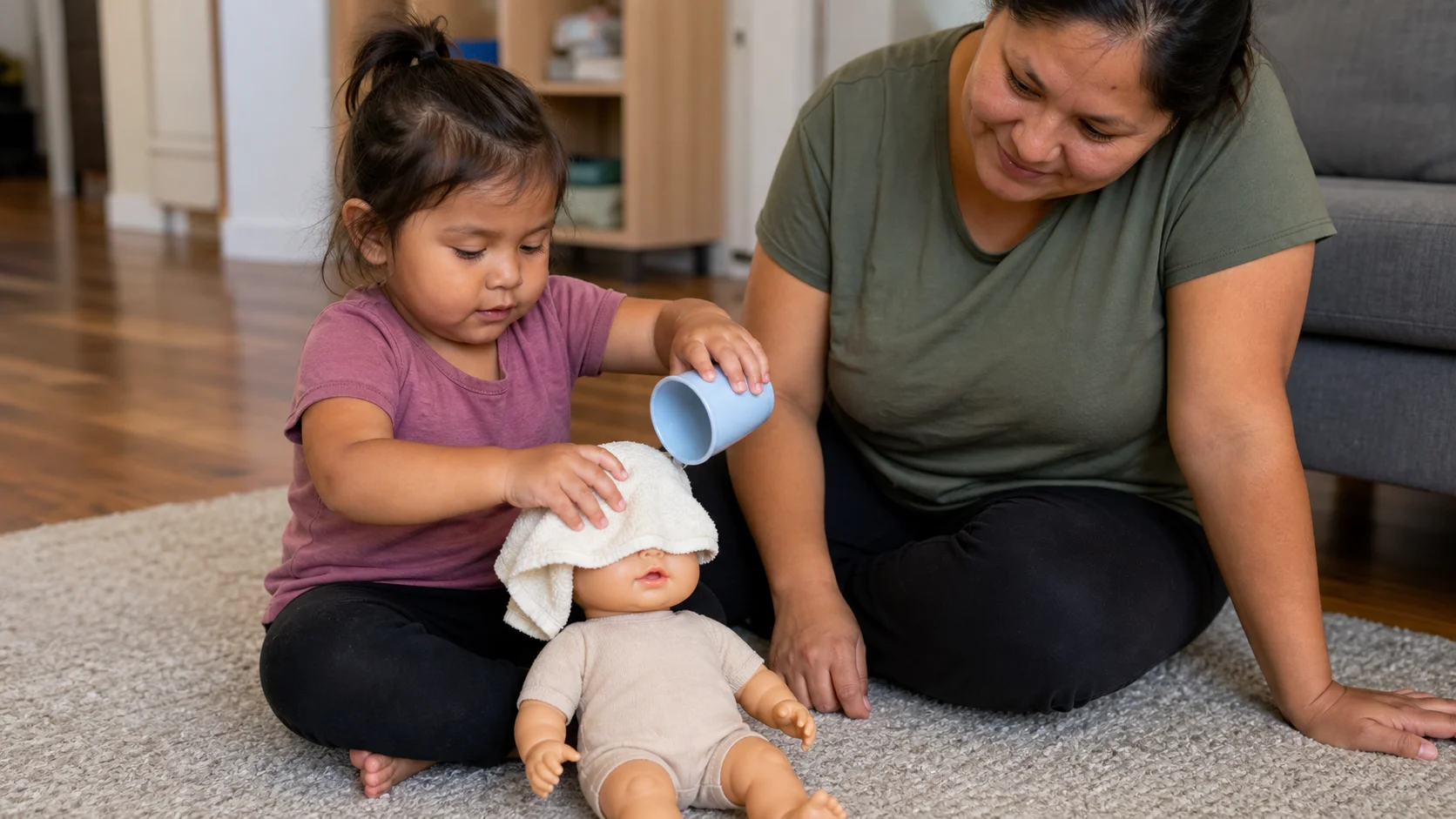

A toddler on the floor covers a doll's eyes with a washcloth and tips an empty plastic cup over the doll's head while a grown-up watches nearby.
Skill builderSensory-friendly supportFinish And ResetIndoor Floor Or Table Space

Doll Face Shield Rinse.

A dry cloth and empty cup turn doll play into one calm hair-rinse practice turn.

Play time
1-5+ min
Age
2-3 years
Energy
Low
Mess
Low
Effort
Low
Where
Indoor Floor Or Table Space
Start here

The recipe.

Low parent effort
3 things

What you need

  • 1 doll or stuffed toy with a visible face
  • 1 dry washcloth, flannel, or small towel
  • 1 empty plastic cup or small jug
1 min minimum

Setup

Then start the loop
Step 01
On a dry floor spot or low table, place the doll in the middle with the face easy to see and reach.
Step 02
Beside the doll, set the dry washcloth on your child's stronger-hand side and the empty cup on the other side so the order stays obvious
cover first, pretend rinse second.
Step 03
Sit beside your child where you can point to the doll's eyes or model 1 calm turn if needed.
"Cloth on."
The loop

How play unfolds.

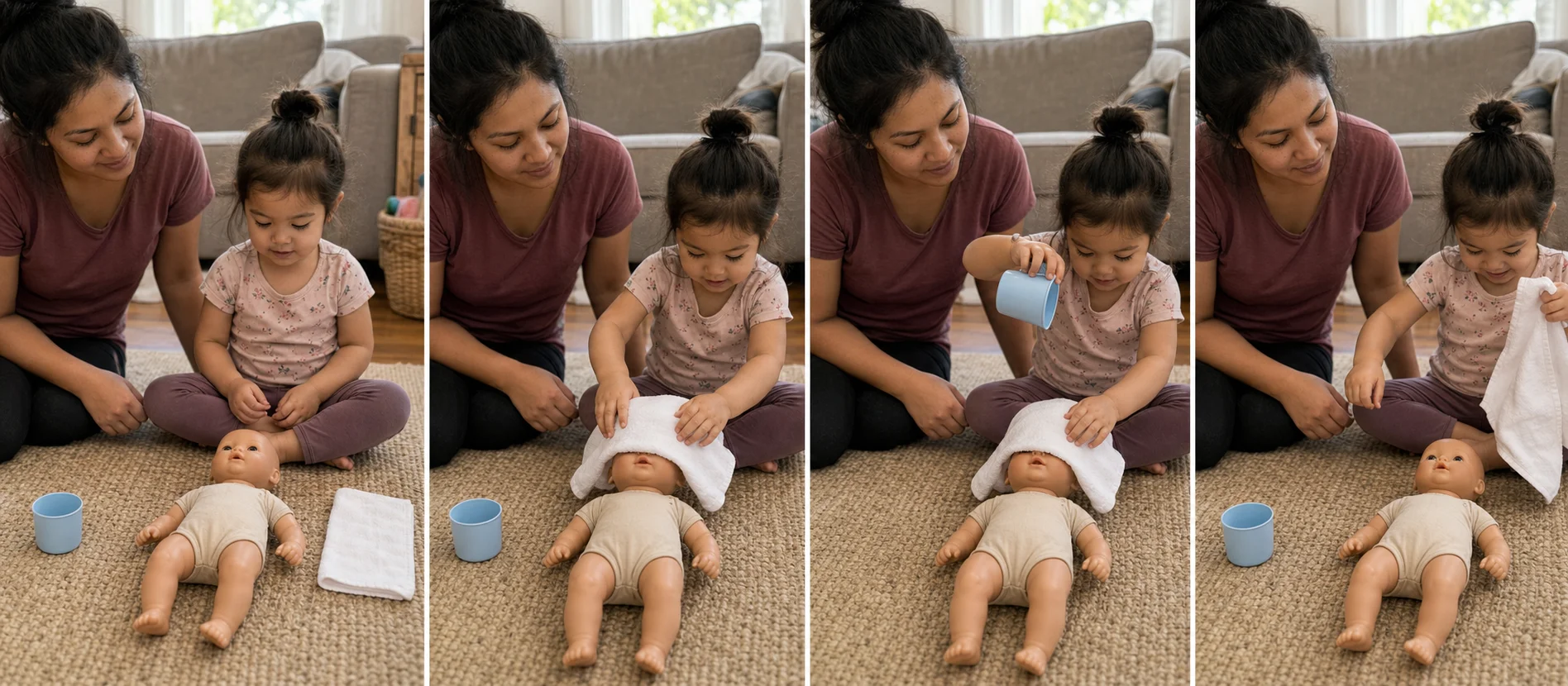
Four panels show a child covering a doll's eyes with a cloth, tipping an empty cup once, lifting the cloth to check the dry face, and resetting for the next turn.
  1. 01
    Say, "Cover dolly's eyes," and let your child place the dry cloth over the doll's eyes and upper face.
  2. 02
    Have your child tip the empty cup once over the doll's head or hair area.
  3. 03
    Lift the cloth and check whether the doll's face stayed dry.
  4. 04
    Put the cloth and cup back in place and repeat for a few calm turns, or stop after one good turn if your child is done.

Safety Check

  • Use only a light plastic cup and a dry cloth.
  • Keep the cloth on the doll, not over your child's own nose or mouth.
  • Keep this version fully pretend. Adding real water changes the demand beyond the current activity evidence.
  • Stop after 1 calm success if the child gets upset by even the pretend hair-care step.
Supporting the play

What to say in the moment

Match what you say to what you see.

Prompt ladder
Level 1 (Start)
"Cover dolly's eyes."
Level 2 (Keep going)
"Pour once, then check."
Level 3 (Stretch)
"Keep dolly's face dry."
Level 4 (Extend)
"You lead the whole turn."
If your child seems...
What you'd see
Focused
What to do
Say
"You know this one. Cover and check."
Add
Use 1 learning prompt after the check, like "Wet or dry?"
Extend
Pause before the cup so your child starts the rinse step alone.

Make it easier

Younger end
  • -Keep the doll very close to your child so the face target stays easy to reach.
  • -Spread the cloth fully open before each turn so your child does not have to fix bunches first.
  • -Stop after 1 successful dry-face check instead of stretching for a longer round.

Make it harder

Older end
  • +Let your child reset both the cloth and the cup back to their starting spots after each check.
  • +Wait 1 beat after the cloth goes on so your child remembers the cup step without your cue.
  • +Ask your child to smooth the cloth over both eyes before the pretend rinse.

If it's not working

If you see
If child ignores it
Do 1 quick model turn yourself, then hand over only the cloth and say, "Cover dolly's eyes."
If you see
If child misuses it
Remove the cup for 1 turn and practice only cover-and-check, then bring the cup back after that success.
If you see
If child gets frustrated
Place 1 corner of the cloth on the doll's forehead, let your child finish the cover, and stop after 1 completed check.
Skill spotlight
Finish And Reset

Finishing a short shield-and-rinse routine

This helps your child move through 1 small care routine in order, see a clear end to the rinse step, and take part in hair-washing preparation with more control.

  • Covering the doll's eyes before the pretend rinse turns "protect first" into something your child can do, not just hear about.
  • The face check gives an immediate action-result payoff your child can see right away.
  • Resetting the same cloth and cup keeps the whole routine short, predictable, and easy to finish.
Real-world transfer
  • Getting ready for a real hair-rinse step with a cloth or towel.
  • Following 1 short self-care routine from start to finish.
  • Using a clear check step before moving on in washing or drying routines.