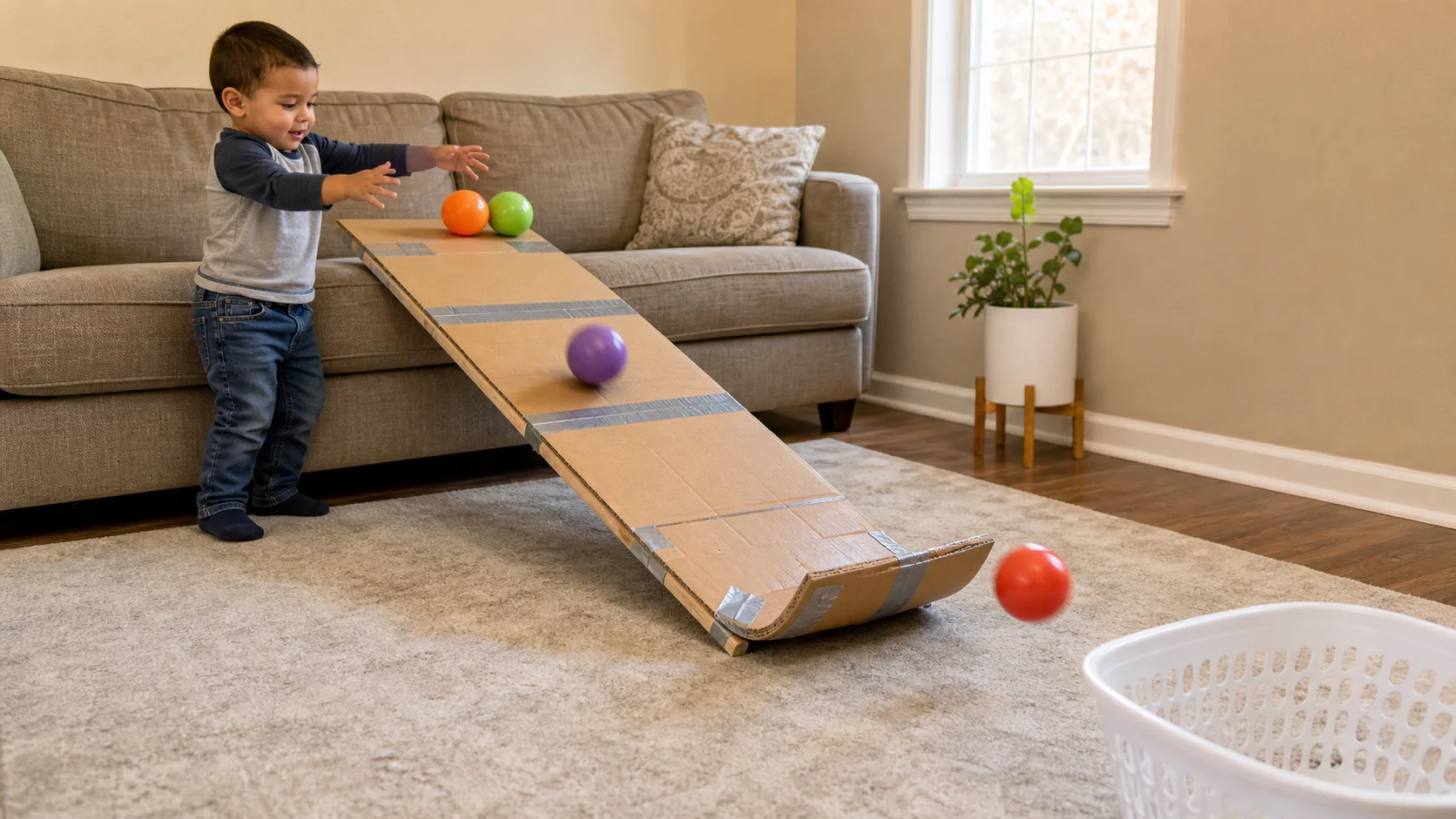
Toddler releasing a ball down a cardboard ramp toward a basket on the floor.
ThinkingTest And CompareIndoor

DIY Ball Ramp.

Build a cardboard ramp and let your child roll balls toward a basket, adjust after misses, and try again.

Play time
15-30+ min
Age
2-5 years
Energy
Medium
Mess
Low
Effort
Low
Where
Indoor
Start here

The recipe.

Low parent effort
6 things

What you need

  • 1 cardboard box
  • Duct tape
  • 1 broom handle
  • Several balls
  • 1 basket or muffin tin target
  • 1 stable raised surface, such as a couch
15 min minimum

Setup

Then start the loop
Step 01
On the floor, cut open the cardboard box so it lies flat as one long ramp.
Step 02
On the back of the cardboard, fold loose flaps flat and tape them down.
Step 03
Along the back of the cardboard, tape the broom handle in place so the ramp stays stiff.
Step 04
At the low end of the cardboard, bend the bottom edge upward into a gentle curved jump.
Step 05
On a stable couch or similar raised surface, rest the high end of the ramp so the cardboard slopes down into open floor space.
Step 06
On the floor in front of the curved end, place the basket or muffin tin where a ball could jump into it.
Step 07
Beside the high end of the ramp, place a few balls within your child's reach.
Step 08
Before inviting your child over, roll one ball yourself. If it stops halfway, smooth or lower the ramp. If it flies past the target, move the basket or soften the curve.
"Ball on top."
The loop

How play unfolds.

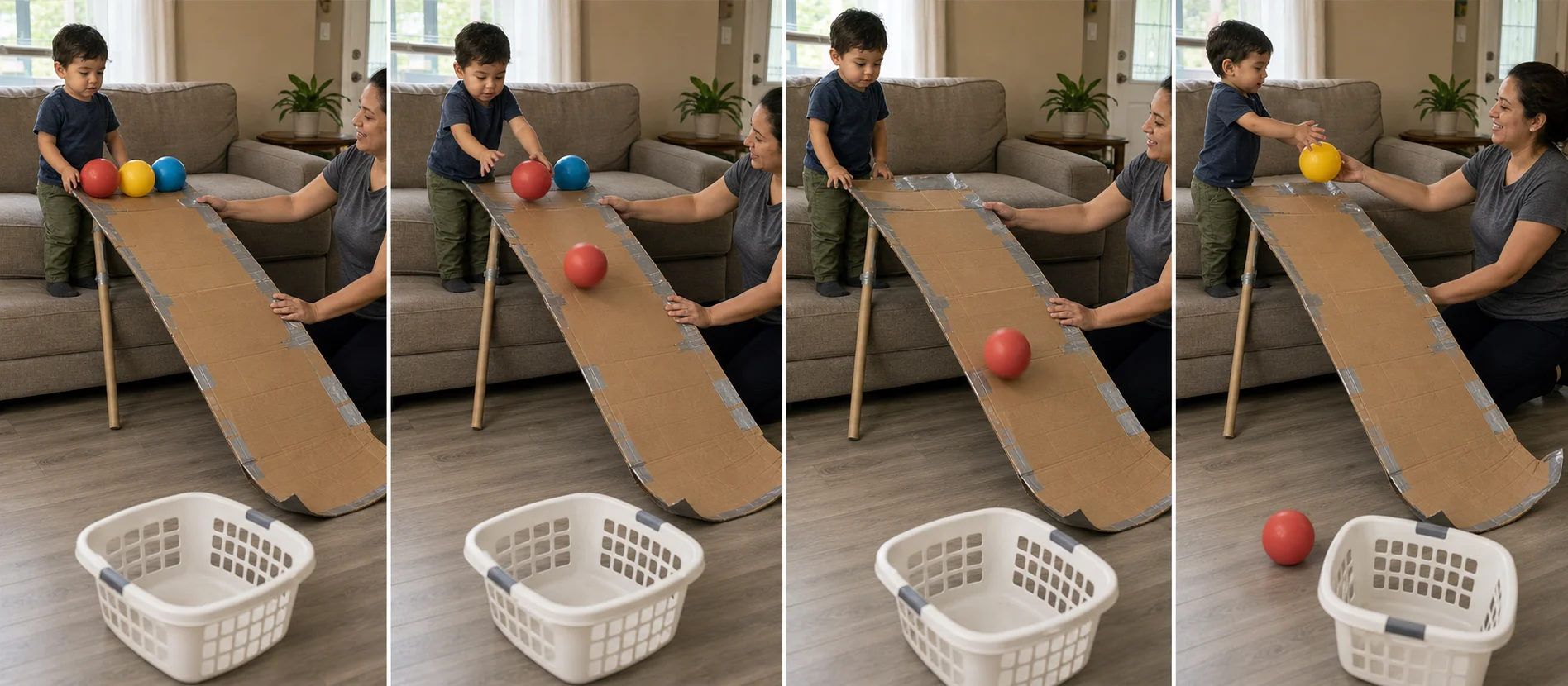
Three-step sequence showing a cardboard ramp setup, a ball rolling down, and the child checking the basket target.
  1. 01
    Roll one ball from the top and say, "Watch this ball jump."
  2. 02
    Hand your child a ball and say, "Can you send one into the basket?"
  3. 03
    Let your child release the ball, watch where it lands, and name the result with one short word, such as "in," "close," or "past."
  4. 04
    Roll again with a new aim, ball, or target position.

Safety Check

  • Stay close while your child launches balls from the raised surface.
  • Use balls that are too large to be a choking risk for your child.
  • Keep the raised surface stable and the landing area clear of furniture, feet, and breakable items.
  • If balls are thrown across the room instead of rolled down the ramp, pause and restart with one ball at the top.
Supporting the play

What to say in the moment

Match what you say to what you see.

Prompt ladder
Level 1 (Start)
Roll one ball slowly and invite your child to send the next one.
Level 2 (Keep going)
Point to where the ball landed and say, "Try that spot again."
Level 3 (Stretch)
Let your child choose a new ball and watch what changes.
Level 4 (Extend)
After a basket hit, move the target one small step and roll again.
If your child seems...
What you'd see
Focused
What to do
Say
"That one jumped far."
Add
Ask, "Which ball was faster?"
Extend
Let your child choose one change: ball, aim, or target spot.

Make it easier

Younger end
  • -Use one favorite ball for several turns before offering choices.
  • -Hold the ramp edge steady while your child places the ball.
  • -Let the adult retrieve balls so your child can focus only on launching.

Make it harder

Older end
  • +Ask your child to predict "basket" or "past" before releasing the ball.
  • +Try for two basket hits before switching balls.
  • +Aim for the left side, middle, or right side of the target.

If it's not working

If you see
If child ignores it
Do one dramatic slow roll, cheer for the jump, and hand over the next ball without explaining the whole activity.
If you see
If child misuses it
Move closer, place the ball back at the top, and say, "Balls go down the ramp." Pause if throwing continues.
If you see
If child gets frustrated
Move the basket closer, use a rounder ball, or count any smooth roll down the ramp as a win for a few turns.
If you see
If balls get stuck
Smooth the cardboard, retape a loose flap, or lower the high end a little.
If you see
If balls keep running away
Put the basket near a wall, couch, or pillow boundary so missed balls are easier to gather.
Skill spotlight
Test And Compare

Seeing how one change affects where the ball lands

This helps your child notice that one small change can shift the result, which matters for aiming play, trying again after a miss, and adjusting how they move objects in everyday play.

  • The roll, jump, and landing give your child a clear result to notice after each launch.
  • Trying a new ball, aim, or target spot helps your child see that small changes can shift where the ball lands.
  • Misses stay useful because they create the next choice: move the basket, try another ball, or roll again.
Real-world transfer
  • Aiming toys or balls toward a spot
  • Adjusting after something rolls too far or misses
  • Sticking with simple trial-and-check play a little longer

Parent questions