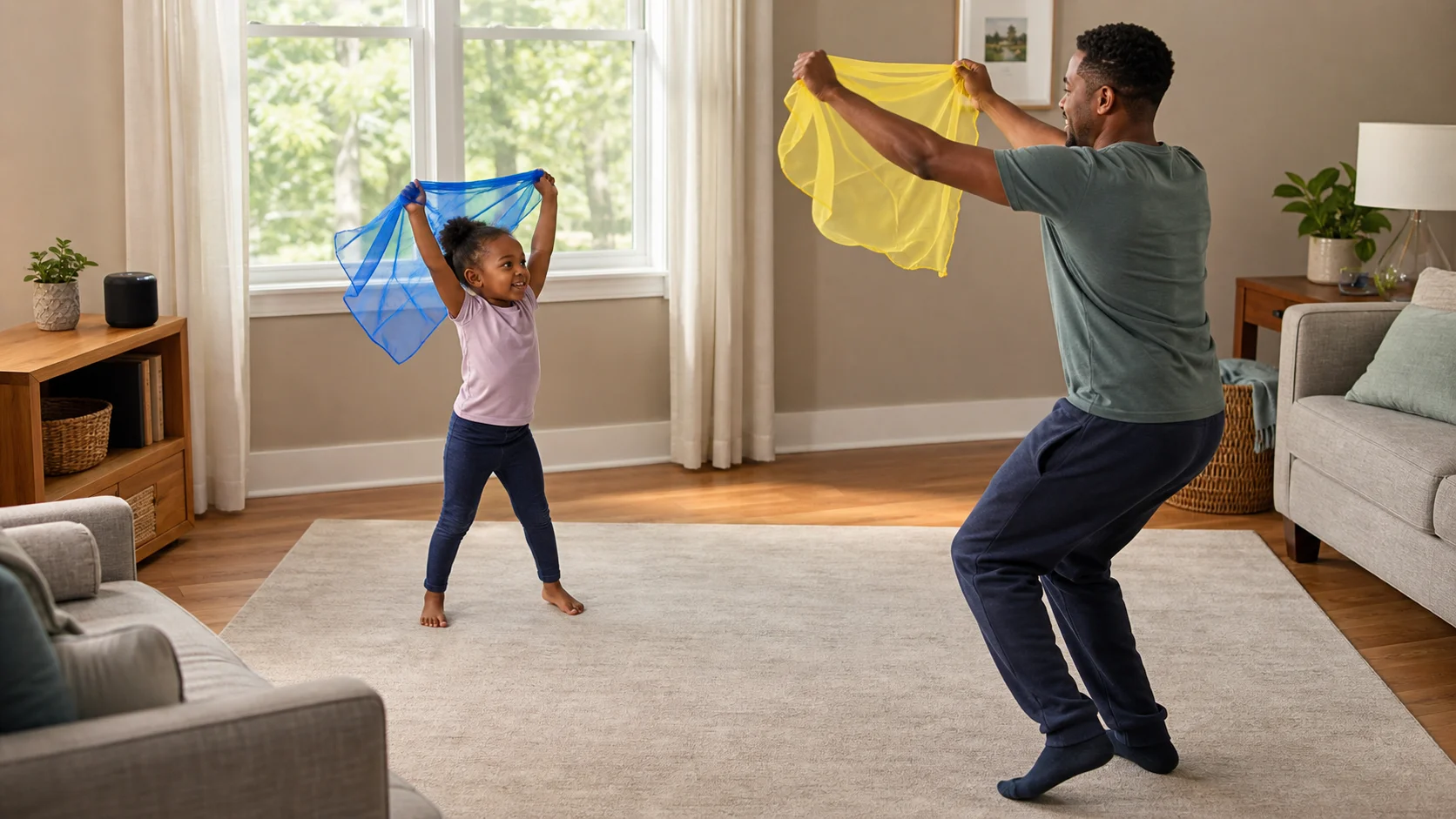
A child and grown-up waving light scarves while dancing in an open indoor space.
Skill builderCopy Then TryIndoor Open Floor Or Another Safe Open Movement Space

Dancing with Scarves.

Wave, copy, switch, and repeat with a light scarf or tea towel.

Play time
5-10+ min
Age
3-5 years
Energy
Medium To High
Mess
No Mess
Effort
Low
Where
Indoor Open Floor Or Another Safe Open Movement Space
Start here

The recipe.

Low parent effort
4 things

What you need

  • 1 scarf, tea towel, or similar light fabric for your child
  • 1 scarf, tea towel, or similar light fabric for the grown-up, or empty hands for copying
  • Music
  • A safe open movement space
5 min minimum

Setup

Then start the loop
Step 01
On the floor, clear a dance spot where your child can lift the fabric high, sweep it low, and turn without hitting furniture.
Step 02
Outside the dance path, place the music source where it will not be stepped on, kicked, or grabbed.
Step 03
In your child's hands, place one light scarf, tea towel, or similar fabric.
Step 04
In the same open space, stand facing your child with room for both people to move their arms.
Step 05
Start familiar music.
"You lead."
The loop

How play unfolds.

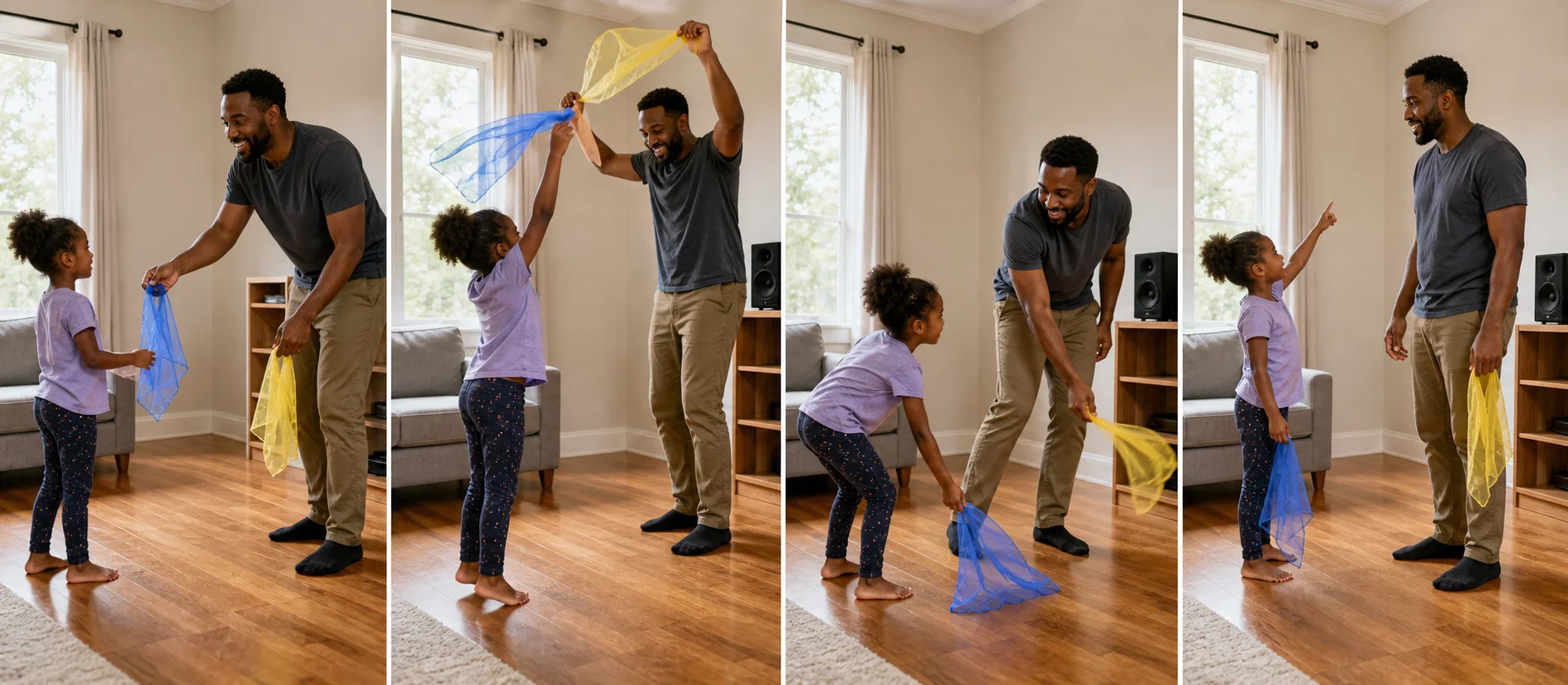
A child leads a scarf move, the grown-up copies, then they switch roles and copy again.
  1. 01
    Wave your scarf high, sweep it low, and say, "Show me one scarf move. I'll copy you."
  2. 02
    Let your child lead one scarf move, then copy it right away.
  3. 03
    Say, "Now copy me," and make one easy scarf move for your child to copy.
  4. 04
    Keep swapping leader roles until the song ends, focus fades, or movement gets too wild.
  5. 05
    To reset, pause the music for one breath and ask, "High or low next?"

Safety Check

  • Use light fabric that stays loose in your child's hands. Do not use fabric long enough to wrap tightly around the neck, wrist, or body.
  • Keep the music device outside the movement path.
  • Pause the music if spinning, running, rough whipping, or face contact starts.
Supporting the play

What to say in the moment

Match what you say to what you see.

Prompt ladder
Level 1 (Start)
"Make one scarf move and I'll copy you."
Level 2 (Keep going)
"Choose high, low, round, fast, or slow."
Level 3 (Stretch)
"Now switch. Copy my move."
Level 4 (Extend)
"Make two scarf moves before we swap."
If your child seems...
What you'd see
Focused
What to do
Say
"I see your scarf moving."
Add
Name one movement word after the child finishes a turn.
Extend
Let your child lead two turns before you swap leaders.

Make it easier

Younger end
  • -Let your child lead while you do all the copying for a few turns.
  • -Use only high and low moves until the copy-and-swap rhythm returns.
  • -Pause between turns so your child can see who leads next.

Make it harder

Older end
  • +Ask your child to change speed once, such as slow to fast.
  • +Invite your child to remember and repeat the last scarf move.
  • +Try two child-led moves before the grown-up takes a turn.

If it's not working

If you see
If child ignores it
Copy anything your child already does with the scarf, even a tiny shake, then say, "I copied you."
If you see
If child misuses it
Pause the music, unwrap or lower the fabric, and restart with two safe choices: "high" or "low."
If you see
If child gets frustrated
Stop leading for one round and let your child make any slow scarf move for you to copy. End after one successful copy if the mood is fading.
Skill spotlight
Copy And Swap Turns

Copying a move, then taking a turn

This helps a child watch another person, hold a short direction in mind, and move at the right time during songs, group games, and everyday back-and-forth routines.

  • The copy-and-swap loop gives your child a clear leader turn and a clear follower turn.
  • Watching one scarf move before acting helps your child practice pausing long enough to copy.
  • High, low, fast, and slow movements connect simple words with whole-body action.
  • Pausing the music creates a built-in reset when the movement gets too big.
Real-world transfer
  • Copying actions in songs and circle games
  • Listening before moving during simple directions
  • Taking turns in back-and-forth play without rushing ahead

Parent questions