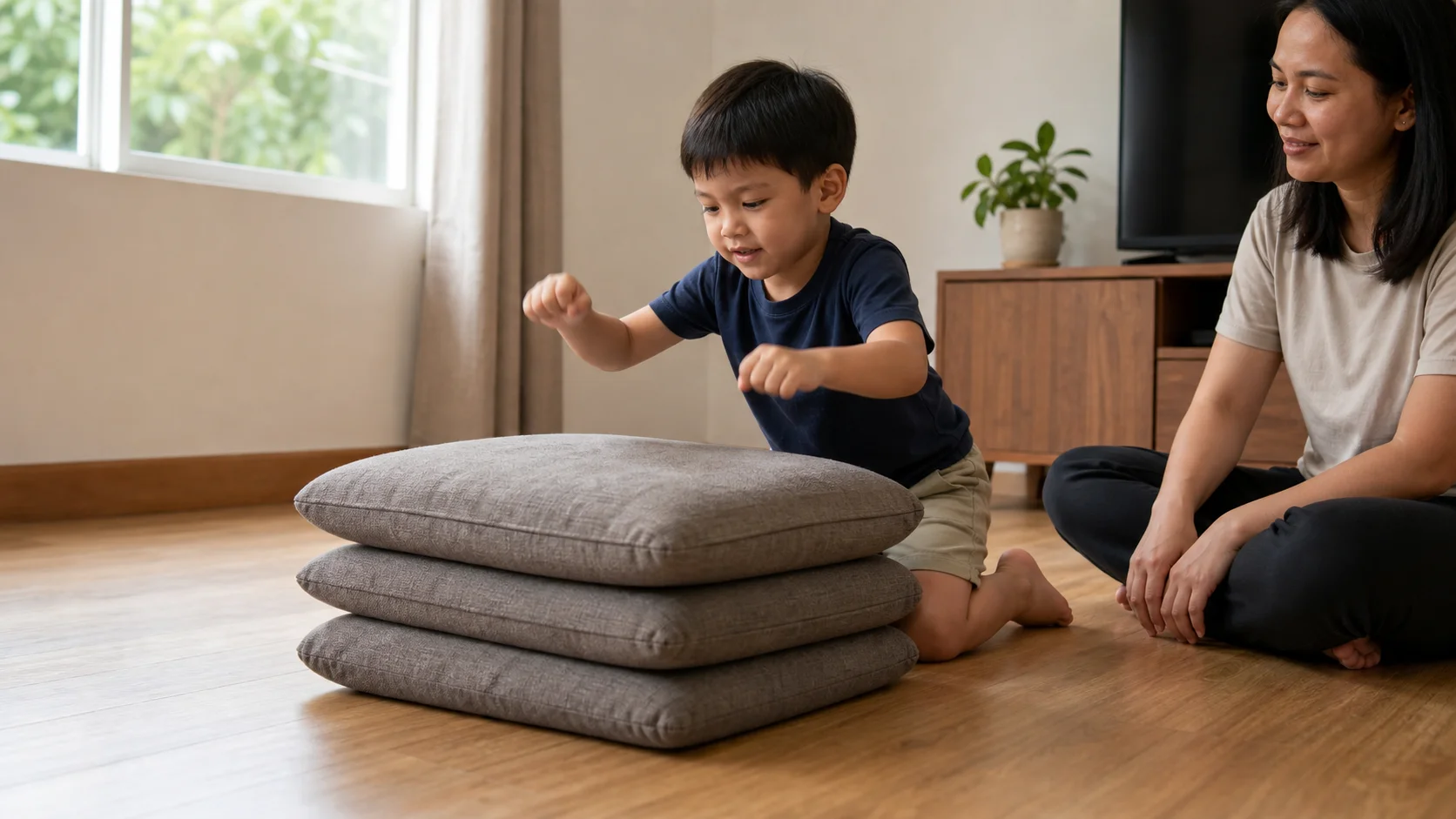
A young child kneels on the floor and thumps a therapy ball with both fists while a grown-up sits nearby.
Gross motorOT-adjacent supportPush Against ResistanceIndoor

Cushion Drum Beats.

A therapy ball or cushion pile turns into a soft drum for short slow rounds of thump, pause, and repeat.

Play time
5-10+ min
Age
2-5 years
Energy
Medium
Mess
Low
Effort
Low
Where
Indoor
Start here

The recipe.

Low parent effort
1 things

What you need

  • 1 therapy ball or 1 stable pile of 2 to 4 cushions
5 min minimum

Setup

Then start the loop
Step 01
Choose a calm floor spot with enough open space for your child to swing both fists without hitting furniture.
Step 02
Put 1 therapy ball on the floor or make 1 stable pile of 2 to 4 cushions that will not slide apart on the first hit.
Step 03
Place your child close enough to reach the target easily while kneeling, sitting, or standing.
"Hit here."
The loop

How play unfolds.

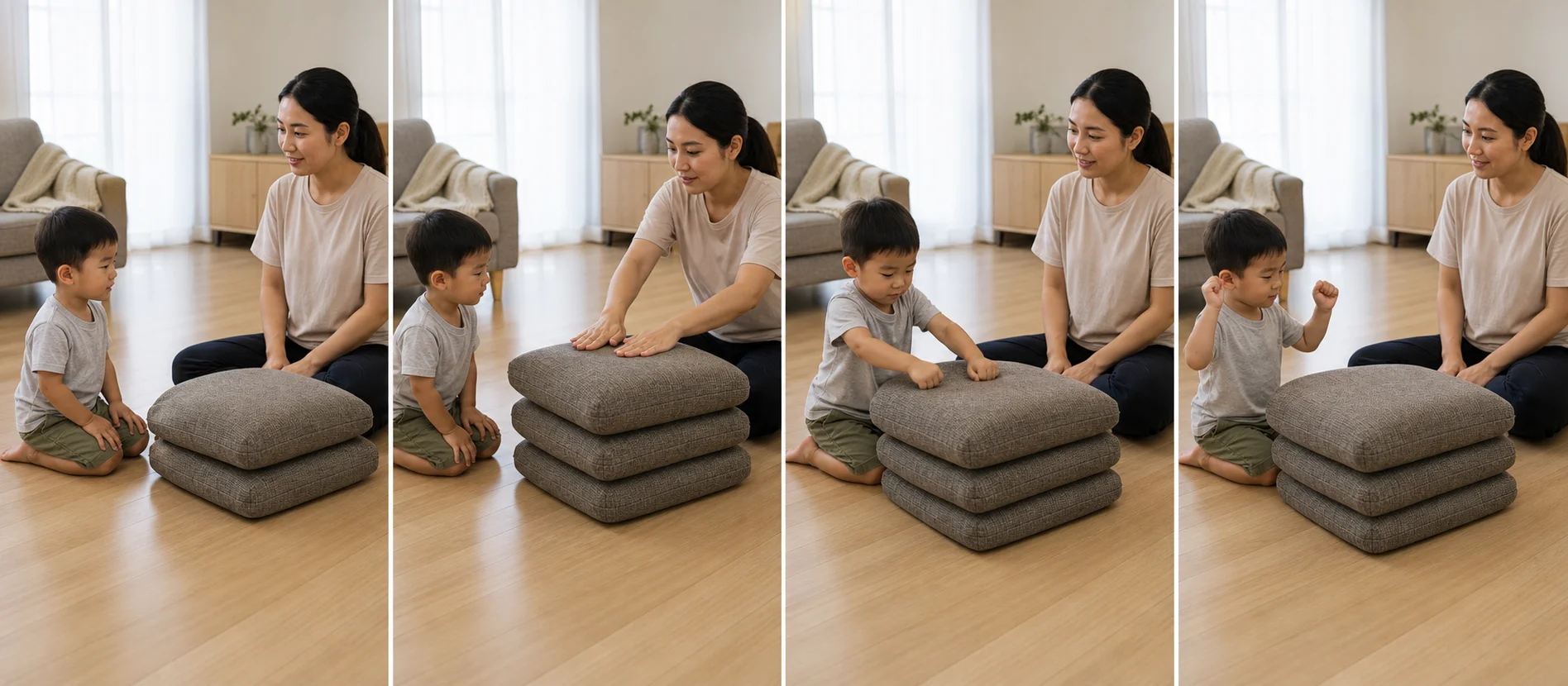
A multi-panel sequence shows a grown-up modeling slow drum beats on a cushion pile, a child copying the beats, pausing, and starting another short round.
  1. 01
    Model 2 to 4 slow beats on the therapy ball or cushion pile and say, "Drum, drum."
  2. 02
    Let your child thump the same target with both fists.
  3. 03
    Pause for 1 breath, then start another short round.
  4. 04
    Stop when your child slows down, looks calmer, or walks away.

Safety Check

  • Keep the target away from hard furniture, lamps, and breakable items.
  • Make sure the ball or cushion pile stays in place when pressed before your child starts hitting it.
  • Stop or simplify if your child starts aiming at people, the floor, or nearby objects instead of the soft target.
Supporting the play

What to say in the moment

Match what you say to what you see.

Prompt ladder
Level 1 (Start)
"Drum, drum."
Level 2 (Keep going)
"More beats."
Level 3 (Stretch)
"Slow beats."
Level 4 (Extend)
"One more round."
If your child seems...
What you'd see
Focused
What to do
Say
"You are keeping the beat."
Add
Let your child do the next 2 beats without your model.
Extend
Pause and wait to see if your child starts the next round alone.

Make it easier

Younger end
  • -Use 1 large cushion instead of a taller pile.
  • -Keep the child in a kneeling or seated position for the round.
  • -Stay with the same 2-beat pattern every time.

Make it harder

Older end
  • +Let your child copy a 3-beat round before the pause.
  • +Wait to see if your child starts the next round without your first beat.
  • +Alternate between 2 slow beats and 3 slow beats while keeping the same target.

If it's not working

If you see
If child ignores it
Sit beside the target, do 2 loud slow beats yourself, and stop to wait.
If you see
If child misuses it
Move the target back in front of them and say, "Hit here."
If you see
If child gets frustrated
Cut the round to 2 beats and thump together with your child.
Skill spotlight
Push Against Resistance

Using both fists to push force into a soft target in a calm repeatable pattern

This helps a child put body force into a clear place, control the pace of that force, and stay with a short calming routine.

  • Short drum rounds give your child a clear place to send body force instead of scattering it around the room.
  • The repeated thump, pause, and restart pattern helps your child practice slowing down without needing many words.
  • Hitting the same soft target over and over gives strong hand, arm, and shoulder feedback through a simple routine.
Real-world transfer
  • Using body force in a safer more organized way.
  • Joining a short calming routine when big feelings show up.
Back to library
Keep playing

Related activities.