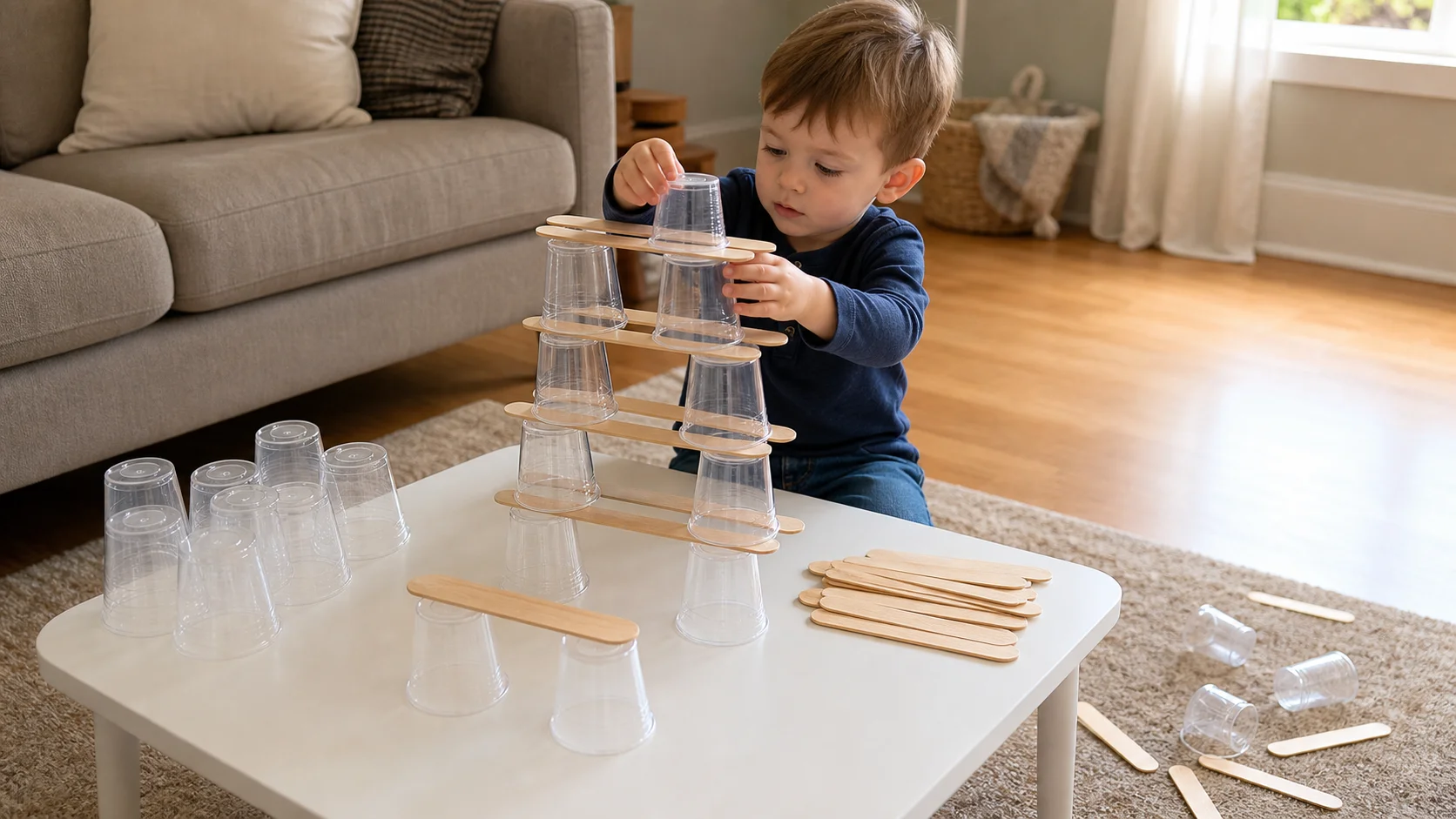
Toddler stacking upside-down cups and jumbo craft sticks into a wobbly tower on the floor.
Fine motorPlace With ControlIndoor

Cup Towers.

How tall can your child build before everything comes tumbling down? Alternating plastic cups and jumbo craft sticks turns careful stacking into a balance challenge that builds fine motor control and problem-solving.

Play time
5-15+ min
Age
2-5 years
Energy
Low
Mess
Low
Effort
Low
Where
Indoor
Start here

The recipe.

Low parent effort
3 things

What you need

  • 10 to 20 plastic cups
  • At least 10 to 15 jumbo craft sticks
  • 1 flat surface, such as a table or open floor spot
5 min minimum

Setup

Then start the loop
Step 01
Gather 10 to 20 plastic cups and 10 to 15 jumbo craft sticks on a flat surface.
"Your cup goes here."
The loop

How play unfolds.

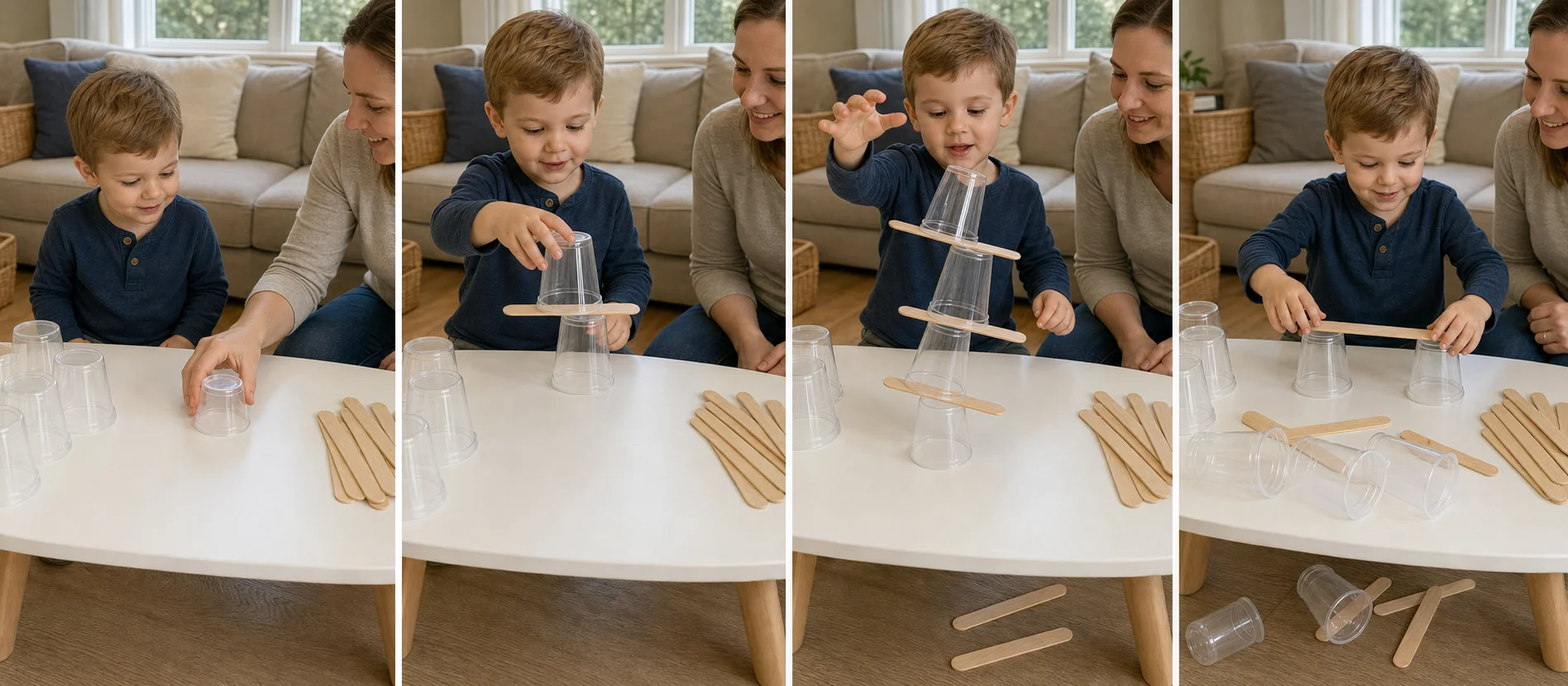
Three-step sequence showing a cup-and-stick tower being built, wobbling, and rebuilt after a crash.
  1. 01
    Place one cup upside down and lay a jumbo craft stick across its flat top.
  2. 02
    Have your child place another upside-down cup on the craft stick.
  3. 03
    Keep alternating cups and craft sticks to see how tall they can build before the tower falls.
  4. 04
    Start again or try building a wider tower, pyramid, or bridge.

Safety Check

  • Stay close during stacking and knock-down play.
  • Stop and reset if cups are thrown or sticks are swung.
  • Keep the building spot away from fragile objects, because the tower is meant to fall.
Skill spotlight
Controlled Placement

Placing pieces with control

This helps a child guide pieces into place, steady their hands when an object might tip, and make small fixes that also show up in block play, simple tools, and everyday helping jobs.

  • The cup and stick pattern gives your child repeated practice placing one piece carefully before adding the next.
  • The wobble gives fast feedback, so your child can see when a base needs to be wider or a hand needs to slow down.
  • The crash-and-reset loop supports retrying after a miss without turning the fall into a failure.
Real-world transfer
  • Stacking blocks, containers, or toy pieces so they stay put
  • Using careful hand placement when pouring, setting down dishes, or lining objects up on purpose
Supporting the play

What to say in the moment

Match what you say to what you see.

Prompt ladder
Level 1 (Start)
Put one upside-down cup down and invite your child to add the next piece.
Level 2 (Keep going)
Ask, "Where should the next stick go?"
Level 3 (Stretch)
Pause before the next piece so your child can notice and fix the wobble.
Level 4 (Extend)
Let your child choose a tall tower, wide tower, bridge, or crash-and-rebuild.
If your child seems...
What you'd see
Focused
What to do
Say
"You are watching it balance."
Add
Ask one quick counting or shape word while the tower is still growing.
Extend
Let your child decide the next build shape before you hand over another piece.

Make it easier

Younger end
  • -Build on the floor so crashes feel smaller and pieces are easier to reach.
  • -Let your child place only cups while you place the sticks for one round.
  • -Stop after one steady shelf instead of pushing for a tall tower.

Make it harder

Older end
  • +Ask your child to fix a wobble before adding the next cup.
  • +Build a bridge with two cups spaced slightly apart.
  • +Try to rebuild the same shape after a crash.

If it's not working

If you see
If child ignores it
Build the first two layers yourself, pause with one cup in your hand, and ask, "Where should this one go?"
If you see
If child misuses it
Move closer, keep the stick pile near you, and hand over one stick at a time.
If you see
If child gets frustrated
Start with two cups on the bottom and one stick across them so the first platform is wider and steadier.

Parent questions