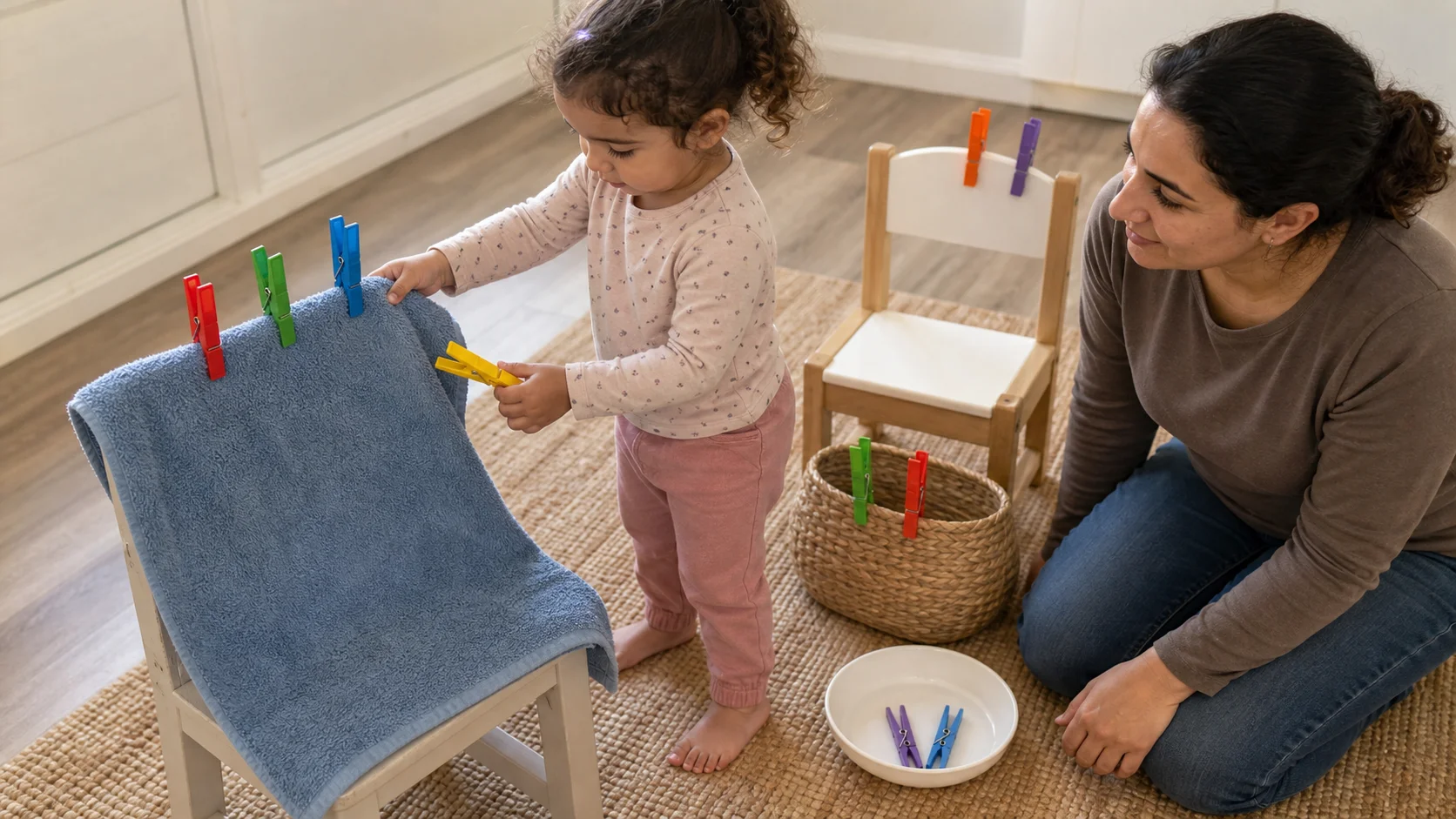
Toddler removing a clothespin from a towel during an indoor hunt game.
Fine motorSqueeze And ReleaseIndoor Home Space

Clothespin Hunt.

Hide a few clothespins in plain sight, then let your child search, squeeze, collect, and reset.

Play time
5-10+ min
Age
2-5 years
Energy
Medium
Mess
Low
Effort
Low
Where
Indoor Home Space
Start here

The recipe.

Low parent effort
4 things

What you need

  • 6 to 10 clothespins or clothes pegs
  • 1 safe room or clearly bounded home area
  • Reachable clipping spots, such as towels, clothes, basket rims, chair backs, or other sturdy household surfaces
  • 1 visible return spot near you, such as the floor beside you or a low table edge
5 min minimum

Setup

Then start the loop
Step 01
In one room or one clear part of a room, choose a spot where you can see every clothespin from where you will sit or stand.
Step 02
On towels, clothes, basket rims, chair backs, or other sturdy low surfaces, clip 6 to 10 clothespins around the area.
Step 03
On the floor beside you or on a low table edge, choose one return spot for found clothespins.
Step 04
In your hand, show one clothespin. Squeeze it open, clip it onto a towel or shirt, take it off, and place it on the return spot.
"Find one peg."
The loop

How play unfolds.

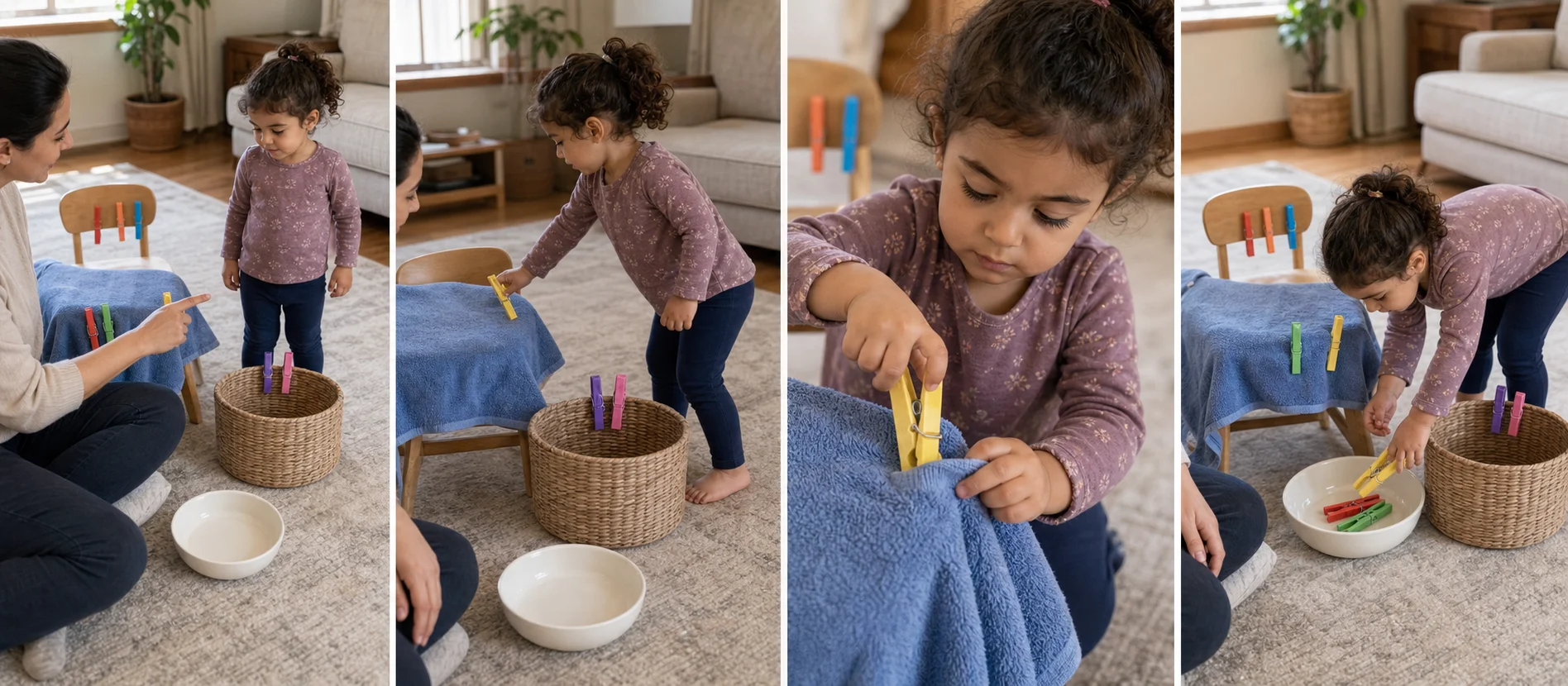
Three-step sequence showing clothespins clipped around a room, a child squeezing one open, and the pegs returning to one spot.
  1. 01
    Say, "I hid some pegs for you. Can you find one, squeeze it open, and bring it back here?"
  2. 02
    Let your child find one clothespin at a time, squeeze it open, and pull it free.
  3. 03
    Have them bring each found peg to the return spot.
  4. 04
    Name where it was found: "That one was on the towel."
  5. 05
    Repeat until all the clothespins are back, or clip a few onto easy spots for another round.

Safety Check

  • Use clothespins that are large, intact, and not broken into small parts.
  • Keep every clothespin within adult view.
  • Do not clip pegs onto stairs, sharp edges, loose cords, blinds, unstable furniture, delicate fabric, or anything that tips when pulled.
  • Keep the hunt low enough that your child does not need unsafe climbing.
  • Stay close with younger toddlers because squeezing, reaching, and climbing can create pinch or fall risks.
Supporting the play

What to say in the moment

Match what you say to what you see.

Prompt ladder
Level 1 (Start)
Find one peg and bring it back to me.
Level 2 (Keep going)
Can you squeeze one more peg?
Level 3 (Stretch)
Can you find a peg in a new spot?
Level 4 (Extend)
Hide your eyes while I clip two pegs again.
If your child seems...
What you'd see
Focused
What to do
Say
"Where was that one hiding?"
Add
Name the surface after the peg comes back.
Extend
Clip two found pegs back onto new low spots.

Make it easier

Younger end
  • -Turn each peg so the pinch end faces your child.
  • -Use only 1 or 2 pegs for the first round.
  • -Keep every peg below shoulder height.

Make it harder

Older end
  • +Place pegs at different safe body levels, such as low, middle, and near-shoulder reach.
  • +Ask your child to bring back a peg from a place you name.
  • +Let your child clip one peg back on before finding the next one.

If it's not working

If you see
If child ignores it
Put 2 or 3 clothespins in plain sight on one towel, point to the first one, and do the first find together.
If you see
If child misuses it
If the clothespin goes on skin, hair, or an unsafe surface, calmly take it off and move the game back to clothes or towels only.
If you see
If child gets frustrated
Hold the clipped surface steady, squeeze one side of the clothespin slightly open, and let your child finish pulling it off.
Skill spotlight
Grip Control

Squeezing a clothespin open and taking it off with control

This helps a child build the hand strength and finger control used for clothes fasteners, small tools, and everyday pick-up tasks.

  • Each found peg gives your child a real reason to line up fingers, squeeze, and release with control.
  • Searching around one safe area adds whole-body movement without turning the game into a chase.
  • Bringing each peg back to one spot keeps the sequence predictable: find, squeeze, return, repeat.
  • Naming where each peg was found connects simple location words to an action your child just completed.
Real-world transfer
  • Opening and closing clips, snack bags, and simple fasteners
  • Using finger strength and hand control during dressing, helping, and table tasks

Parent questions