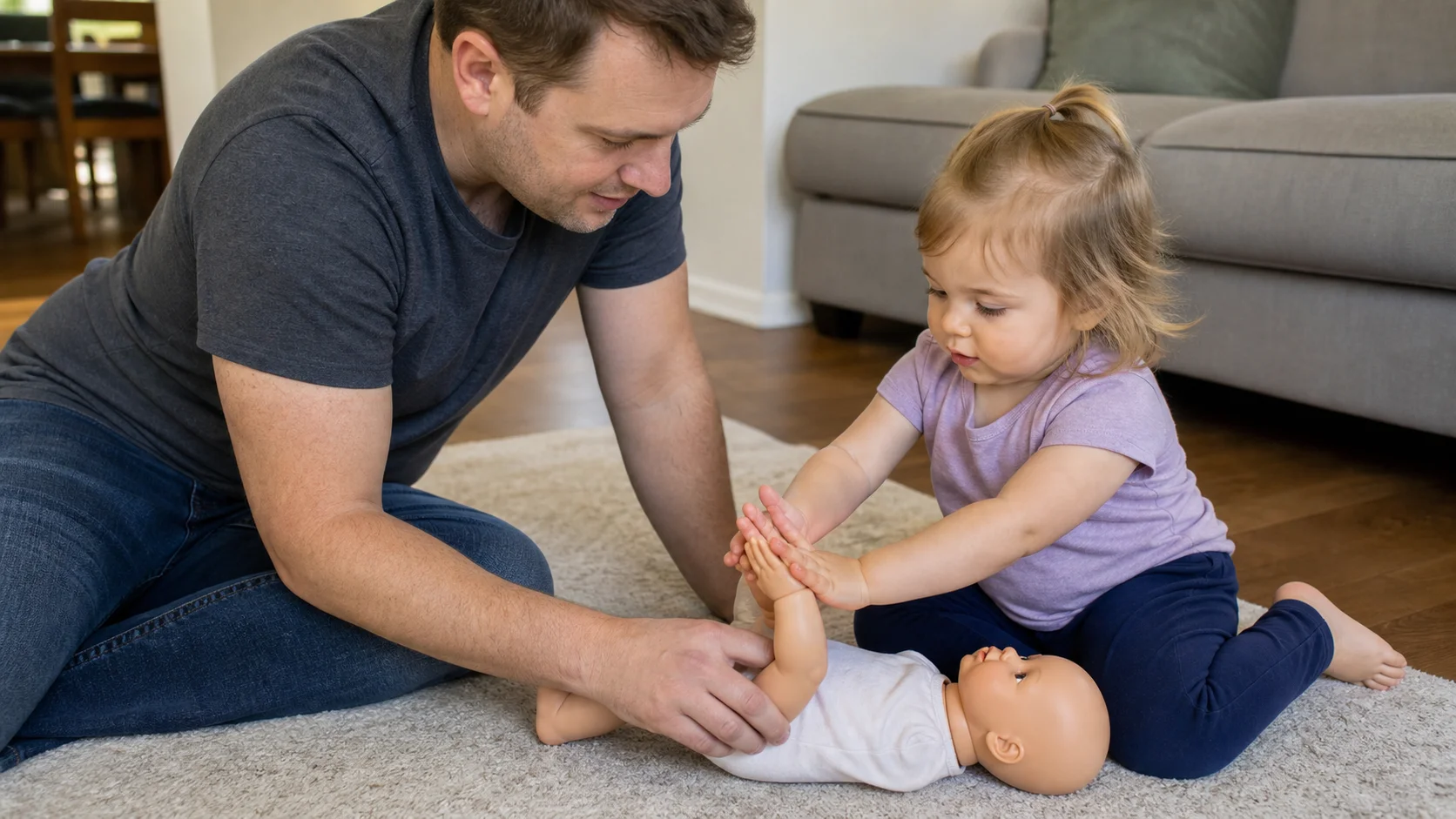
A toddler and grown-up sitting on the floor with a baby doll, helping the doll clap its hands once.
Skill builderCopy Then Try`Indoor

Clap Baby Hands.

This quick doll game gives your child one clear job: make the baby's hands clap, open them again, and copy your turn.

Play time
5-10+ min
Age
2-3 years
Energy
Low
Mess
Low
Effort
Low
Where
Indoor
Start here

The recipe.

Low parent effort
3 things

What you need

  • 1 realistic baby doll with visible hands
  • 1 adult
  • 1 child
5 min minimum

Setup

Then start the loop
Step 01
On the floor or at a low table, sit beside your child and place the doll between you with its face up.
Step 02
Turn the doll so both hands point toward your child and are easy to see and reach.
Step 03
Keep one hand near the doll's wrists so you can model the first clap without the doll tipping or sliding.
"Baby clap."
The loop

How play unfolds.

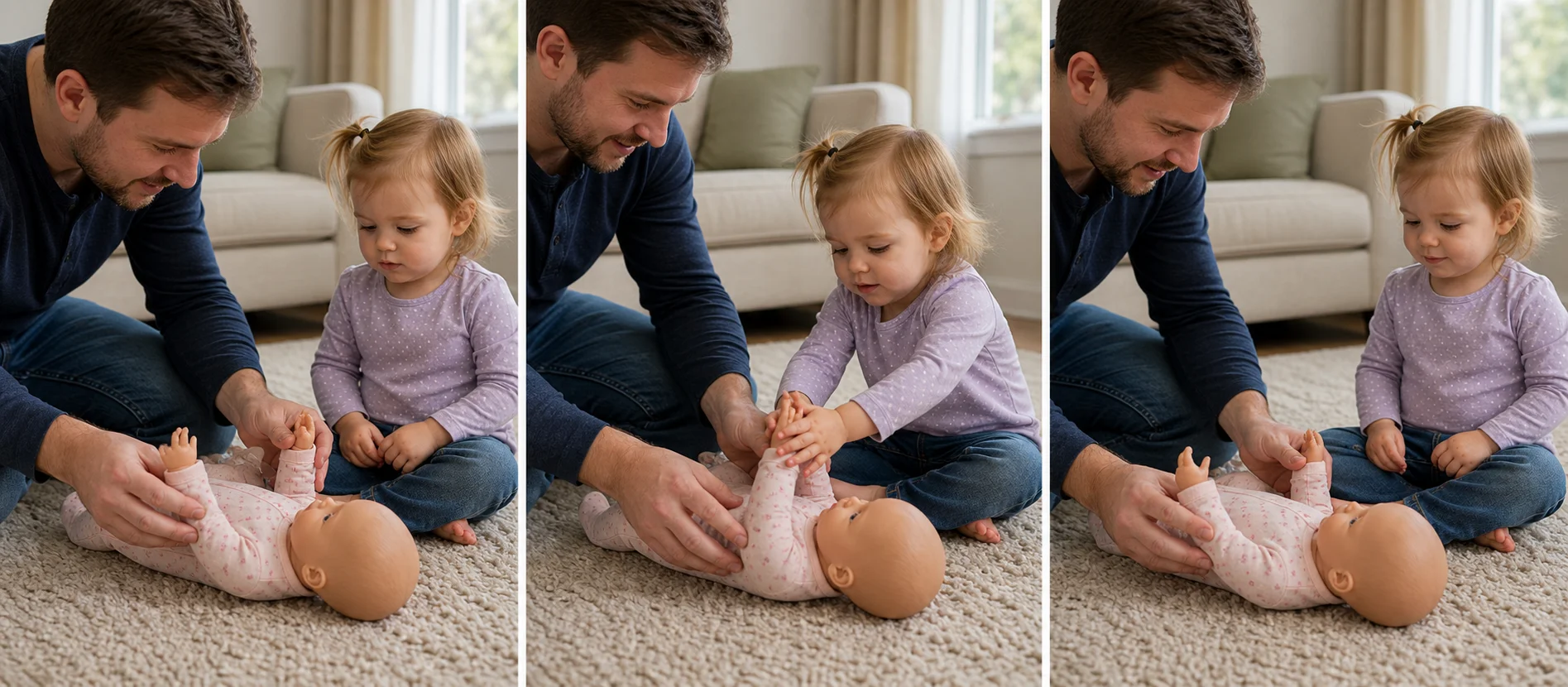
A three-panel sequence showing a grown-up modeling a doll clap, a toddler copying the clap, and the doll resting after the turn.
  1. 01
    Point to the doll's hands and say, "Let's clap the baby's hands," then model one clap and open the hands again.
  2. 02
    Let your child take the doll's hands and copy the same clap-and-open turn.
  3. 03
    Count it as a success when your child helps make one clear clap, even if you steady the doll.
  4. 04
    Stop after one successful child turn or do one extra repeat if your child clearly wants it.

Safety Check

  • Use a child-safe doll with no loose or detachable parts.
  • Stay close because the activity depends on adult modeling and guided turn-taking.
Supporting the play

What to say in the moment

Match what you say to what you see.

Prompt ladder
Level 1 (Start)
"Let's clap the baby's hands."
Level 2 (Keep going)
"Open, then clap again."
Level 3 (Stretch)
"Can baby do one more clap?"
Level 4 (Extend)
"Wake baby up for one clap, then let baby rest."
If your child seems...
What you'd see
Focused
What to do
Say
"Baby is ready."
Add
Name one body part once: "Hands."
Extend
Let your child try the next clap before you help.

Make it easier

Younger end
  • -Keep the doll resting against your leg or the floor so it cannot tip while your child moves the hands.
  • -Start each turn with the doll's hands partway together so your child only has to close the last small gap.
  • -Support one doll wrist yourself so your child can focus on moving just one hand.

Make it harder

Older end
  • +Pause after your first words and wait to see if your child starts the doll clap before you help.
  • +Let your child reopen the doll's hands after each clap before the next turn.
  • +Alternate turns so you clap once, then your child claps once without extra modeling in between.

If it's not working

If you see
If child ignores it
Pull the doll into your child's lap or right up to the table edge, do one slow model clap, and offer one more turn before stopping.
If you see
If child misuses it
If your child grabs the whole doll or claps their own hands instead, hold the doll steady, point back to the doll's hands, and restart with one slow clap.
If you see
If child gets frustrated
Guide one doll hand while your child moves the other, praise the single clap, and stop after that success.
Skill spotlight
Copy Then Try`

Copying a simple pretend action after a model

Copying one short pretend action helps a child join shared play, take a turn, and act on a familiar spoken cue during songs, care play, and daily routines.

  • One short copy turn makes turn-taking easier to enter than a bigger pretend-play routine.
  • Moving the doll's hands together and apart gives your child a small two-hand job with a clear start and finish.
  • The same cue and same action help connect one spoken prompt to one visible movement.
Real-world transfer
  • Copying hand motions in songs, finger plays, and simple care routines
  • Joining pretend play with dolls, stuffed animals, and other familiar toys

Parent questions